
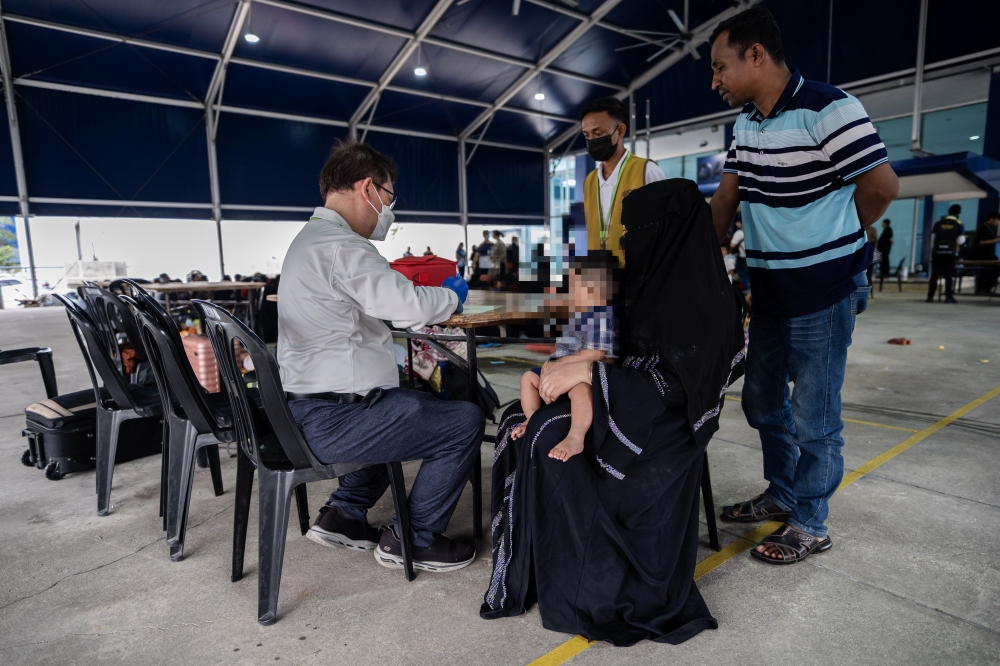
PUTRAJAYA, Aug 27 — The Home Ministry (KDN) has finalised the first phase of a voluntary repatriation programme that will send 5,000 eligible Myanmar refugees back to their home country in stages, the ministry announced in a statement today.
The first batch of the Voluntary Repatriation Programme will proceed on September 29, involving 1,476 Myanmar nationals identified by Myanmar’s government through a diplomatic note dated August 13.
The date was agreed at a coordination meeting involving the Home Ministry, Foreign Ministry, National Security Council and Defence Ministry, after accounting for logistical needs — moved back from Myanmar’s original proposal of August 28. The operation will use two Myanmar naval warships and a hospital ship.
The move follows Foreign Minister Datuk Seri Mohamad Hasan’s remarks on August 14, when he said Malaysia would prioritise the safety and welfare of Myanmar refugees ahead of any return, stressing that verification with the UN refugee agency (UNHCR) and KDN was essential to assess the security situation returnees would face.
He had also said Malaysia did not need to wait until all 5,000 were ready, and that an initial group of 1,000 already verified could be sent back first. He added that Asean regarded the Myanmar refugee crisis as a serious, collective concern that should continue to be addressed through the bloc’s Five-Point Consensus.
According to today’s KDN statement, of the Myanmar nationals slated for processing this year, 4,008 — mostly ethnic Rohingya — will be channelled into the Refugee Registration Document (DPP) programme, while the remaining 5,000 will undergo the phased voluntary repatriation.
The ministry said that as of August 15, there were 10,388 Myanmar nationals held at Immigration Detention Depots, cautioning that this figure covers all detained Myanmar nationals and should not be read as entirely refugees. The Immigration Department, working with police, is verifying each individual’s identity, citizenship, immigration status, asylum claims and security background, with the DPP registration exercise for this group expected to conclude in the fourth quarter of 2026.
KDN described its approach as “two-pronged”: continuing diplomatic negotiations with Myanmar to ensure an orderly, staged and accountable return of its nationals, while simultaneously registering and profiling individuals claiming refugee or asylum status through the DPP programme to give the government comprehensive data for monitoring, enforcement and eventual resolution — including repatriation when conditions allow.
The ministry said the DPP scheme will eventually be expanded to cover all undocumented migrants outside detention depots, including UNHCR cardholders, with registration made mandatory to obtain biometric and personal data. Those who qualify will receive a DPP card allowing temporary stay under conditions set by the government.
KDN noted that more than 95 percent of refugees in Malaysia are from Myanmar, including Rohingya, Chin, Karen and Mon communities, and reiterated that a resolution cannot be unilateral, requiring continued direct diplomatic engagement with Naypyidaw.
The statement stressed that Malaysia is not a party to the 1951 Refugee Convention or its 1967 Protocol, and that the DPP programme should not be construed as recognition of or accession to those instruments. Instead, it described the DPP as reflecting the government’s own humanitarian approach, balanced against national interest and sovereignty, aimed at addressing what it called a decades-long unresolved issue that has become a financial burden and a security concern.