
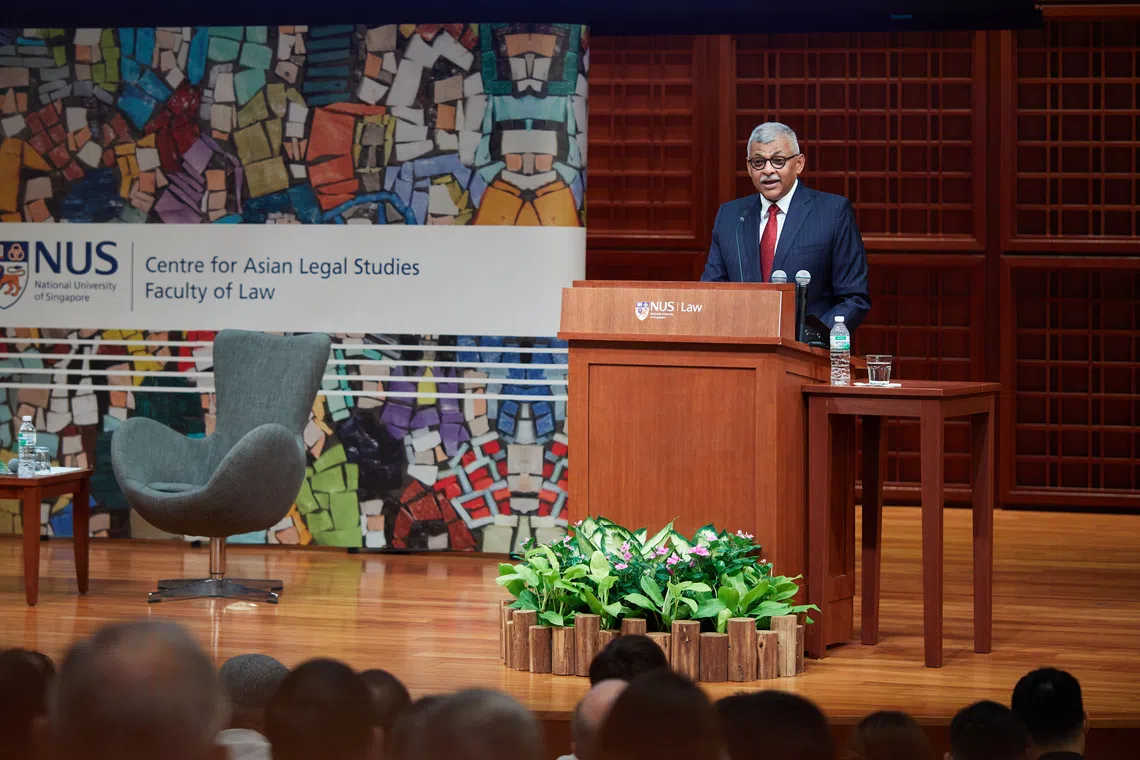
SINGAPORE – Singapore’s repeal of a law that had criminalised sex between men is an example of why the rule of law should never be regarded as a “finished achievement” and must adapt as societal values and circumstances evolve, said Chief Justice Sundaresh Menon on Sept 2.
Section 377A of the Penal Code reflected the prevailing social norms of an earlier era. Its repeal showed that the rule of law has to evolve to produce an outcome suited to society, even as the underlying principles endure, he said.
He was speaking at a dialogue after delivering the National University of Singapore Law Bicentennial Lecture on the Rule of Law at the Yale-NUS College Hall.
In the hour-long lecture, he spoke about how the rule of law has been instrumental in stability and development in Singapore since the days of Stamford Raffles, through ensuring legal certainty, justice and equality, and how its conception must respond to the political, social and historical conditions in which it operates.
The challenge against Section 377A of the Penal Code and its eventual repeal illustrated these points, he said at the dialogue that followed.
The law was officially repealed in January 2023 by the Government, after the Court of Appeal ruled in February 2022 that it was unenforceable in its entirety in a legal challenge.
In its judgment, the apex court had also said that the law could violate Article 12 of the Constitution – the equal protection provision – if a particular approach were taken to evaluate it.
Talking about the case during the dialogue, Menon said the rule of law had provided a framework for ordered liberty within which diverse groups can have their concerns about 377A addressed.
Different branches of the Government had also played their respective role leading to the eventual repeal.
Given that many of the issues cited in the legal challenge had been political, social and moral in nature – such as whether the law should be repealed and whether homosexuality is moral or immoral – they were not questions for the court to decide, he said.
Instead, the court focused on the legal question of whether prosecution under the law was permitted, given the promises by the Government before 2023 to leave the law on the books without proactively enforcing it, he said.
By staying out of the political questions, the court had been criticised by some for not going further, he added.
But it was important to allow each of the branches of government to operate fully within their respective lanes and spheres, he said.
“If you fail to do that, it can result in positive harm, because a change that is imposed by reason of the judicial victory can leave groups that lost feeling alienated and excluded, and this in turn can delegitimise the cause, which can really give rise to a foundational threat to the rule of law.”
Following the apex court’s judgment, the Government, which is the political branch, then held extensive consultations before eventually repealing the law, he noted.
“These kinds of questions – political questions, social questions, questions of morality – are best left to politics, where society and the diverse groups can forge their consensus and find an acceptable deviated compromise or resolution,” he said.
Eventually, with the judiciary, executive and legislative branches each playing their role, the law was repealed. The Constitution was also amended to stave off future legal challenges on the definition of marriage.
“I think it has delivered an outcome that meets our unique needs and circumstances,” Menon said, noting that the issue is generally no longer divisive in Singapore society.
The Criminal Law (Temporary Provisions) Act (CLTPA), which allows for detention without trial, is also a result of adaptation to society’s needs, he said during his speech.
It was enacted in 1955 and expanded later to deal with Singapore’s secret societies.
The secret societies were growing into powerful criminal organisations that operated “a quasi-feudal system beyond the protection of the law”, he said.
As victims and witnesses would not testify for fear of reprisals, the ordinary criminal trial process was effectively defeated.
Acknowledging that the CLTPA’s powers might sit uneasily with some people, Menon said that the choice was not between an ideal trial process and preventive detention.
Instead, the real question was whether the state could restore the basic public order needed for the laws to function at all, he added.
“The rule of law requires both sufficient authority to restore public order and legal limits to prevent that authority from itself becoming arbitrary. The two are not inconsistent,” he said.
He cited the example of how the Court of Appeal had ruled in 2015 that the detention without trial of alleged global match-fixing mastermind Dan Tan Seet Eng had been unlawful and ordered his release.
“The grounds initially supplied for the detention did not explain how (Tan’s) conduct threatened public safety, peace or good order in Singapore, as the CLTPA required,” Menon said in the lecture.
Following this, the Government issued a fresh order that addressed the legal gaps, and, of its own accord, reviewed the detention of three others allegedly connected to the syndicate, whose cases were not before the courts.
“The Government complied not only in form but also in spirit, and not only in the case we decided but in cases that were not even before us. This is accountability and proper governance under law in action,” Menon said.
Noting how Singapore has progressively developed the legal order it inherited from the British over two centuries, he said the Republic’s conception of the rule of law has a communitarian dimension that places weight not only on the protection of individual rights but also on conditions that enable society as a whole to flourish.
This has implications for the exercise of public power, such as the need for a strong and effective executive capable of acting decisively in the interests of the community in some circumstances, he said.
But this need not be antithetical to the rule of law. “The critical point is that executive power, however strong, remains constrained by the law,” he said.
Menon will be speaking more on this at the Global Rule of Law Conference to be held in Singapore in November as part of a series of five lectures on different aspects of the rule of law that he will deliver over the next three months.