
Follow our live coverage here.
SINGAPORE – The Singapore Government recognises the humanitarian impact of global conflicts and does not prohibit artists from expressing concern for those who are affected, said Senior Minister of State for Digital Development and Information Tan Kiat How.
This is provided their content does not undermine public order, national security or stability in Singapore, he said on Sept 10 in Parliament.
Approvals had been given for several performances that feature such causes, including those covering the Israel-Gaza conflict and which explore themes of genocide, he added.
Tan was replying to a question from Hazlina Abdul Halim (East Coast GRC) on how the Government assesses artists’ conduct on international conflicts.
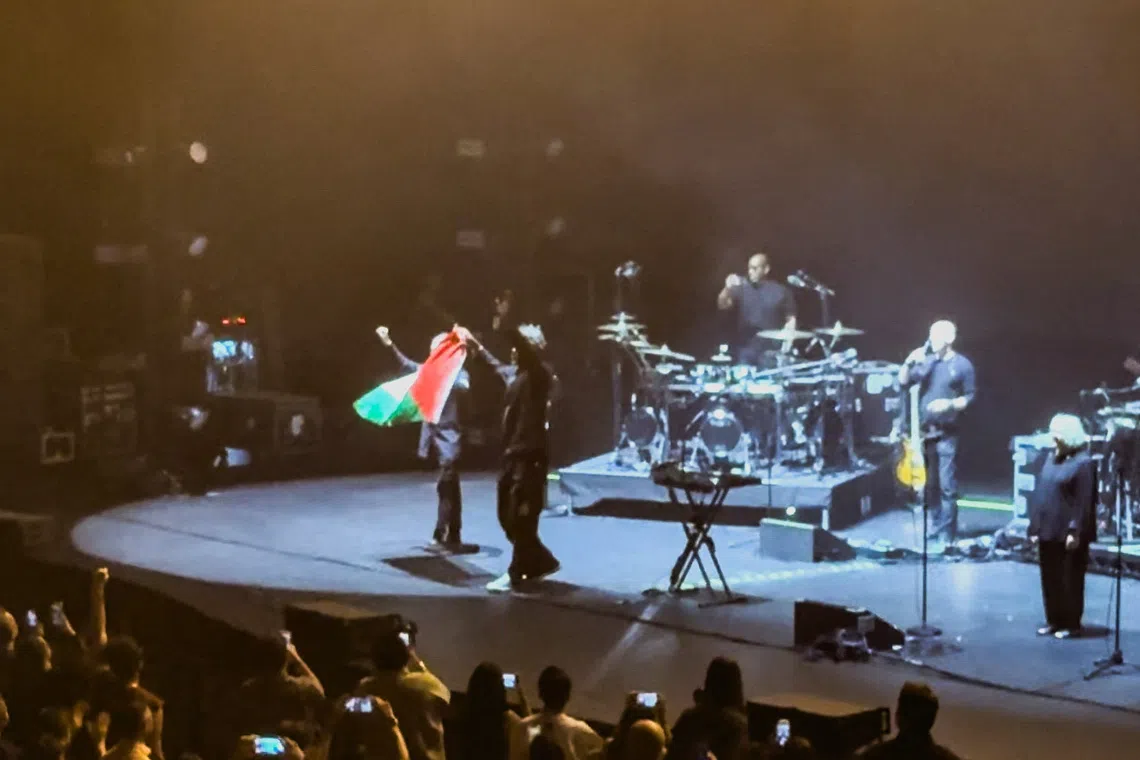
Her question comes after two members of British trip-hop band Massive Attack were issued warnings by the police and banned from re-entering Singapore. They had displayed a Palestinian flag at their concert here on July 29, with one of them shouting “Free Palestine”.
The entry ban also means that the Infocomm Media Development Authority (IMDA) will not grant any future application for performances by the band.
Elaborating, Tan said that local and foreign artists performing here are expected to comply with Singapore’s laws and the conditions of their licence during their events.
The condition that artistic expression should not undermine public order here is made clear in IMDA’s Arts Entertainment Classification Code that all licensees must comply with. The code classifies arts entertainment according to their suitability for different age groups, covering plays, stand-up comedies, art exhibitions, literary readings, dance performances, and music performances like variety shows and concerts.
Besides the intent of the actions, IMDA will also consider the likely impact of their performance to assess if the conditions are met, Tan added.
“Moreover, Singapore should not be used by foreigners as a platform to further political causes, including those relating to conflicts or political issues overseas,” he said.
In follow-up queries, Hazlina asked Tan if there was an example of a performance by an international artist with a social cause that was allowed here.
She also asked whether any changes were made after Massive Attack’s actions and in the lead-up to an upcoming November concert by Guns N’ Roses, a band known for displaying a Ukrainian flag during one of their songs.
Tan cited three performances that were allowed here. In May, R18 event To The Unforgotten was organised to celebrate humanity and offer solidarity to various groups around the world. It featured a song, poem and multimedia elements on the Israel-Gaza conflict.
Another performance was 6 Microlectures On Genocides, which was last staged in May. The R18 show comprised short works that explored themes of genocide, war crimes and contemporary conflicts.
The third example was a stand-up comedy called Namaste in 2024 with an Advisory 16 rating. It had a segment where the comedian spoke about the Israel-Gaza conflict.
Tan said that the licensing framework is designed to protect young people from unwanted content and also allow people to make decisions on what they can watch. At the same time, boundaries are needed for content that may stir up public disorder or national security considerations.
He added that any assessment on licensing “has to be contextual” because it is based on the prevailing sentiment and assessment by the agencies and the regulator at a given point in time.
With this in mind, Tan encouraged arts applicants to engage IMDA early, and the agency will contact other relevant public agencies for their inputs if needed. This is so that clarity and guidance can be given earlier.