
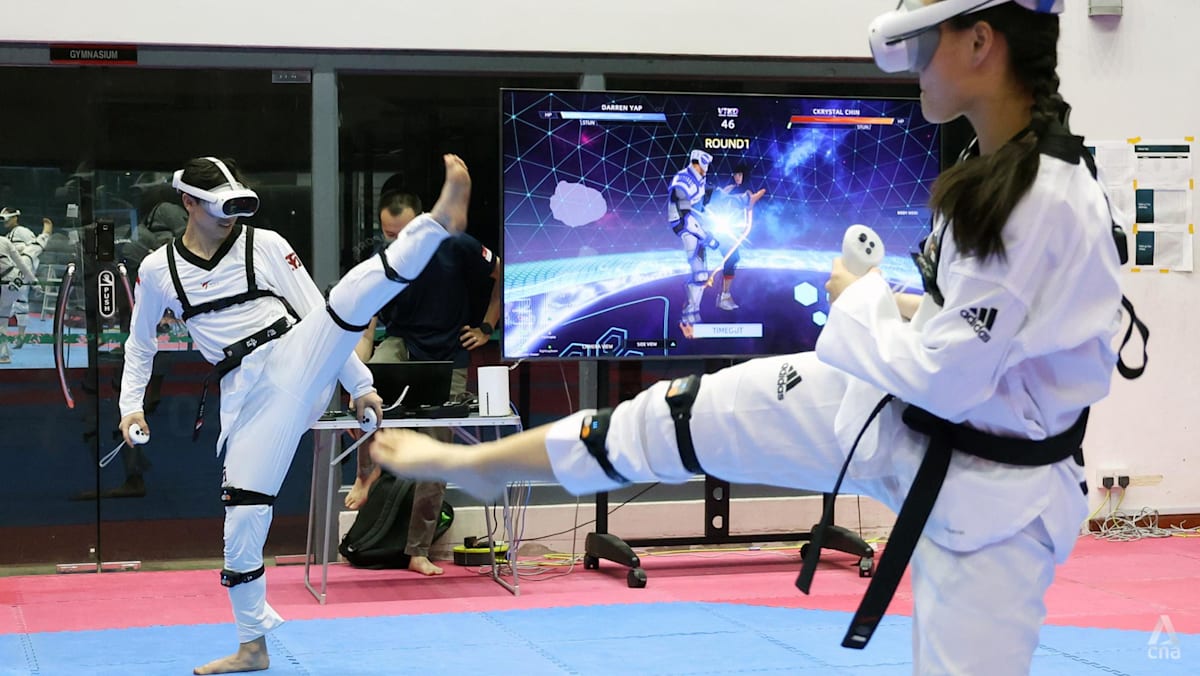
SINGAPORE: Put on a virtual reality headset, strap on motion sensors and start kicking at an opponent – without ever physically touching them.
It might sound like a video game, but virtual taekwondo will make its Asian Games debut in October, with Singapore’s Darren Yap among the athletes competing for a medal.
The 22-year-old will take part in the mixed-gender event as part of the 2026 Asian Games in Japan, which run from Sep 19 to Oct 4.
Despite its obvious similarities to gaming, virtual taekwondo is not classified as an esport at the Games.
And for Yap, who has practised conventional taekwondo since he was four, mastering the virtual version has meant learning a different way of fighting.
“You are not fighting against an actual human. You’re actually just fighting as an avatar,” he told CNA.
“But the main difference is also that gauging your distance when you’re fighting is a very big change, and also just getting used to the system, getting used to the equipment.”
HOW VIRTUAL TAEKWONDO WORKS
So how does a taekwondo fight take place without either competitor actually hitting the other?
Co-developed by World Taekwondo and Singapore-based technology company Refract Technologies, virtual taekwondo combines the physical movements and techniques of taekwondo with virtual reality and motion-tracking technology.
Athletes wear virtual reality headsets and motion-tracking devices, or nodes, on their spine, thighs and shins.
Their movements are translated onto digital avatars, allowing them to kick and attack their opponent in a virtual arena without making physical contact. Successful strikes deplete their opponent’s virtual health bar.
Refract Technologies chief operating officer Gerald Lee told CNA that the technology grew out of an idea to use the human body itself as a controller.
After encountering limitations with existing motion-capture technology, the company developed its AXIS motion-capture system, which is now used for the sport.
At the Asian Games, 16 athletes will compete in a mixed-gender knockout tournament, according to the Olympics website.
Matches follow a best-of-three format and are contested in a 4m by 4m space, with each round lasting 60 seconds, according to the Virtual Taekwondo website.
Virtual taekwondo was showcased at Singapore’s Olympic Esports Week in 2023 and held its inaugural world championships in Singapore the following year.
Its progression to the Asian Games has been quicker than even its developer expected.
Lee said its inclusion “reflects the credibility the sport has built since 2023”.
Virtual taekwondo is also expected to feature at the 2027 SEA Games, AP reported in July.
In Singapore, it featured at this year’s GetActive! Singapore Pesta Sukan, with categories ranging from juniors to participants aged 55 and above, including mixed-gender events.
The Singapore Taekwondo Federation also formed a national development squad this year to “sustain the development” of Singapore’s virtual taekwondo talent. The squad has 14 athletes.