
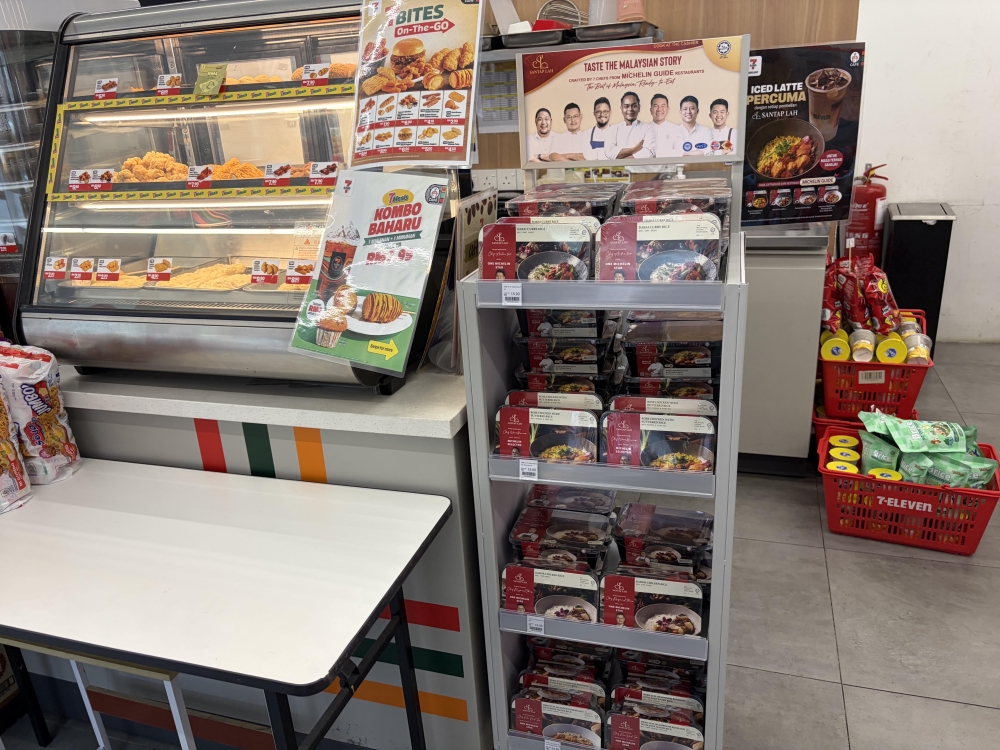
GEORGE TOWN, Sept 20 — What if having a restaurant-quality meal is possible with just the press of a button?
This is what sparked the birth of Santap Lah, a newly launched brand of microwaveable meals curated, prepared and approved by chefs from Michelin recognised restaurants in Malaysia.
Benson Chang used to grab a quick lunch from the convenience store near his office on busy days but one day, while having his usual microwaved meal, he wondered if he could work with some restaurants to produce better quality ready-to-eat meals.
That was the spark that led the Santap Lah managing director to seek out chefs from restaurants that he was familiar with.
Chang, who is the founder of restaurant reservation platform TableApp, is no stranger to many restaurants and chefs in Malaysia.
“I was close with many chefs so when I got this idea, I started asking my chef friends if they were interested in developing this with me,” he said in a recent interview with Malay Mail.
His idea was to produce good quality, delicious and ready-to-eat meals that have a shelf life of at least a year without being frozen or refrigerated.
“After asking around, several chefs showed interest and that was when we started developing recipes for the meals,” he said.
Chang also has a contact who operated a retort food manufacturing facility to produce and pack the meals.
“It took two years of development, testing the recipes over and over, going back and forth with the chefs to make sure the flavours and textures are up to standard,” he said.
The manufacturing process of the meals uses high temperature and pressure to sterilise the food, allowing the sealed meals to be stored at room temperature without refrigeration.
“We also sent the meals to be tested in laboratories and results placed their shelf life at up to 18 months, but we opted to place a 12-month expiry period on the meals to be safe,” he said.
The products are manufactured in a halal-certified facility using halal-certified ingredients and contain no added preservatives or MSG.
“Being chefs from Michelin-selected restaurants, they are of course quite particular about ingredients being used, they absolutely do not want any artificial flavourings, preservatives or MSG,” he said.
Selecting the type of meals was also a challenge due to the manufacturing and packing process as it would mean they cannot have crispy components, vegetables or most seafood.
“Crispy food will just become soggy in the process, the vegetables will oxidise and change colour while seafood does not respond well to prolonged heat,” he said.
He said this was why they had to only work with braised, steamed and oven-cooked dishes using chicken, beef, lamb, mushrooms and other vegetarian ingredients.
He said each time the meal was produced, the chef would rate the flavours.
“The first time the food came out, the quality was already very good as the chefs gave it about 6.5 or seven out of 10,” Chang said.
They subsequently suggested adjustments to the texture, colour, seasoning and water content of each dish.
“The samples went through several trial runs until the chefs gave scores of at least 8.5 before we started mass production and distribution,” he said.
However, Chang said every production batch is still sent to the respective chef for quality control, while some of them also buy the products from 7-Eleven outlets to check their consistency.
“The main focus of Santap Lah is on Malaysian flavours, thus our tagline ‘Taste the Malaysian Story’,” he said.
In the first phase of volume one of Santap Lah: Taste the Malaysian Story are four rice meals from Restaurant au Jardin’s Kim Hock Su, akar’s Aidan Low, Beta KL’s Raymond Tham and Jawi House’s Nurilkarim Razha.
The four rice dishes introduced are Kim Hock’s hericium mushroom rendang with rose water rice, Aidan’s dabai curry rice, Raymond’s kadok chicken rice and Nurilkarim’s rose chicken with buttered rice.
Chang said they will be releasing the noodle-based meals next month by Dewakan’s Darren Teoh, Gai’s Darren Chin, and gēn根’s Johnson Wong.
The noodle dishes are Teoh’s Dewakan laksa, Chin’s tom yam ramen and Wong’s buah kulim noodle.
The rice dishes are priced at RM15.90 each, while the noodle meals cost RM19.90.
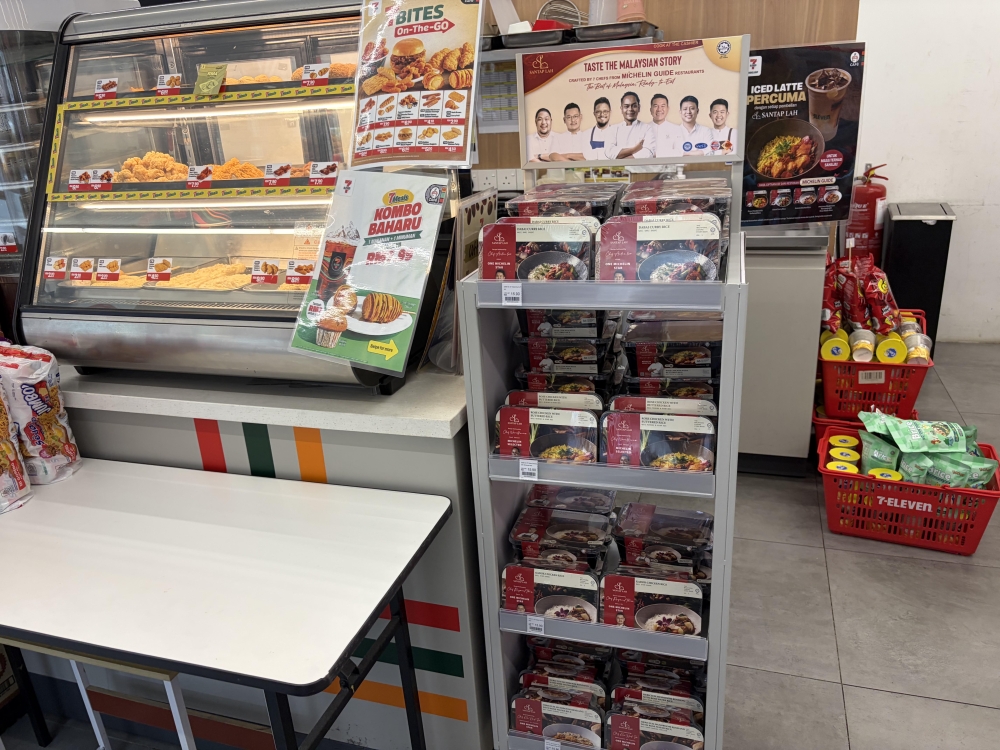
The four rice meals are now available at selected CAFé by 7-Eleven outlets nationwide. — Picture by Opalyn Mok
The food of Penang celebrations
One of the chefs, Nurilkarim, said Santap Lah offers him another avenue to introduce Jawi Peranakan and local Malay cooking to a wider audience.
His rose chicken with buttered rice, or nasi minyak and ayam ros, is inspired from a Jawi House signature and a recipe published in his mother’s cookbook, Feast of Penang.
The chicken is prepared in a creamy tomato-and-onion gravy containing cashew nuts, candlenuts, spices and chilli before being finished with rose water.
“Penang-style ayam ros is different from the ayam masak merah commonly served at kenduri elsewhere,” he said.
He added that nasi minyak is traditionally associated with weddings, doa selamat ceremonies and other celebrations.
“When people see a couple getting serious, the elderly will say, ‘Boleh bau dah nasi minyak’, they can already smell the nasi minyak brewing which means a kenduri is on the way,” he said.
He said this was why he chose to pair the ayam ros with nasi minyak because it would be more readily recognised throughout Malaysia.
Convenience without compromise
Chang said the chefs maintained the ingredient standards used in their own kitchens despite the higher production costs.
“The chefs do not allow the use of chicken powder, instead they insist that the chicken stock be made from scratch using chicken feet and wings,” he said.
He said they chose to use Malaysian ingredients such as dabai, a seasonal Sarawak fruit, for the dabai curry rice and buah kulim for Wong’s noodle dish.
He said the meals are available exclusively at selected CAFé by 7-Eleven outlets, usually on dedicated racks near the counter.
“The meals can be microwaved at the outlet or stored at home or in the office,” he said.
He said those without microwave ovens can heat up the food by placing the unopened pouch in boiling water for about 10 to 15 minutes.
“Our target is to make it as convenient as possible for young workers or adults with busy schedules,” he said.
He said convenience is also the reason they decided to partner with 7-Eleven and produce the meals according to orders from 7-Eleven.
“They have 2,000 outlets nationwide and most people go to 7-Eleven for convenient food so I feel it is a good choice to release Santap Lah in 7-Eleven,” he said.
Taking regional flavours further
Nurilkarim believes Malaysian food promotion should also venture beyond familiar offerings such as nasi lemak.
He pointed to the wealth of regional cooking across the country, from nasi kerabu on the East Coast and kacang pool and mee rebus in the south to Minangkabau-influenced masak lemak, Melaka’s asam pedas and the lesser-known ingredients of Sabah and Sarawak.
“Aidan using dabai in the curry is a great way to highlight Sarawak and Borneo because they have a wide range of ingredients that many people don’t know,” he said.
Chang is already considering subsequent volumes under the “Taste the Malaysian Story” banner.
“We are planning for volume two of different meals with the same seven chefs since they are already familiar with the process,” he said.
Looking forward, Chang said they hope to one day bring Santap Lah and its Malaysia flavours outside of Malaysia.
“We hope to be able to export the ready-to-eat meals to countries like Taiwan, Hong Kong, Dubai, Singapore, and other countries,” he said.