
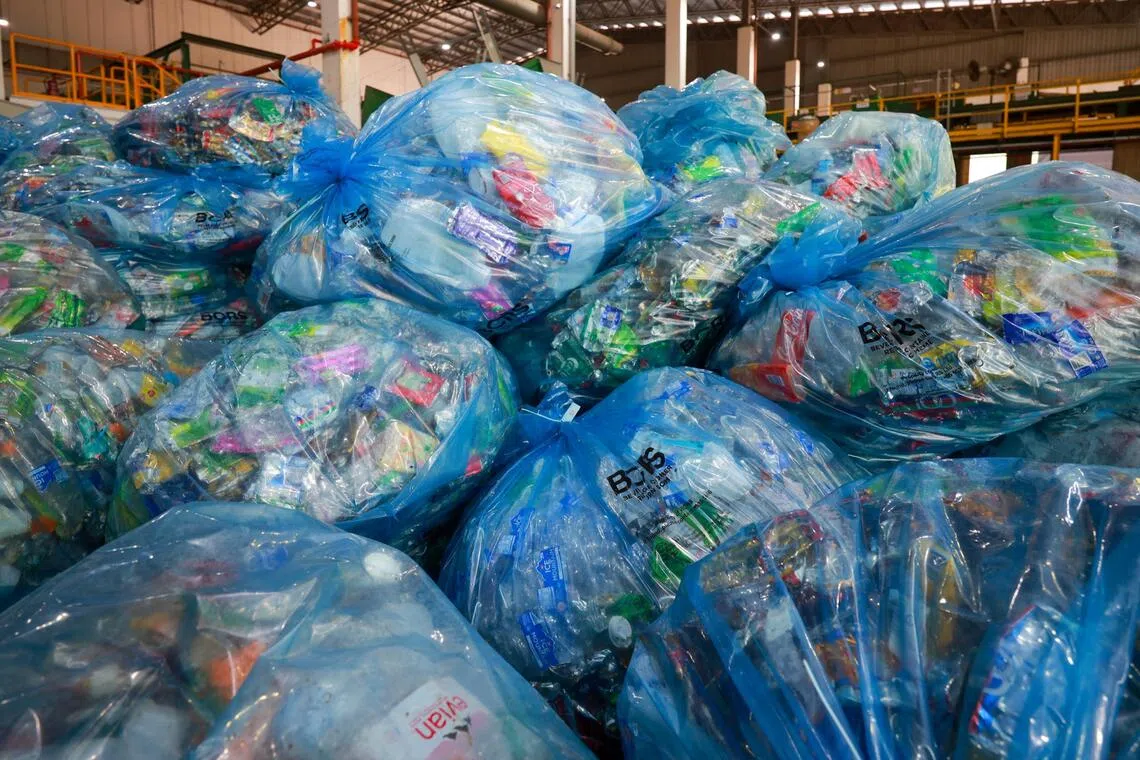
SINGAPORE – The Beverage Container Return Scheme’s Counting and Sorting Facility was officially opened on Sept 21.
Operational since August, it receives cans and bottles from reverse vending machines across Singapore. The Straits Times journeys through the process of recycling used drink containers.

1) Collection and transport

A vehicle unloading bags of beverage containers at the Counting and Sorting Facility in Tuas Bay.
ST PHOTO: JASON QUAH
-
Empty bottles and cans are collected from around 1,300 reverse vending machines and transported to the Counting and Sorting Facility.
-
Each day, more than 1,200 bags are delivered to the facility.

Since April, members of the public have been returning their used cans and bottles – which are labelled with the deposit mark – at reverse vending machines islandwide.
PHOTO: LIANHE ZAOBAO
2) Robots empty bags

Robot arms pick up the bags, slice them open and empty the containers into a storage bin. The red bags come from reverse vending machines in the west of Singapore.
ST PHOTO: JASON QUAH
-
AI-powered overhead cameras identify and count bags by colour, which indicates which region in Singapore the reverse vending machines come from.
-
Robot arms pick up the bags, slice them open and empty the containers into a storage bin called a screw bunker.
-
The plastic bags are also recycled.
3) Draining excess liquid
-
The containers are further compressed inside the screw bunker
-
Residual liquid is collected at the bottom and drained out through an outlet, reducing contamination risk.
4) Separating steel cans

Steel cans being sorted out through magnets.
ST PHOTO: JASON QUAH
-
A magnetic separator removes steel cans from the mix.
5) Air-propelled transport

The air conveying system transports beverage containers through enclosed pipes.
ST PHOTO: JASON QUAH
-
The remaining plastic bottles and aluminium cans are propelled through pipes to a separating drum and wind sifter, which removes their labels.
-
The rotating drum screen filters out bottle caps and rings.
-
Using pipes instead of conveyor belts shrinks the facility’s overall footprint, contains odours, and minimises the dispersion of loose particles.
6) Separating aluminium cans

Processed materials are sold to recyclers by the bale.
ST PHOTO: JASON QUAH
-
Non-magnetic aluminium cans are separated from the remaining plastic containers by a machine using eddy currents to induce magnetism in the metal.
-
The recovered aluminium cans are compressed into bales and sold to recyclers.
7) Sorting the plastics

Plastic sorters use infrared technology and optical cameras to identify the specific types of plastic.
ST PHOTO: JASON QUAH
-
The system sorts four types of plastics, including PET, coloured PET and HDPE (commonly used for milk and juice).
-
Infrared rays “read” the plastic containers to identify their specific material type.
-
Air jets shoot each bottle into its designated bin.
-
The sorted containers are baled and sent to recyclers.
