
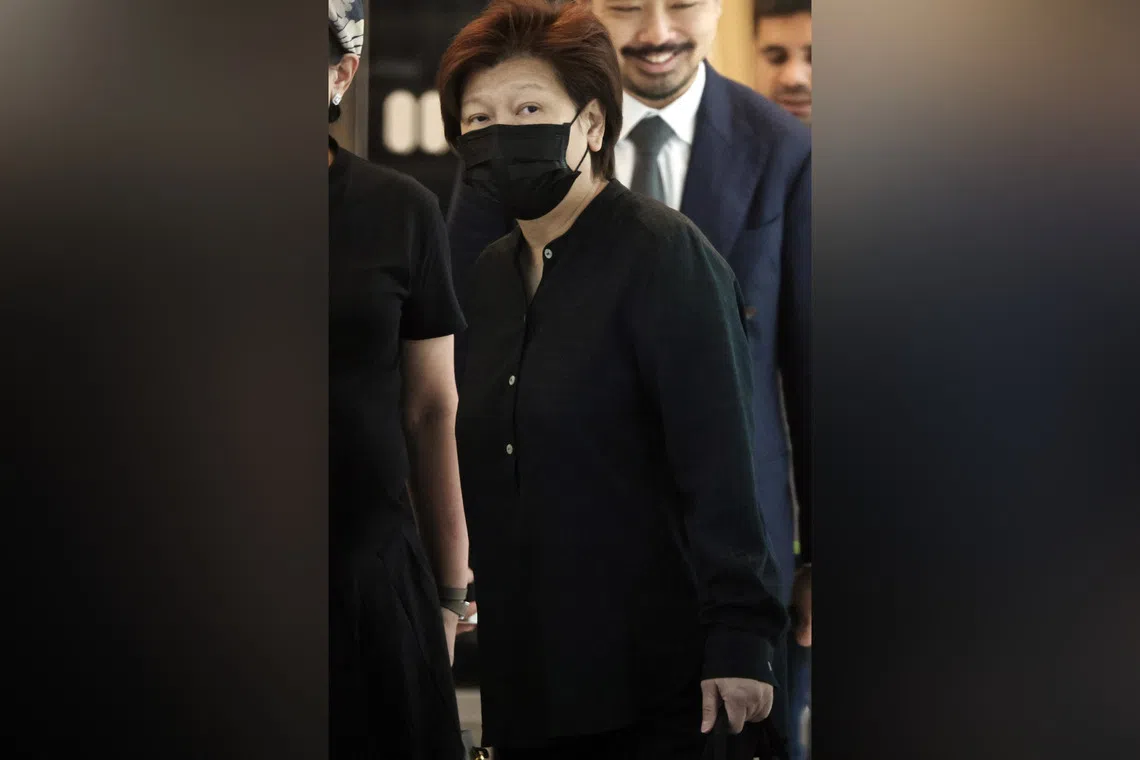
SINGAPORE – The criminal trial of Hyflux founder and former chief executive Olivia Lum closed on Sept 29 after 59 weeks of proceedings, during which 22 witnesses were called in relation to the collapse of the water treatment firm, one of Singapore’s largest corporate scandals.
On Oct 21, the defence, led by Senior Counsel Davinder Singh of Davinder Singh Chambers, will indicate whether or not to submit a “no case to answer”.
According to the prosecution, because of Lum’s determination to win the Tuaspring integrated water and power project in 2011, the 65-year-old entrepreneur intentionally failed to disclose material information, including the fact that the project’s profitability hinged on electricity sales, as she feared doing so would deter investors.
Hyflux was placed under judicial management in November 2020 and wound up in 2021. Its collapse due to weak electricity sales left about 34,000 investors of perpetual securities and preference shares, who had sunk in a combined $900 million, with nothing.
The case underscored the risks of project finance complexity, disclosure failures and the need for stronger investor protection regulations.
The prosecution, led by Deputy Chief Prosecutor Christopher Ong, had called 22 witnesses including former Hyflux staff who were involved in preparing corporate announcements or documents, and bank representatives who interacted with Hyflux personnel in negotiating Tuaspring’s financing.
Hyflux won the tender for Tuaspring with the lowest submitted bid. It had proposed to sell water to PUB at a first-year tariff price of 45 cents per cubic metre, undercutting its competitors by at least 27%. But that meant the plant would operate at a loss, the prosecution alleged.
“To make the project financially viable, and also fulfil PUB’s requirement to procure or produce electricity for the desalination plant at Hyflux’s cost, Hyflux intended for the power plant to supply electricity to the desalination plant, while actually selling the vast majority of the power that it generated to the national grid,” the prosecution said.
But Hyflux had no prior experience in power generation, much less selling electricity.
The criminal trial began in August 2025 before Principal District Judge Toh Han Li.
Over 54 days, the court heard why Hyflux allegedly did not disclose that it would have significant exposure to the electricity market, how it had looked to retail and institutional investors to fund Tuaspring because it had trouble getting bank loans, and that DBS was the party that floated the idea of Hyflux issuing preference shares to raise funds in 2011.
In August 2025, the prosecution proceeded on 11 charges against six defendants. These included two charges each against Lum and four former independent directors – Teo Kiang Kok, 70; Gay Chee Cheong, 69; Christopher Murugasu, 67; and Lee Joo Hai, 70.
Hyflux’s ex-chief financial officer Cho Wee Peng faces one charge over conniving in Hyflux’s omission to disclose the information about Tuaspring.
Of the six charges Lum faces, four Companies Act charges were stood down. The prosecution proceeded on the two remaining charges against her.
Those charges relate to her consenting to Hyflux’s omission of information relating to Tuaspring, when disclosure was required under Singapore Exchange (SGX) listing rules. This information was necessary to avoid the establishment of a false market in Hyflux’s securities.
According to one charge, she consented to intentionally failing to notify SGX that the Tuaspring project was Hyflux’s expansion into the new business of selling electricity, and that the plant’s profitability was contingent on electricity sales revenue, which was projected to make up a significant proportion of its overall revenue.
This had implications for Tuaspring’s resulting exposure to market risks arising from the volatility of electricity prices. If convicted of this charge, Lum faces up to seven years’ jail, a fine of up to $250,000, or both.
She was also charged over Hyflux’s omission to disclose the information about Tuaspring in the offer information statement issued for the offer of $200 million, 6% preference shares on April 13, 2011. If convicted of this charge, she faces up to two years’ jail, a maximum fine of $150,000, or both.
The four former independent directors were each charged with neglect relating to Hyflux’s failure to disclose information relating to Tuaspring as required, and omitting material information in the 2011 offer information statement.
One other independent director, Rajsekar Kuppuswami Mitta, pleaded guilty on Aug 7, 2025, to a charge of neglect in relation to the March 7, 2011, announcement by Hyflux to SGX.