
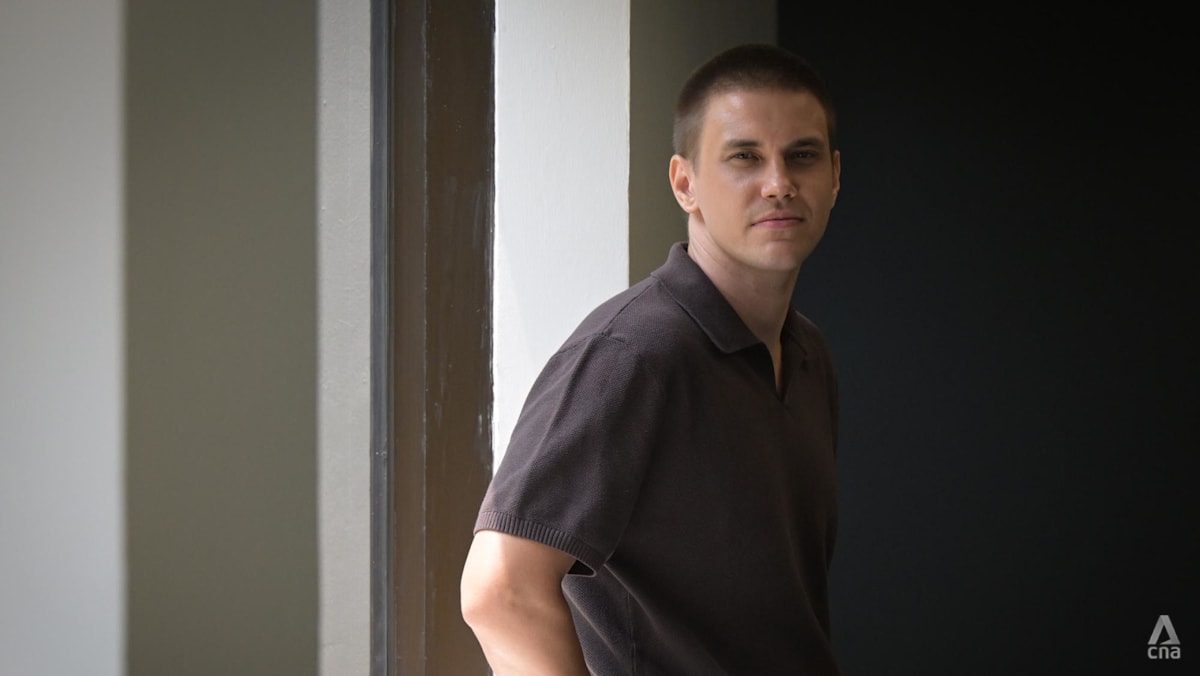
He told CNA how he stayed in three different kinds of cells – first, a four-man cell while on remand, then a single-man cell after he was sentenced, and an eight-man cell while he was in prison school.
Mr Panfilov described his experience of being convicted of rape in May 2025 as a “really, really scary rollercoaster”.
He believed that he had enough facts to prove his innocence, but there were legal details that Mr Panfilov said mattered more than he thought they would.
While he lodged an appeal, the conviction itself was a huge shock and he had to begin to “live with the idea” that he may be in prison for a long time.
Mr Panfilov was housed in Changi Prison’s A1 cluster, a maximum-security prison for offenders who have been given lengthy sentences. There, he met others who were serving longer sentences than him.
“So the moment I got there with my 11-and-a-half years, everyone was kind of like, ‘ah bro, nothing lah’.”
Even as he gradually came to adapt to his new environment by making friends with other inmates, Mr Panfilov continued to hope that he would win his appeal.
This was despite “everyone” around him telling him that his chances were slim.
“But I knew, at the back of my head that I’m innocent, that we will do everything we need to do, and I had trust in the judicial system, and in the end it proved to have corrected the mistakes that were made earlier, and I’m grateful for that,” said Mr Panfilov.
Determined to make the most of his time, he enrolled in prison school to prepare for his GCE A-Levels, which he is still slated to sit this November.
Mr Panfilov recalled reading “voraciously”, estimating that he finished over 100 books in his time in jail, spanning fiction and non-fiction including Russian authors and local memoirs by people like Lee Kuan Yew and Goh Chok Tong.
He also joined religious counselling sessions, “found God” while in prison and became a Christian.
“You just pretend that you’ve got this magnifying glass and you maximise the little benefits and the positives that you have in life, and you diminish all the other negatives around you,” he said.
His present girlfriend, whom he had known for a long time and started dating in 2021, also visited him in prison weekly or monthly, depending on the availability of visits.
APPEAL AND ACQUITTAL
Following his conviction in May 2025, Mr Panfilov’s appeal was handled by Mr Johannes Hadi, Mr Eugene Thuraisingam and Ms Seraphine Loh.
They were his third set of lawyers – the first being Mr Ashwin Ganapathy and Mr Anil Balchandani. The latter is known for representing Ms Parti Liyani, a former maid who was acquitted of stealing from the family of ex-Changi Airport Group chairman Liew Mun Leong.
Mr Manoj Nandwani and Mr Sameer Melber from Gabriel Law took over the case after the first set of lawyers finished cross-examining the woman for 13 days.
While attending the appeal hearing was a “nerve-racking” moment for him, Mr Panfilov sensed a faint glimmer of hope because of how the judges were asking questions about the case.
He was only notified in his cell the day before his next hearing that the verdict would be delivered. When the judges acquitted him of all charges, Mr Panfilov recalled wondering what to do next.
He was released that same evening after being acquitted, but he did not know where his mother’s new home was in Singapore.
“The only person whom I had in Singapore whom I was close to was my girlfriend, and luckily I still remembered her address,” said Mr Panfilov.
With only the S$50 returned to him from his personal property upon discharge, no phone, and two bags of books, he could not hail a ride until a security guard helped him book a Grab.
Mr Panfilov went straight to his girlfriend’s home, but no one was in except for his dog. His girlfriend, who is in her 30s and works in the business aviation sector, had been waiting for him in the wrong place as she thought he would be released from court.
“So no one even met me,” said Mr Panfilov. “It’s just me walking out, you know, not knowing what’s happening like John Travolta (from the Pulp Fiction meme).”
Even though he was in jail for only about three years, he felt out of place re-entering society.
“I was like struggling to cross the road in the beginning … you know, things moved so fast. I had not seen cars moving, didn’t have to cross the street for a long time,” he said.
In jail, he did not have to use his phone or send emails, so every single message he received in there was “an event”.
“Every single letter that you get is like, wow, because there are all these pent up emotions, so you feel that any sign of care or concern by other people outside of prison is important to you,” he said.
“Now … I get messaged frequently as everyone else does, and it’s a non-stop flow of messages, and that was something that I was finding hard to adjust to.”
WHAT’S NEXT?
With the five years of police investigations, court appearances and jail time now behind him, Mr Panfilov said he is extremely relieved that justice has prevailed.
“My faith in the Singapore judicial system has been restored,” he said. “But it’s a type of relief that is mixed with a lot of grief … and a type of darkness.”
The grief, he said, came from the time he lost and the process of re-adjusting back to his regular life.
His first goal is to recoup the monetary losses from the case.
To do so, he has set up a recruitment firm called Found Partners. Mr Panfilov retained his Singapore permanent resident status since he was acquitted.
“Because I’ve lived here half my life, Singapore’s become an intrinsic part of me, and I do consider myself a Singaporean to a certain extent. At least, I did some National Service, and I did go to secondary school,” he said.
“And now I’ve been to prison, so I know … all the aspects of Singapore,” he said with a smile.
Now, he wishes to expand his horizons, explore living elsewhere, and eventually pivot to the creative industry. He also intends to marry his girlfriend.
Asked if he had any comment on the woman who accused him, Mr Panfilov paused as he thought about what to say.
“I don’t really occupy myself with thoughts about her too much, because I’ve got my own life to focus on,” he said. “You know, people make mistakes.”
While he insists the incarceration was not an “educational experience” but punishment for a crime he did not commit, he said the ordeal impressed upon him the vital importance of having competent legal counsel, noting that those with fewer resources might not be able to protect themselves adequately.
He added that the experience has made him a more patient person, since such situations may take a long time to sort out.
“One thing I noticed is I don’t really laugh at things as much as I used to,” he said, describing how he watched some of his favourite comedians on release from jail and found that it was no longer funny.
“I think I’ve become more compassionate as well, and less judgmental,” said Mr Panfilov.
“Before going to prison, I used to think that everyone in prison is – don’t deal with him, you know, don’t talk to that person basically.
“But now I understand that a lot of people, they just make mistakes, and well, they’re out there to correct themselves, and everyone deserves a second chance, or a third chance, or a fourth chance, as many chances as they need, within the parameters of the law.”