
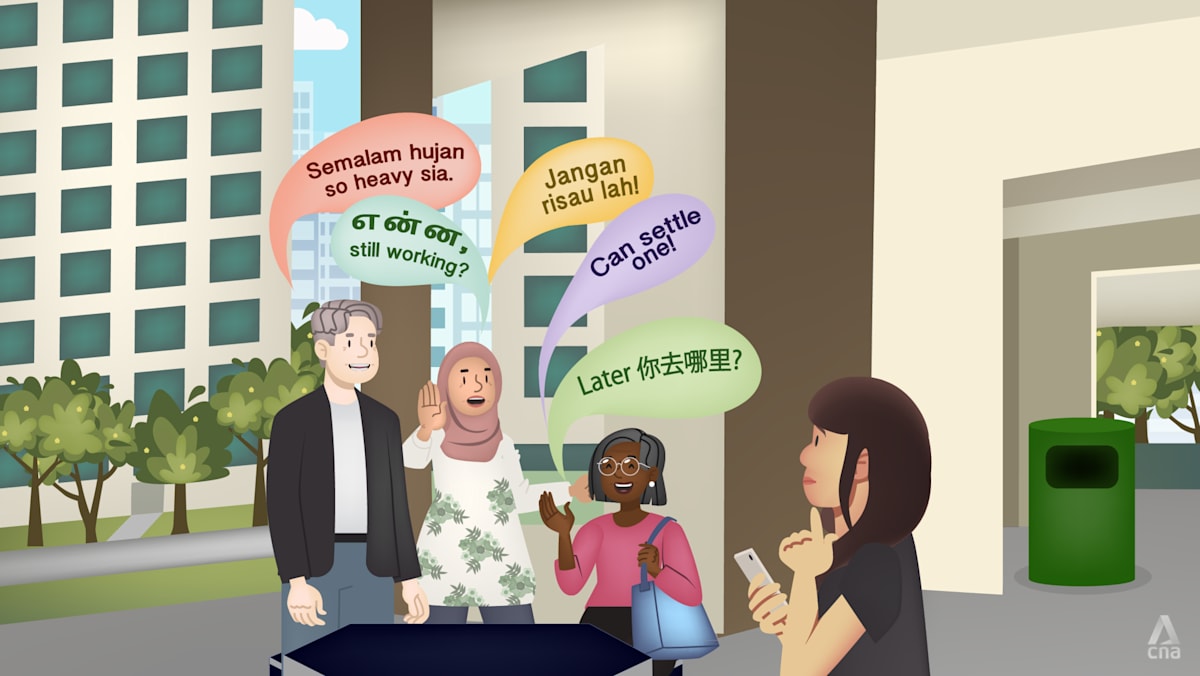
You only have to look at younger Singaporeans to see the proof of this everywhere.
I see plenty of youths voluntarily learning Korean by looking up tutorials and learning resources online, and begging their parents to sign them up for classes.
They don’t want an A1 in Higher Korean at the O-Level exams. They just want to understand the lyrics to their favourite K-pop songs, Korean shows and interview clips for which English subtitles may be hard to come by.
CONNECTION, NOT CATEGORISATION
In his National Day Rally speech, PM Wong also warned that Singapore “must not become a monolingual society“.
Multilinguists like my parents – and hordes of teen K-pop fans – have taught me a simple but underrated secret: Language thrives most when it is part of everyday life.
If we genuinely want multilingualism to remain core to Singaporean identity, perhaps the shift needs to begin in early childhood.
Now, as a mum of two young children, I find myself wondering: Would it be too much to introduce some elementary Malay into kindergarten curriculums? Not another examinable subject but simple songs, greetings, numbers, food, games and everyday phrases.
As children get older, why not give them opportunities to practise what they’ve learnt, outside of Racial Harmony Day once a year?
Short courses of Malay classes throughout primary and secondary school, focusing on conversational proficiency rather than written examinations, could go a long way.
The objective behind these efforts shouldn’t be producing yet another certificate. It should be producing Singaporeans who aren’t afraid to connect with their cultural heritages – both their own and that of their friends.
This, to me, is the true value of encouraging Singaporeans to learn each other’s languages.
For those of us long past our schooling days, it’s not too late for us to make small efforts in our own daily lives.
Say “terima kasih” instead of “thank you” occasionally. Try ordering food in Chinese even if the stallholder decides to save everyone time by replying in English. Look up the Hokkien phrase your colleague keeps using.
Most importantly, don’t let fear of embarrassment or failure prevent us from giving it a shot.
Maybe my father was right after all. You don’t have to “learn” – you just have to try.
Jillian Lim has nearly two decades of experience in broadcasting and is now pursuing a degree in business marketing.