
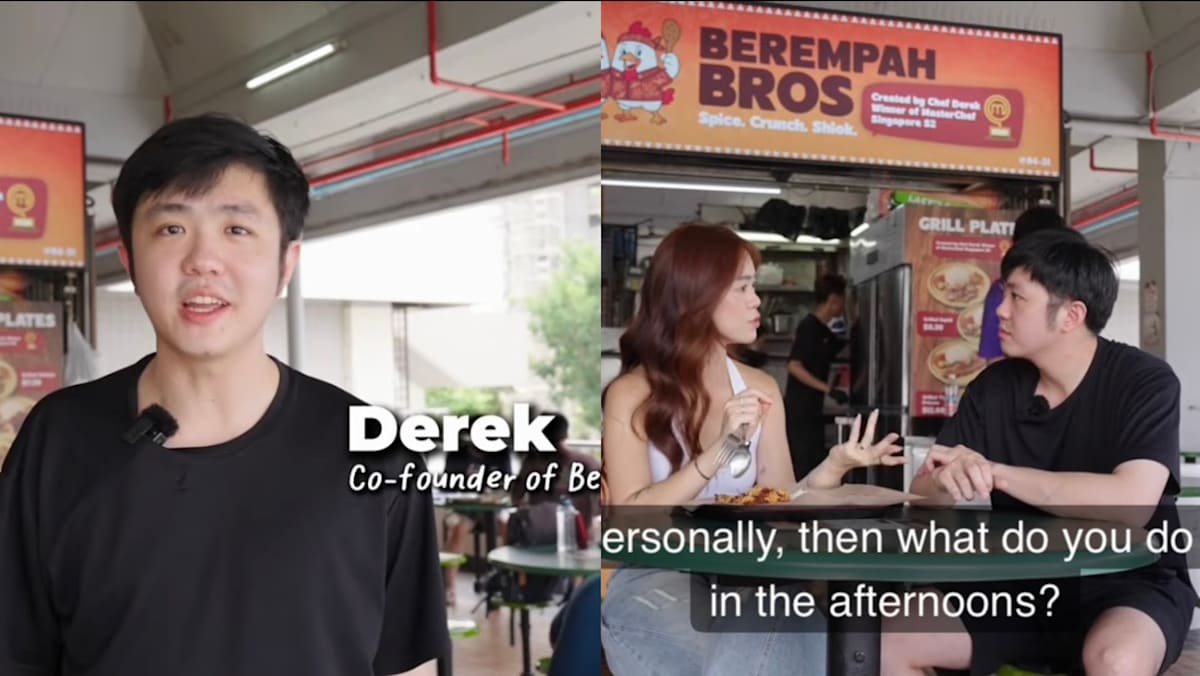
You would think winning MasterChef Singapore would mean spending most of your time in the kitchen.
Not Derek Cheong, 28, who won the second season of the reality cooking competition show in 2021, now runs six hawker outlets across Singapore.
But here’s the surprising part. He doesn’t actually cook at any of them.
In an episode of Gen Z Crash Course, Derek gave YES 933 host Chen Ning a glimpse into his daily routine as a hawker business owner.
“I’m a hawker by day and a fine dining chef by night. I run six hawker stores all around Singapore, and people see me and they think, ‘Wah, this guy say he’s MasterChef and talks big all the time!’ So what do I actually do?” he said.
At his Buona Vista outlet, Derek was seen inspecting the food, tasting everything from the rice and sambal to the chicken and achar.
And even the rice wasn’t spared his scrutiny.
“Today I’m tasting a little bit of inconsistencies in the rice, so some parts are hot, some parts are a bit more clumpy and wet,” he observed. Thankfully, the chicken passed his test.
But when he’s not conducting quality checks, what else does he do?
“Oh, I nag. What are you bad review, I send to the group and say, ‘Hey, what happened?'” he joked.
Of course, running six outlets at 28 sounds pretty impressive, but Derek’s journey hasn’t exactly been smooth sailing.
“I have failed miserably at two ventures. So one of them, I used to do artisanal chocolate bonbons before. Then we did it for one year, lost about maybe six digits or so,” he recalled.
And that wasn’t even his most expensive lesson.
“I’ve also done a franchise in a hawker centre as well as a food court in Singapore Poly. Then as a franchisee over there, I believed in the business model, but it did not turn out what I expected. So I ended up losing maybe close to $200,000 in one year,” he revealed.
But clearly, Derek wasn’t about to let those setbacks put him off the F&B business.
As it turns out, he comes from a family of hawkers. But unlike his parents, who preferred doing things themselves, Derek has a rather different approach.
“So it’s very important for us, we always think about it as business scalability. We always find people, good talents, streamline our operation, streamline our SOP to make it super fast, and to be able to scale to many outlets very fast,” he explained.
Berempah Bros, currently operates six outlets, including a takeaway kiosk at CPF Plaza in the CBD.
A seventh outlet is apparently already in the works.
Interestingly, while Derek treats his hawker business as exactly that, a business, his real passion still lies in fine dining.
Derek runs a private dining experience from his home, where he gets to experiment with dishes and flavours.
There’s a dry-aging cabinet for ducks, a dining table that seats around 14 people, and even his MasterChef Singapore trophy on display.
“Definitely I lean towards doing fine dining, because that’s my passion and I’m kind of like an artist also in the kitchen because I like to create new flavours, new dishes, and I always like to create something that has a new type of taste,” he shared.
“So hawker is basically creating something that the mass market will enjoy, and that’s more of like a business. But this is, even though fine dining is also a business, I also treat it as a place to showcase my creativity,” he added.
But when Chen Ning asked whether he’d rather own 10 hawker stalls or one fine-dining restaurant, Derek didn’t even need to think.
“10 hawker stores. You can buy landed in no time!” he quipped. “10 good hawker stores, 10 good hawker stores because you open one fine dining restaurant, you will lose money to no end!”
And when asked whether that was based on experience, Derek had an even more blunt response.
“Fine dining don’t make money!” he chortled.
“I think for me, the end goal is definitely firstly to provide for my family, and then I also plan to have many kids, so I definitely need to have a mini playground of a house, so my house needs to be big enough,” he added.
And that is not all.
“I also want to buy things that I like, like Pokémon cards, travel as and when I like, be able to enjoy the food that I like as well. I like to eat sushi, so sushi is quite expensive, so I need to be able to afford that also,” he added.