
No part of this story can be reproduced without permission from 8days.sg.
When someone tells you they’re representing Singapore in an international sporting competition in kayak fishing, your immediate reaction will probably be, “What is that?”
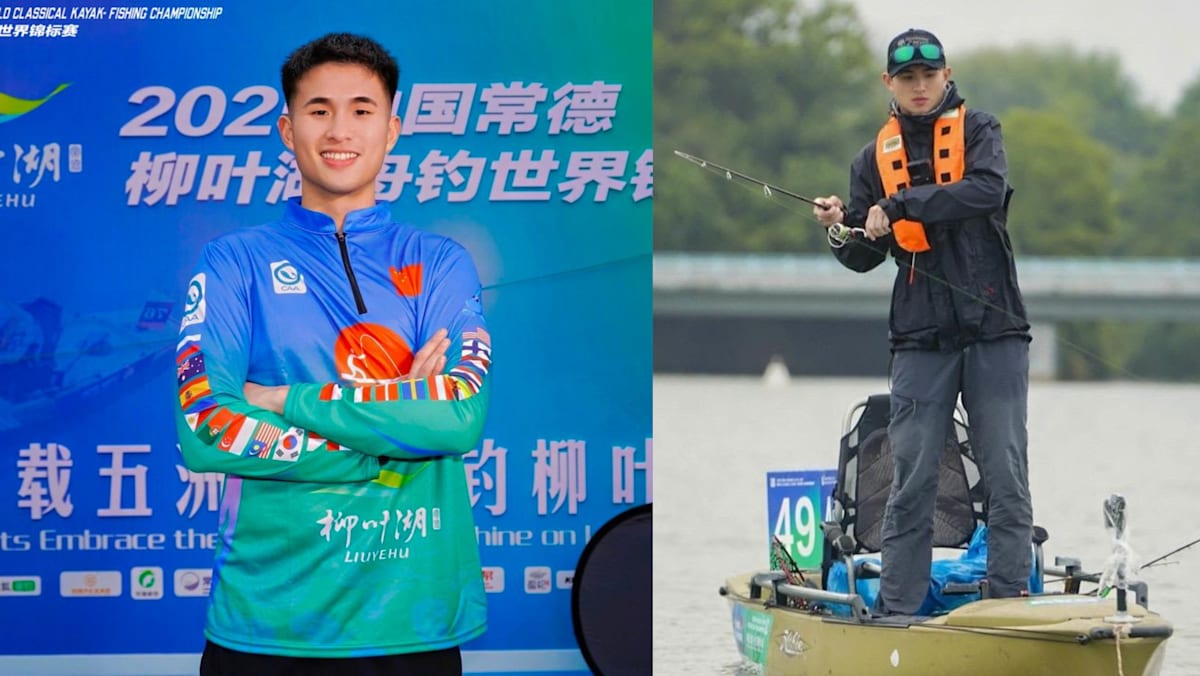
Meet Charles Foo, a 25-year-old financial adviser with HSBC Life who recently travelled to China to compete in the World Kayak Fishing Finals.
In an Instagram video, Charles shared that he often gets the same reaction whenever he tells people about his overseas competitions.
“I realised when I told people what I was in China for, they would always ask me the same question. How do you compete in a fishing competition?” he said.
Speaking to 8days.sg, Charles reveals that he was one of two Singaporeans selected to compete in this year’s finals, held in China from September 20 to 26. The other was fellow angler Max Tan.
“Every year, two to three anglers are selected to represent Singapore in these international competitions. This year, I was selected by one of my local sponsors, BONE Fishing, to compete,” he tells us.
The competition brought together 79 anglers from 17 countries, with Charles eventually finishing 22nd.
Charles isn’t entirely satisfied with his results.
“I should and could have performed better, my goal is always top 10,” he admits.
His biggest catch during the tournament was a 37cm topmouth culter.
And if you’re wondering how a fishing competition works, here’s the short version.
Anglers spend the first day scouting for promising fishing spots, followed by two days of competition. They aim to catch up to six fish a day, with their scores based on the combined lengths of their catches.
Each fish must be photographed on an official measuring board and released alive, with video proof.
So no, nobody’s bringing home fish for dinner.
Now, here’s something that might surprise anyone who thinks fishing is a relatively inexpensive hobby.
A competitive kayak fishing setup can cost more than S$10,000.
According to Charles, the kayaks used in international competitions retail for around US$4,000 to US$5,000 (approximately S$5.1K to 6.4K).
And that’s before adding fishing rods, reels and electronic equipment.
Charles owns a Daiwa Exist 2500, which costs around S$900, and a Shimano Stella SW6000, priced at about S$1,100, and they’re funded partially by his sponsors.
His flights, accommodation, kayak and most equipment for the China competition were also sponsored.
“The only thing I had to pay for were meals had outside of the hotel,” he says.
His love for fishing started when he was just five, with his father taking him to Bottle Tree Park in Khatib, which was later renamed to ORTO.
Charles eventually discovered kayak fishing after renting a kayak to fish for barramundi around Pulau Ubin.
And he’s been hooked (literally) ever since. Between completing National Service and starting university, he would go fishing as often as five times a week.
These days, with work and other commitments, he tries to fish at least once a week.
And he’s had some rather impressive catches. His biggest was a giant trevally caught in West Papua, Indonesia. The fish measured 130cm and weighed an estimated 40kg.
“It took me about 30 minutes to get it in the boat!” he recalls.
Closer to home, Charles has also caught a giant trevally weighing around 20kg off Singapore’s southern coast. Other notable local catches include a 9kg peacock bass, a 10kg giant snakehead, also known as a toman, and even a 40kg blacktip reef shark.
And while Charles has caught some impressive fish, he insists the hobby isn’t always about getting something on the hook, and once spent 13 hours fishing without catching anything.
“Most of the times it’s not really about catching fish, more so being out on the water and in nature,” he explains.
And despite spending so much time fishing, Charles doesn’t actually keep his catches for dinner.
“For me, fishing is all about sport and I do strictly catch and release. I am passionate about Singapore’s biodiversity and conserving the ecosystem. Nothing makes me happier than seeing a fish swim away healthily,” he says.
While Charles has represented Singapore overseas, he believes there’s still room for the sport to grow locally.
“I think the main thing is a lack of awareness as well as restrictions. Fishing in Singapore has never been easy,” he says.
Charles is currently preparing to launch a fishing podcast, with the first episode focusing on fishing restrictions in Singapore.
We also asked Charles what he thought about youngsters who have come under fire online for fishing in prohibited areas, including those who filmed themselves fishing near the Louis Vuitton Island Store at Marina Bay Sands.
While he doesn’t condone breaking the rules, Charles thinks there’s a reason some anglers are casting their lines where they shouldn’t.
“While I do not condone youths getting themselves into trouble, I realise that Singapore is extremely scarce when it comes to areas to fish,” he says.
“The population of anglers in Singapore is only growing, and our legal fishing grounds aren’t getting any bigger. Thus, I understand why youths would fish in prohibited areas. But at the end of the day, they are just fishing, and fishing should not be treated as a crime. It is far better than staying at home and doomscrolling,” he adds.