
SINGAPORE – Greater bilateral trade, investment flows and technological upskilling were among the topics discussed during Foreign Minister Vivian Balakrishnan’s official visit to Islamabad, Pakistan, on Oct 30.
He was in Pakistan at the invitation of the country’s Deputy Prime Minister and Minister for Foreign Affairs, Mohammad Ishaq Dar, to mark Singapore and Pakistan’s 60th year of diplomatic relations.
“Over the years, there have been high-level exchanges at the leadership level, sometimes all over the world; not often enough in our own home countries,” Balakrishnan remarked on the very rare direct high-level visits between leaders of the two countries during a joint press conference with Dar in Islamabad.
“I was checking the records. My former prime minister Goh Chok Tong was here in 2004. So this is belated, but better late than never.”
The minister affirmed that the two governments have remained in constant communication “far more than people realise”, and that they have a “very effective partnership”.
Balakrishnan noted that the first order of business in Singapore’s relations with Pakistan would be to work on improving trade, economic cooperation and areas like carbon markets.
“Our trade relations – looking at the numbers and the data – ought to be much higher,” Balakrishnan said.

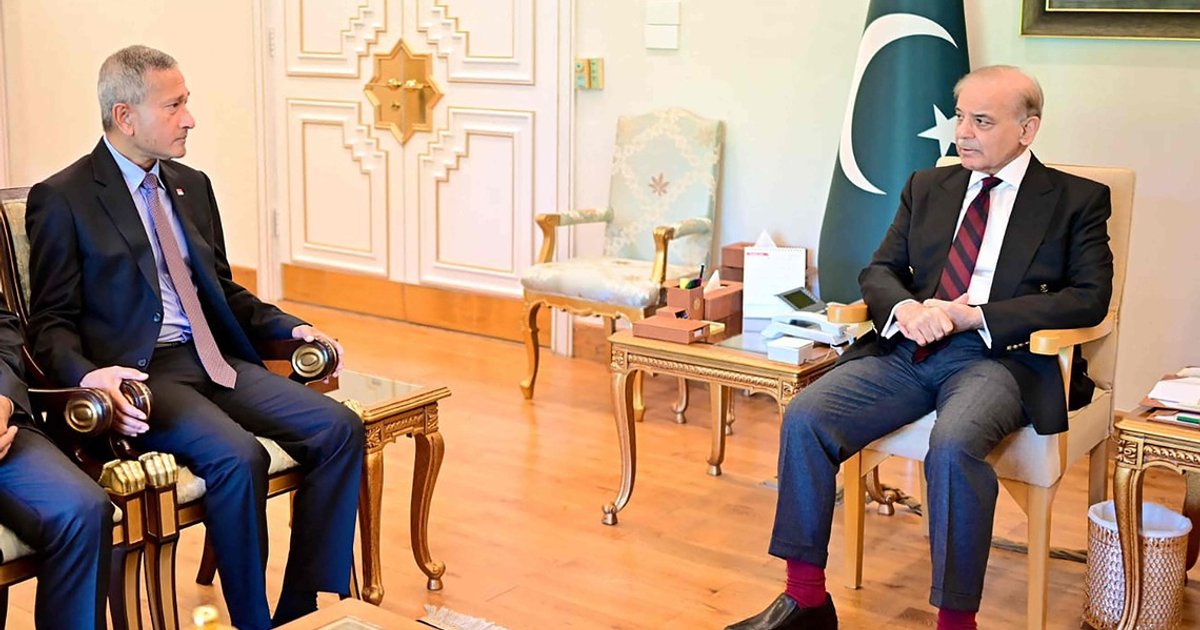
Foreign Minister Vivian Balakrishnan (right) meets Pakistan’s Deputy Prime Minister and Minister of Foreign Affairs Mohammad Ishaq Dar in Islamabad on Oct 30.
PHOTO: MINISTRY OF FOREIGN AFFAIRS
He noted that businesses, particularly small and medium-sized enterprises, need to engage directly to understand commercial opportunities and risks across South-east Asia and South Asia. He added that governments must facilitate these interactions and identify new avenues for mutually beneficial cooperation.
Trade ties between Singapore and Pakistan are currently valued at around US$1.19 billion (S$1.5 billion). For comparison, Singapore’s trade with India and Bangladesh are valued at around US$35 billion and US$3 billion respectively.
Balakrishnan said that the second area of cooperation between the two countries would be on disaster preparedness and response. Singapore Civil Defence Force and Pakistan’s National Disaster Management Authority exchanged a memorandum of understanding (MOU) during Balakrishnan’s visit.
“Pakistan, unfortunately, has extensive experience in responding to large-scale natural disasters, including floods and other extreme weather events, and so there is much that Singapore can learn from Pakistan in how to cope and how to be more resilient for the future,” Balakrishnan said.
“Through this MOU, we hope to explore cooperation in areas including early warning systems, the sharing of best practices, strengthening search and rescue capabilities, as well as hopefully, conducting joint training and exercises. It’s worth remembering that disasters do not respect boundaries, do not have passports, and the more we can work together, the better,” he added.
Balakrishnan also expressed appreciation for Pakistan’s “unique, but very constructive and valuable role” in the current crisis in the Gulf region. He also reaffirmed both countries’ commitment to International law and the United Nations Convention on the Law of the Sea 1982, which sets out the right of transit passage in Straits Used for International Navigation.
With Singapore chairing ASEAN in 2027 and Pakistan leading the Shanghai Cooperation Organisation, Balakrishnan said that this will create opportunities for the two diverse regional blocs to do more together. He also noted that Pakistan is already a sectoral dialogue partner of ASEAN.
“In an increasingly uncertain global environment, including on the business side of it, it is even all the more important for our two countries to remain open, connected, and constructively engaged with each other,” he added.