
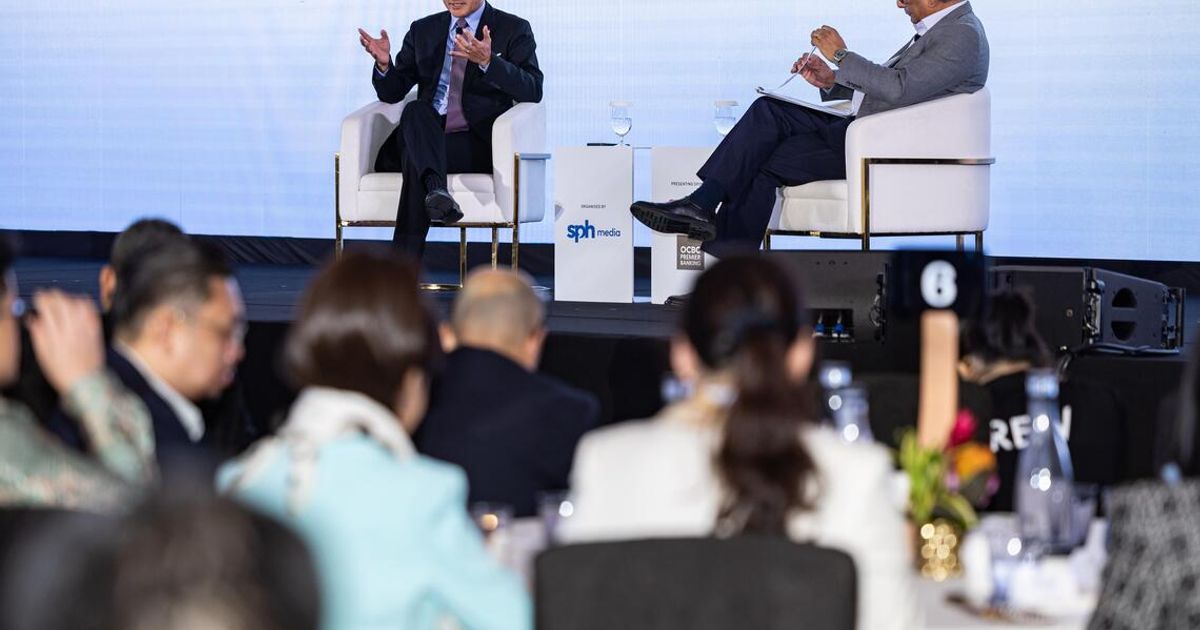
SINGAPORE – Singapore’s upcoming ASEAN chairmanship can be considered a success if the grouping’s 11 members stay in relative peace and security, and it makes more progress on economic integration, said Foreign Minister Vivian Balakrishnan.
On the economic front, ASEAN has not yet fulfilled its vision of becoming a single market and investment zone, he said during the closing dialogue of SPH Media’s Asia Future Summit on Nov 27.
There will be challenges negotiating the agreements needed to make this happen, including lowering trade barriers and committing to building a shared power grid, Balakrishnan said.
“But clearly, we need to do that,” he added in response to a question on what would mark a successful year for the Republic as chair of the regional grouping.
Singapore will assume the role, which rotates annually among the grouping’s 11 member states, in 2027 – taking over from the Philippines.
The Republic wants to maintain ASEAN as an open, inclusive engagement zone, but not allow the region to become an arena of proxy wars, he said at the dialogue moderated by Ravi Velloor, a senior columnist from The Straits Times.
“We don’t want to be forced to choose, but we want to engage all sides.”
The grouping’s 11 nations have different levels of economic and political dependency on the superpowers, he said, referring to the US and China.
But ASEAN has “great potential” as long as it can stay open and inclusive, trade with and attract investments from the world, and run a “fair and honest system”, Balakrishnan added.
“That’s what success is in the medium to long term,” he said, adding that Singapore will do its part to move this along.
On the political front, the grouping needs to maintain ASEAN centrality – referring to the diplomatic doctrine the states subscribe to, which defines the regional grouping as the primary platform to drive South-east Asia’s politics.
“We will have squabbles, we will have disagreements, but our shared vulnerabilities far exceed our differences,” he said.
“Just keeping the 11 of us together in relative peace and security is the first success factor.”
ASEAN has come a long way since its founding in 1967, Balakrishnan noted.
Then, many of its member states had ongoing disputes and, in some cases, recently-ended open conflict, including the Konfrontasi, where Indonesian commandos bombed MacDonald House in Singapore, killing civilians.
“We’ve made tremendous progress,” Balakrishnan said, despite the ongoing civil war in Myanmar and a border dispute between Cambodia and Thailand.
The minister was also asked to weigh in on another ongoing issue: competing territorial claims in the South China Sea.
A set of rules for managing relations between ASEAN and China in the area, known as the Code of Conduct (COC), has been proposed, with negotiations meant to conclude by the end of 2026.
In an update earlier in November during the 2026 ASEAN summit in Manila, Philippine Foreign Secretary Ma. Theresa Lazaro said ASEAN and China have reached a provisional agreement on about 80% of the COC.
The South China Sea has strategic significance for China, Balakrishnan said, and ASEAN nations need to be realistic about this.
He noted that the ASEAN states that have overlapping claims with China in the area – Brunei, Malaysia, the Philippines and Vietnam – also have overlapping disputes with one another.
There are difficult aspects to the negotiations, including a lack of consensus over the geographical scope of the disagreements in the first place.
There are also disagreements on whether the COC will be legally binding, he added. “These are very sensitive and difficult topics which we will need to work to get through.”
The issue has been discussed since at least 2018 – the last time Singapore was ASEAN chair, he added. “So it’s come down one full circle. All I would say is, we will do our best to try to move things along.”
The main considerations are to keep the peace and keep trade flowing, he said.
On China’s rivalry with the US, and how small states like Singapore can deal with it, he offered two rules.
The first, he said, is “try your best to stay out of trouble”.
The second is to engage all powers – but the question is how.
“I do not believe it is for Singapore to go around saying ‘yes sir, yes sir, three bags full’ in Beijing, then in Washington, and then in London or Paris,” Balakrishnan said.
Instead, the city-state must be consistent in its message: that it is not looking for handouts or subsidies.
“What we want is access. We want access to technology. We want access to your markets. We want to be treated fairly, and we want to be useful but not made use of,” he said.
Singapore must “play the game straight”, with a realistic assessment of its vulnerabilities and strengths, he said.
In response to a question on whether there has been a fundamental shift in Singapore’s relationship with the US, Balakrishnan said all relationships evolve, and that the US has been a vital, essential and stalwart partner.
Singapore has benefited from both America and China, he said, adding that the question is what happens when both “actually have a fracture”.
The Republic needs to have an honest relationship with both, and to reassure both sides that while it does not want to be forced to choose, it will not be used by either side as a tool against the other.
“It’s not a question of balance. That’s why maintaining a principled, consistent foreign policy is so critical for us”.

-
For more information, visit www.asiafuturesummit.com