
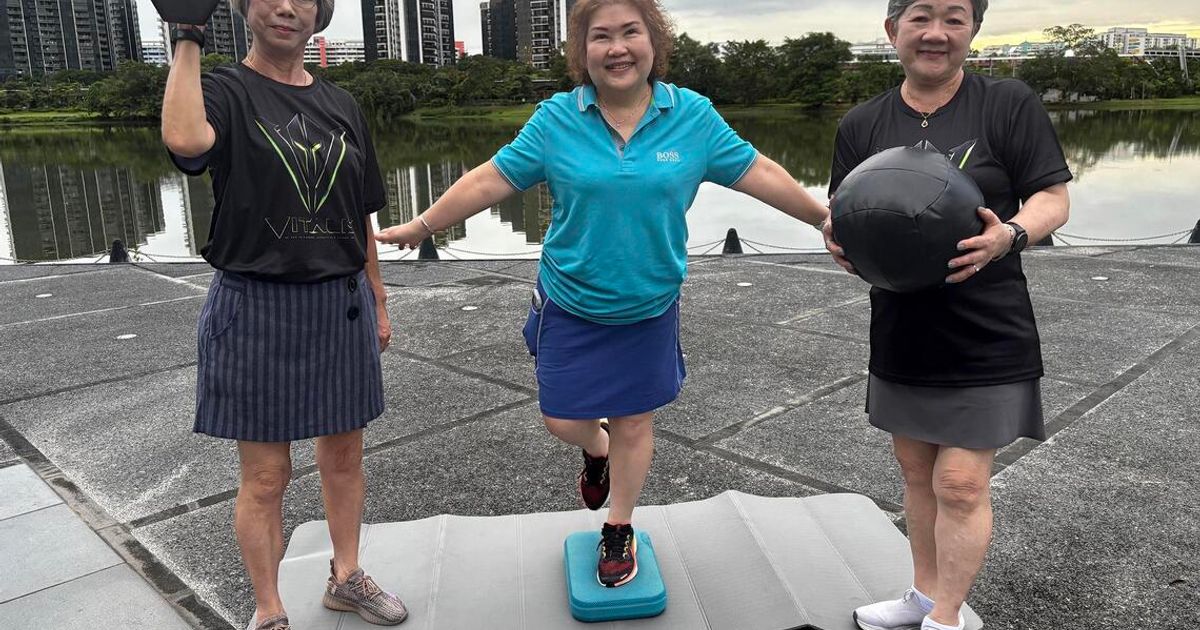
SINGAPORE – Watching a group of seniors going through the paces at different workout stations at the Taman Jurong Community Club piqued the curiosity of 77-year-old Pauline Chew.
“I was not wearing my exercise outfit that day but my friend Cindy (Tay) cajoled me into trying out the different exercises. She said it was fun, so I went home to change,” said Chew, who works at a Japanese bakery.
And she was hooked. There was no turning back for Chew, who ended up becoming the oldest participant at Vitalis, a “Hyrox-reimagined” programme for the 50-somethings and older.
“Unlike Hyrox, which is high intensity, we came up with a version befitting active seniors, pairing functional strength with brain-boosting challenges,” said veteran TV actor Terence Cao.
Vitalis is the brainchild of Cao, 59, and singer and athletic coach Alfred Sim, 45.
They are supported by actor and former Singapore national football team assistant manager Colin Chee, 59, and actor-director Asher Su, 61.
“Vitalis began with a simple belief: that growing older should never mean losing our sense of purpose, belonging or possibility,” Cao said.
Singapore has officially become a super-aged society, with more than 21% of its citizens aged 65 and older.
The average lifespan is 85.4 years while healthy life expectancy or healthspan is 74.1 years. This leaves an average gap of about 10 years spent in less-than-optimal health.
To address this, the Government has taken crucial steps to meet the changing needs of Singapore’s rapidly ageing population and these include shifting healthcare towards preventive care, expanding care beyond hospitals and bringing in new citizens.

Vitalis participant Pauline Chew taking a memory test at one of the stations during training. The test is one of three cognitive challenges in the games.
ST PHOTO: JUDITH TAN
Cao said that as he approaches 60, he does not fear growing old, but leaving regrets behind. He hopes to make the most of his time by doing meaningful work and channelling his passion into charity and health initiatives.
“So we created the games because we want seniors in the community to feel seen, valued and encouraged. Challenges such as loneliness, physical inactivity and declining confidence among the elderly can be overcome through friendships and community,” Cao said.
“Through movement, friendly competition and shared experience, we hope to build more than physical strength. At Vitalis, we want to build the confidence to try, the courage to face challenges and the resilience to start all over again.”
Doctors told The Straits Times that seniors with heart, blood pressure or metabolic issues should consult a doctor before taking part. They should also start with short, five- to 10-minute sessions before building up to the games.
Public health physician and academic Jeremy Lim said: “Exercise is good for all ages. Everyone should be physically active and include exercises that build up stamina, strength and balance. We should do this progressively and avoid ‘zero to hero’ theatrics. For seniors, we advise getting a good physical check-up before strenuous training to ensure suitability and being cautious about injuries.”
Agreeing, GP Dana Elliott Srither, who has more than 20 years of experience, said there should be spotters at each station.
“Risks always increase as age increases, along with the corresponding need for medications such as those for hypertension. Postural hypotension (a sudden drop in blood pressure when you stand up from sitting or lying down), is a common problem among the elderly.
“The exercises are good, but there must be risk management, especially against falls. For the aged, a fall from a stationary position, if not caught before impact, can potentially lead to injuries like a forearm fracture or subdural or intracranial haemorrhages,” he added.
The team spent about four months testing ideas, whittling down dozens of concepts to seven activities that seniors with different fitness levels could safely take part in.
It was Sim, who is trained in athletic coaching, who tried and tested the different forms of exercise to ensure they were safe for seniors to participate in.
“Terence told me I was crazy. When I introduced the exercises to him – burpees, carrying weights, planking and medicine ball tosses – he said it was not possible for the elderly. But we made it happen,” he said, laughing.

Homemaker Cindy Tay practising a 5kg medicine ball throw.
ST PHOTO: JUDITH TAN
The proof was in the pudding at Taman Jurong CC, which was used as the group’s testbed.
The first Vitalis Challenge was held there on Sept 20, drawing more than 400 participants aged 50 and above.
“For some participants, success meant completing a challenge. For others, it meant stepping out of the house, making a new friend or finding the confidence to join in. Every one of these moments matters,” Cao said.
Chew said her success was being able to plank for more than 30 seconds and get up after doing burpees without falling over.
“Before this, I was worried as my knees were weak and painful. Sometimes they even click when I walk, but now no longer,” she added.
Her friend Tay said she had built muscles where she “never thought there were any”.
She joined Vitalis in August and, when she felt stronger from the training, brought accounts executive Ng Mai Lin, 62, along.
The three women hope to sign up for the nationwide competition to be held on Dec 27 at Suntec Singapore.
“There will be six age categories, giving participants at different stages of life the opportunity to show their abilities and sportsmanship,” Cao said.
Registration for the event is open, with a fee of $68 for a team of two participants.
“The amount is nominal as it would be used to cover the rental of the hall space and payment to the company providing the music and deejay only,” Cao said.
He added Sian Chay Medical Institution, a charitable traditional Chinese medicine social service agency, would subsidise or cover the fee for seniors from lower-income groups who would like to join in but could not afford the fee.