
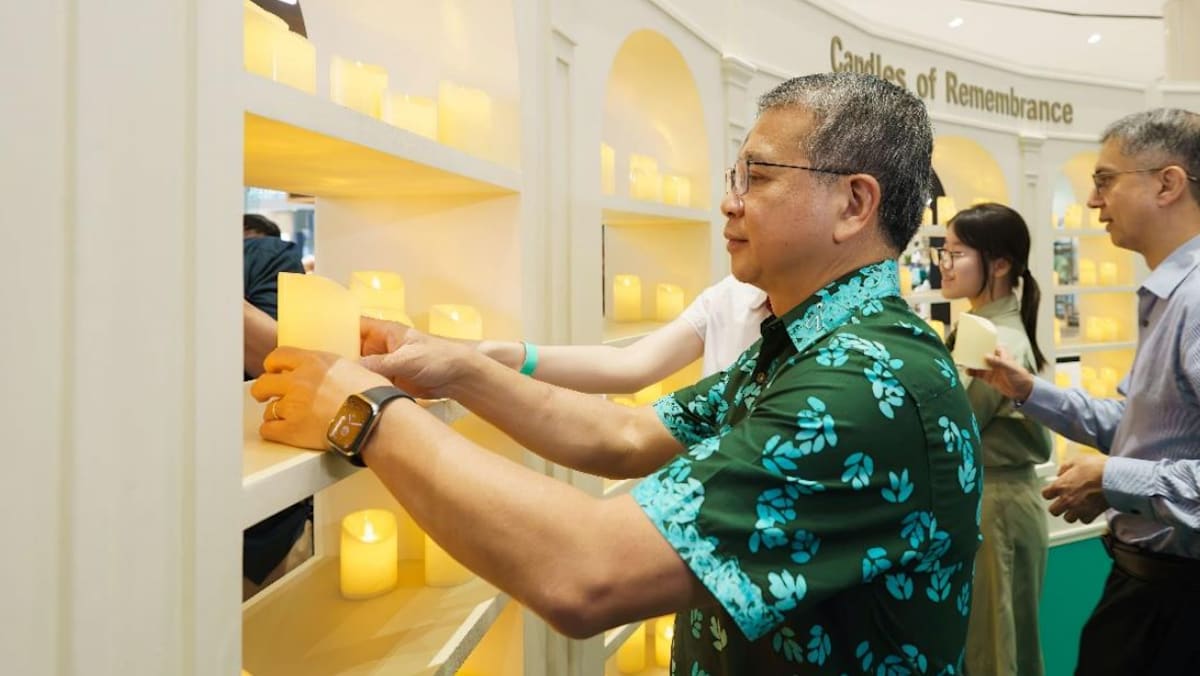
SINGAPORE: First-time drug abusers who voluntarily come forward to the Central Narcotics Bureau (CNB) for help will no longer face detention at the Drug Rehabilitation Centre, said Minister for Law and Second Minister for Home Affairs Edwin Tong on Friday (May 15).
As part of a change to the surrender regime for drug abusers that will take effect on Saturday, all such abusers will be placed on drug supervision in the community with mandatory case management for their rehabilitation.
Under the current surrender regime – in place since 2019 – drug abusers are placed on a “step-down regime” based on CNB’s assessment of their risk levels. This can include being placed only on drug supervision in the community or detention at the Drug Rehabilitation Centre, and all abusers have two surrender opportunities in their lifetime.
Speaking at this year’s Drug Victims Remembrance Day observance ceremony, Mr Tong said the change comes after a review to “encourage more first-time abusers to come forward and seek help with their addiction”.
“Drug abusers who want to wean off their drug addiction and live a drug-free life will be supported with regular counselling sessions in the community,” he added.
The sessions will “involve psychology-based methods such as goal-setting and family engagement, accompanied by regular hair or urine testing by CNB”, said Mr Tong, adding that the conditions of the current surrender regime will continue to apply.
“CONCERNING” DRUG TRENDS IN SINGAPORE
Mr Tong noted in his speech that the global drug situation is “worsening”, with the number of drug abusers worldwide rising 8 per cent to 316 million in 2023, from about 292 million in 2022, according to the World Drug Report 2025.
He added that regionally, methamphetamine seizures in East and Southeast Asia reached a record 236 tonnes in 2024, up 24 per cent from the preceding year, according to the United Nations Office on Drugs and Crime.
Although Singapore’s drug situation remains “stable”, there are “concerning trends” such as increasingly younger drug abusers, as well as a rise in drug-related deaths.
“While the number of drug abusers has remained stable, the number of young abusers has increased. In the last three years, more than half of the new abusers arrested were below 30 years old. And the number of new abusers below 20 increased by 22 per cent between 2024 and 2025. One year,” Mr Tong said.
“Last year, we shared that the youngest abuser ever arrested was 13. This year, the youngest abuser arrested was 12. Each year, we are seeing increasingly younger and younger abusers.”
He added that cannabis, in particular, remains a concern in Singapore.
There were also 68 drug-related deaths in Singapore in 2025, a 15 per cent increase from 59 deaths in 2024, Mr Tong said.
Speaking about regional efforts to curb drug trafficking, Mr Tong said: “As we know, drug trafficking is transnational … The fight against drugs, therefore, cannot be won by any one country alone.
“And in this regard, I am very glad that ASEAN countries have consistently maintained a very strong consensus against drugs and have agreed to Singapore’s proposal to observe an annual ASEAN Drug Victims Remembrance Day.”
The day will be observed on Jun 26, starting this year, alongside the International Day Against Drug Abuse and Illicit Trafficking.