
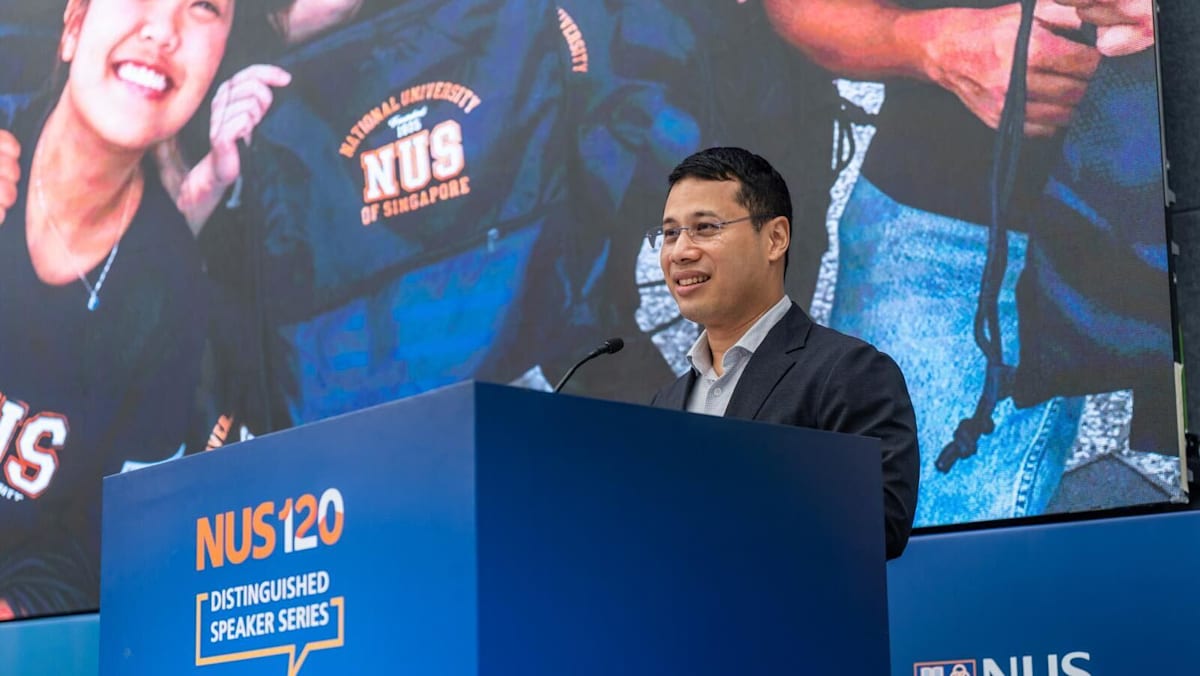
SINGAPORE: From 2027, all students in institutes of higher learning (IHLs) will learn artificial intelligence skills that are tailored to their fields of study, said Education Minister Desmond Lee on Thursday (May 21).
The AI skills taught will be guided by “baseline AI competency frameworks” developed by IHLs.
Speaking at the National University of Singapore’s (NUS) 120 Distinguished Speaker Series, Mr Lee said the frameworks – one for the autonomous universities and the other for polytechnics and the Institute of Technical Education (ITE) – aim to “establish a common baseline across our IHLs, so that every student in Singapore, regardless of which institution they attend, receives a consistent and strong foundation in AI competencies”.
Students from the 2027 academic year will have compulsory modules incorporating those baseline AI competencies, while those already enrolled will have their existing curriculum “enhanced” to build AI skills.
All IHL students, including adults in Continuing Education and Training (CET), will get to develop AI competencies within their discipline as part of their full qualification programmes, said Mr Lee.
The competency frameworks are designed as a “deliberate step-up” from the AI exposure students receive in secondary schools and junior colleges, so that there will be a “coherent as well as cumulative learning journey” all the way into the workforce.
They will aim to help all IHL students develop skills such as:
- Understanding what AI can and cannot do, as well as should and should not do
- Learning with AI in ways that deepen understanding rather than replace thinking
- Using AI to analyse problems, generate insights and come up with better solutions
- Critically evaluating AI, including its ethical, social and legal implications
Citing how students in the Product Design and Innovation module at NUS’ College of Design and Engineering use AI tools to boost productivity, Mr Lee noted that they are still taught the fundamentals, including deep disciplinary knowledge and design judgment.
AI will be increasingly integrated into courses, but pedagogy must continue to guide how it is used, and the technology “should never replace deep, human learning” in schools and IHLs, said Mr Lee.
He pointed out that the “struggle of learning”, such as researching, questioning and grappling, was a fundamental part of education, and that students must continue to experience such struggles – even though “AI can shortcut or short-circuit this process”.
Mr Lee had similarly cautioned against “cognitive offloading” – or letting machines do the thinking – amid students and teachers being encouraged to use AI learning tools in an interview with CNA’s Singapore Tonight programme in March.
The minister added that the IHLs will continue to work closely with industry representatives to understand the evolving needs of the economy and continually adjust their course offerings to better prepare students for the workforce.