
SINGAPORE – Like many of his neighbours, Tampines resident Abdul Razak Subahan is often jolted awake in the middle of the night by loud cars and motorcycles revving their engines along the roads that his flat overlooks.
He said this happens almost every day in the wee hours.
“It can be very painful… When you’re sleeping, it triggers you to wake up. It gives you a shock,” said the software developer, 65, who lives at Block 366 Tampines Street 34.
The sound is jarring, he added. “When you’re sleeping… zoom. It’s as if the world is breaking. That’s really irritating.”
Mr Subahan is among more than 10 Tampines residents who told The Straits Times that
traffic noise from nearby roads has disrupted their daily lives
. Their concerns were raised in Parliament by Tampines GRC MP Charlene Chen in January.
Residents told ST the problem seemed to have worsened after the completion of the TPE flyover towards Changi East in 2023.
While the TPE previously generated some traffic noise, it was still tolerable, they said.
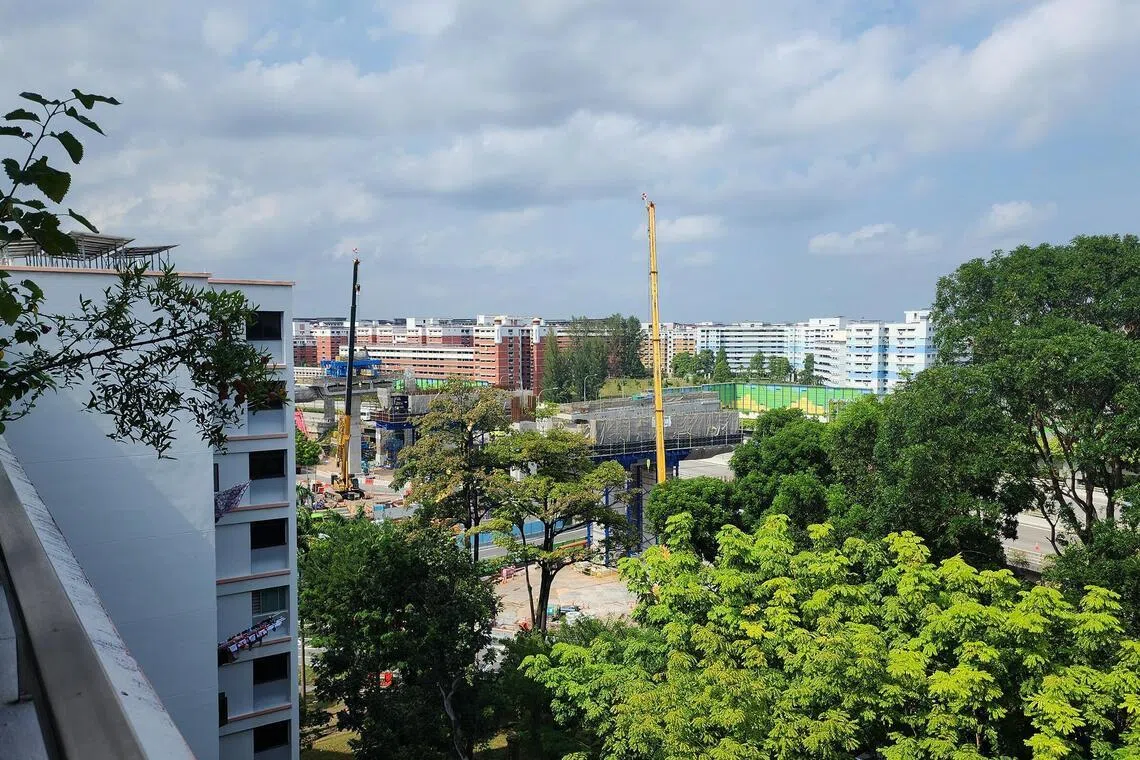
The noise is further aggravated by another flyover under construction near the Loyang Viaduct, as well as a newly built slip road towards Loyang and Tampines Avenue 7, which was opened to motorists in September 2025.
A resident who wanted to be known only as Madam Huang, 72, lives in a unit facing the expressway and shared a similar experience. Even with the windows closed, she said, traffic noise can still be heard at midnight.
The retiree said her husband is particularly affected and is often unable to sleep because of the sounds. The couple have lived in their unit at Block 366 Tampines Street 34 since 2001.
She added that they have little choice but to tolerate the noise as moving elsewhere is not feasible. One of their neighbours, she said, moved out of the area after not being able to cope with the noise.
Another resident, retiree Francis Cheng, 70, said he knows of residents in at least three units who have moved out because of the traffic noise.
Residents fear a “triple whammy” when the Loyang Viaduct is completed in about two years, said Mr Cheng, referring to the two flyovers and the slip road, which they worry will further amplify traffic noise.
All the residents whom ST spoke to said the loudest disturbances occur in the wee hours of the morning.
Raising the issue in Parliament on Jan 13, Dr Chen asked what interim noise mitigation measures are in place near the TPE and Loyang Viaduct construction sites.
She also asked how post-completion noise impact is assessed, and whether additional safeguards would be implemented to protect residents’ sleep and health, and children’s learning environment.
Dr Chen told ST that while construction noise had been an issue, traffic noise has become a growing concern as new roads are completed.
In a follow-up question in Parliament, she said residents had been experiencing significant noise along the TPE late at night and asked whether the Ministry of Transport would consider expediting noise-reducing road surfaces, conducting post-completion monitoring and implementing further mitigation measures if noise levels exceeded what residents could reasonably live with.

Noise complaints are not unique to Tampines. The latest HDB Sample Household Survey, published on Nov 27, 2025, showed that residents islandwide were less satisfied with several aspects of HDB living, including noise levels.
ST PHOTO: LETITIA CHEN
Responding, Minister of State for Transport Baey Yam Keng, who is also an MP for Tampines GRC, said various noise mitigation measures are in place.
Post-construction, permanent noise barriers will be erected along sections of the Loyang Viaduct facing residential blocks, and low-noise pavement mix that better absorbs sound will be used, he said.
Dr Chen said the situation was the worst for blocks facing the TPE flyover, including blocks 366 and 368 in Tampines Street 34.
“Since November, I’ve been receiving feedback on traffic noise from the TPE flyover and nearby slip road in the wee hours of the morning,” she added.
Some parents have also raised concerns about the traffic noise depriving their school-going children of rest and how this could in turn affect their learning, said Dr Chen.
One resident, sales manager Jonathan Wong, 42, described the noise as a “vrooming sound in the wee hours after 2am, especially on weekends”.
His primary school-going children have disturbed sleep as a result, he said, noting that he “forces them to go to school with sleepy eyes”. He described the existing noise mitigation measures as “useless against speeding vehicles” and was worried the situation would worsen once the Loyang Viaduct is completed.
Dr Chen said that since receiving feedback, she has written to the Land Transport Authority (LTA) and the Traffic Police for their help.
Noise complaints are not unique to Tampines. The latest
HDB Sample Household Survey, published on Nov 27, 2025,
showed that residents islandwide were less satisfied with several aspects of HDB living, including noise levels.
Satisfaction with noise levels slipped to 74 per cent, down from 75.7 per cent in 2018. HDB said the main reasons for the dissatisfaction were disturbances from neighbours and noise from the external environment, such as traffic.
Dr Chen said there were concerns that traffic noise would increase as more roads are built in the area.
“For residents at Block 366, they still hear some piling noise during the day,” she said. “But what affects them most now is the motorbike noise from roads very near their block, including the TPE and the slip road that was just built.”
In an overnight enforcement operation involving LTA, the National Environment Agency and the Traffic Police on Jan 16, several motorbikes were found to be emitting loud noises, said Dr Chen.
“I know residents are very frustrated, and we totally empathise with them,” she said. “Enforcement alone can only catch those emitting noise. The bigger question is how we deter this upstream – and that’s something we need to continue working on.”