
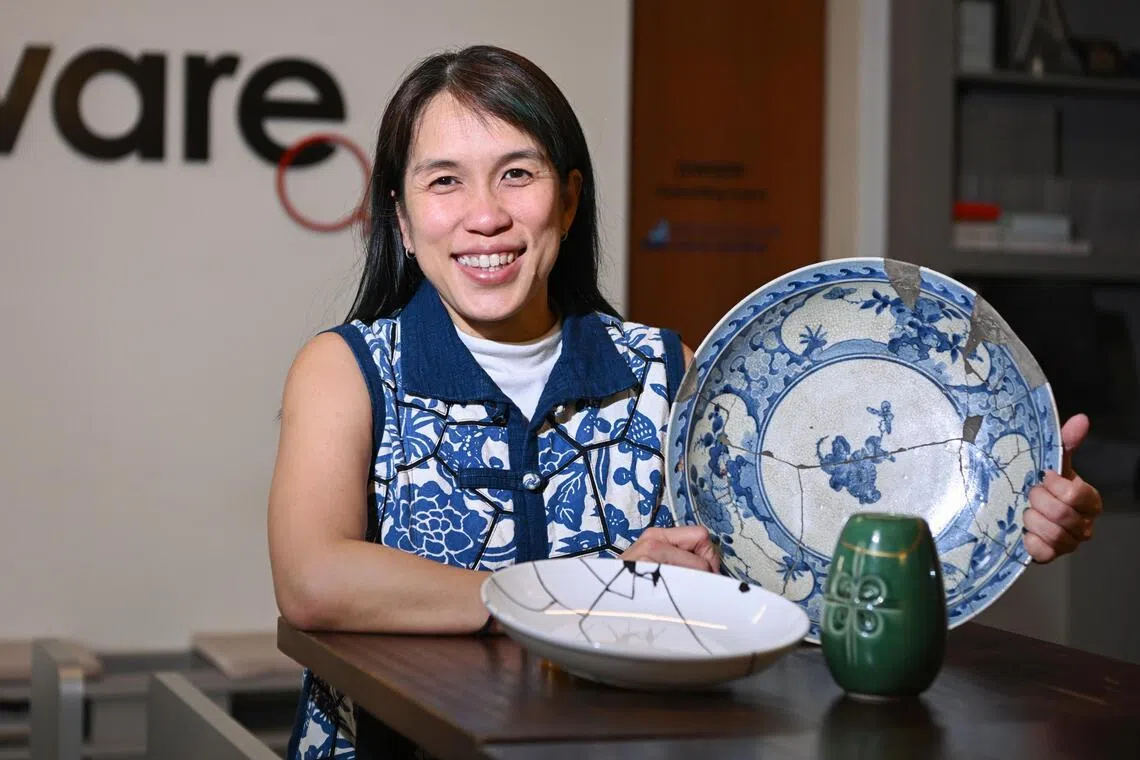
On Ms Lim Shoon Yin, a title feels less like a medal than a backpack: practical, weighty and carried without fuss.
When she became executive director of Singapore women’s rights group Aware on Jan 1, she did not come by the usual activist path of community organising, lobbying and years of committee-room battles. Instead, the former DEI (diversity, equity and inclusion) professional arrived from petrol stations, boardrooms, factory floors and diversity workshops.
What the 51-year-old brought with her was more than corporate experience at multinational organisations such as Shell, Microsoft and Russell Reynolds Associates. She brought an instinct for how systems work, an eye for what others miss, and a habit of asking a simple question: who is missing from the picture?
That instinct was formed long before the acronym of DEI became a corporate buzzword or entered the mainstream.
It began in childhood. Her parents’ marriage broke up when Ms Lim was 10, and her mother, a government scholar who had worked at the Ministry of National Development before joining her husband’s architectural practice, became the family’s anchor.
What followed was a tough stretch of rented homes, long working days and after-school hours spent waiting in offices. The eldest of three children, she learnt early that adulthood was something to shoulder, not something to wait for.
“One important KPI was: don’t let the teachers call my mum.”
Just as important, she says, was finding ways to become independent and financially self-sufficient. Scholarships, holiday jobs, anything that could help, she would take on. The school swimmer and track athlete spent breaks doing whatever work came her way, from wrapping gifts at Raffles City to carrying out administrative duties at DBS Securities.
An alumna of CHIJ Toa Payoh and National Junior College, she won scholarships whenever she could, and eventually secured one from Shell that took her to the National University of Singapore.
She had first set her sights on chemical engineering, the STEM (science, technology, engineering and mathematics) path many bright girls were nudged towards in those days. But when her A-level results arrived, she decided to switch to business administration. They were, she says, “not disastrous… but not what I would want to build engineering on”.
Shell not only agreed but kept the scholarship terms.
“It told me they saw something beyond the grades. And it gave me permission to trust my own instincts about fit,” says Ms Lim, who graduated with first-class honours in 1998.
Her first years in Shell offered the kind of humility no leadership course can teach. As part of her early training, she spent time in petrol stations: pumping fuel, manning the cash register, washing cars and learning the business from the ground up.
“For the taxi uncles, I was this young woman at the pump. They’d ask: ‘Xiao mei (little sister), what are you doing here?’ But it was the best way to learn the business.”
The only woman in the operations team then, she says the experience never quite left her. It taught her that any leader worth listening to must first understand the people on the front line.
“They’re the reason you earn a salary in the corporate head office. But they’re often overlooked and not well supported,” says Ms Lim, adding that it later shaped her approach to DEI.
Even after she moved into more strategic roles – operations, marketing communications, transformation and business planning – in different organisations, she insisted on going to factory and shop floors before designing programmes.
At Swiss fragrance giant Givaudan, for instance, she requested time on the production line, donning safety gear to mix ingredients side by side with technicians. It was how she noticed that the job was designed in a way that excluded most women, and also caused injury to men.
“There were 20kg and 30kg containers, which only the men were handling, and a few 1kg and 5kg ones they gave me,” she says. “I told them: ‘I’m a rescue diver and as part of my certification, I had to pull a grown man out of the water. I can lift 20kg, 30kg. But more importantly, look at all your guys – back braces, elbow braces, wrist braces.’”

Ms Lim (far left) with friends on a dive trip in Pulau Weh, Indonesia, in 2018.
PHOTO: LIM SHOON YIN
Her suggestion for a fix was simple: redesign the containers to 10kg and refill them more often.
“By being inclusive for women, we can actually make it better for the men,” she says.
Ms Lim’s entry into formal diversity work came in 2008, when she became Shell’s second Asia-Pacific diversity manager. Back then, the field was still new enough for people to assume a “diversity manager” belonged somewhere in finance, mistaking diversity for diversification and acquisition.
She joined a small informal network of about eight diversity heads from mostly US multinationals – banks, technology and professional services firms – trying to figure out how to apply American diversity agendas in Asian cultures where LGBT issues were sensitive and disability was poorly understood.
In those rooms, she was often the only Asian.
“I remember saying: ‘Look, if we’re talking about Asia, what I say should matter a bit more than what you all say, right?’” she recalls with a grin. “We were friends but there was always that dynamic of Western frameworks being thundered down.”
She helped set up the oil company’s first nursing room and co-founded its women’s network in Singapore. After nearly 15 years at Shell, she moved to tech giant Microsoft in 2013, where she held senior diversity and inclusion roles across Asia and globally. This was followed by stints at Givaudan and global leadership consultant Russell Reynolds Associates.
Over more than 25 years, she became adept at speaking the language of business and the language of conscience.
If her professional life moved steadily upwards, her personal life was marked by a long, grinding detour through the Family Courts.
The mother of four daughters, aged 15 to 24, does not dwell on the details of her divorce, beyond saying that it was painful and often deeply frustrating. There were counselling sessions that felt repetitive and processes that shifted without a clear explanation.
She grew especially angry at how much harder the system was for people with fewer resources, especially transnational spouses. She met many of them during post-divorce counselling, and saw how powerless they often felt, struggling to adjust to life in Singapore while grappling with immigration and residency hurdles.
“I had a car, job, education, I could speak up for myself,” she says.

Ms Lim, with a shaved head, at Hair for Hope, with her four daughters in 2012. The charity event was organised by the Children’s Cancer Foundation
PHOTO: LIM SHOON YIN
Friends began sending other women in similar situations to her for advice. Through them, she saw just how little ordinary people understood of the system, and how lonely the journey could be.
“I was very clear I didn’t want to turn my personal case into a crusade,” she says. “My work just cannot revolve around my own agenda. But I also knew this is not something I can just walk away from and forget.”
So she made herself a quiet promise that she would come back to it one day.
Ms Lim was not in the thick of Aware’s most famous episode in 2009, when a conservative Christian group tried to take over the women’s group. But the then mother of three followed the saga closely, disturbed by what she saw as a wave of religiously framed attacks on Aware and the work it stood for.
In her view, the episode left Aware carrying a heavier load. It was no longer seen merely as a gender equality group but as a standard-bearer for what advocacy itself could look like in Singapore.
A year later, she invited the outfit’s then newly appointed executive director, Ms Corinna Lim, to speak at Shell as part of a corporate network of companies exploring gender equality. They kept in touch sporadically over the years, swopping updates at events, e-mailing ideas and talking about potential collaborations.
Certain conversations kept recurring: transnational families, better support for women going through divorce, and more recently, a different kind of healing: kintsugi.
After leaving Russell Reynolds in 2024, Ms Lim took what she calls a “micro-retirement” to step away from corporate life and catch her breath. She headed to Japan to learn kintsugi, the Japanese art of repairing broken pottery with gold lacquer. It appealed to her as an act of mending and a metaphor for healing.
She told Corinna she wanted, on her return, to volunteer with Aware to explore a divorce support group that might weave in elements of kintsugi. The latter’s response changed the course of her life.
“She said: ‘You’ve stepped off the hamster wheel. You clearly don’t mind a serious pay cut. Why don’t you apply for the job?’,” Ms Lim recalls, laughing.
In late 2025, Aware announced that its long-serving leader would step down after 16 years at the helm, and that Ms Lim would take over from Jan 1.
The appointment raised some eyebrows in feminist circles. She was not a long-time volunteer or board member, and to some, seemed to be arriving from the outside. Even so, few questioned the depth of experience she brought, or how closely it matched the organisation’s mission.
Aware, for its part, pointed to her more than 25 years of DEI work in the private sector, and to a career spent tackling systemic barriers, advancing women into leadership and helping build safer, fairer workplaces.
Ms Lim, who went through the full selection process, including preparing proposals for how she would lead the organisation, did not decide to apply lightly. The 2009 saga still casts a shadow for some, and she knew that the leadership of Aware comes with scrutiny from all sides.
She discussed it at length with her mother, who was not comfortable with Aware’s reputation as “messy and noisy”.
She also sat her daughters down for a frank conversation, asking if they had what it took to cope with being teased in school or online for having the “Aware auntie” as their mother.
Some friends, too, cited discomfort with the group’s perceived association with LGBT issues and its more activist image.

Ms Lim (fourth from left) at a Pink Dot event with Microsoft colleagues in 2016.
PHOTO: LIM SHOON YIN
“I’m not going to force them,” she says. “I just hope that over time, they might change their minds if they see a different way of doing things.”
In the end, what persuaded her was something quieter than ideology: responsibility. It would be a pity, she says, if the work were left without the right person to carry it forward.
“I don’t know when my children, or my friends, or their children might need Aware. But I know it needs to be there. It would be a real pity if the organisation wasn’t in a good place to help.”
Just four months in the job, she is careful not to sound as if she has all the answers. Still, some priorities are already clear in her mind.
First, masculinity. In 2024, Aware floated the idea of a major study on masculinity at its annual ball and found strong interest from both men and women. Ms Lim intends to see that through.
“If you don’t talk about masculinity, you can’t really move on women’s issues,” she says. “You can’t liberate women from limiting norms without also liberating men from theirs.”
She points to persistent expectations that men must be breadwinners, saviours, stoic and dominant, norms that clash with the realities of modern life and leave many men struggling in silence.
“We tell fathers to be equal caregivers but when they want to pick up their kids from childcare, they run into bosses who ask why their wives can’t do it,” she notes. “We need to talk about that.”
Second, transnational families, especially in the context of Singapore’s low fertility rate and reliance on immigration.
“We haven’t really had a holistic conversation about what transnational families face, whether they stay together or break up,” she says. “Having been through it myself, I know how badly the system can work for those with less power.”
Third, women’s health and bodily autonomy, from reproductive rights and contraception to the way clinical research is designed. She points out that many medical studies have historically been conducted on male subjects, with women treated as simply “smaller men”, leading to gaps in understanding of how drugs and conditions affect women differently.
“When we push for more inclusive research, it’s not just for women. It’s for everyone whose bodies have been treated as an afterthought.”
Alongside longstanding Aware concerns are newer threats such as AI-driven deepfakes and tech-facilitated sexual violence.
In a recent op-ed that attracted attention online, Ms Lim described herself as a “cautious and angry feminist”.
The phrase sparked discussion and plenty of comment.
“I know some people went straight to images of women ripping off shirts and burning bras,” she says dryly. “But you can be angry without being destructive.”
Her anger, she explains, is directed at systems, unjust laws, biased structures and blind spots rather than at individuals or at men as a group.
The work ahead, as she sees it, is unglamorous and slow: conversations, research, public education, support services, policy submissions and listening, especially to those who disagree.
“My worry is that people think we’ve done enough, and that anything more is discrimination against men,” she says. “We need to help people see the whole picture and have better conversations.”