
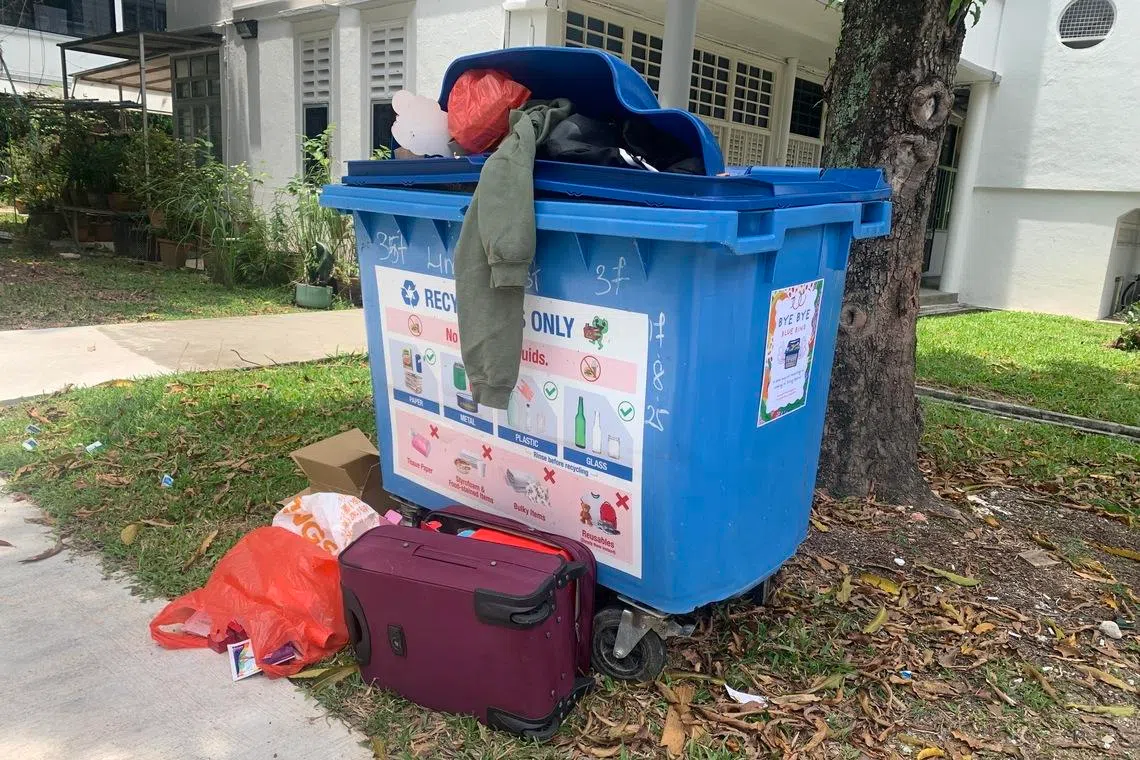
SINGAPORE – With Singapore’s domestic recycling rate falling to an all-time low and contamination remaining a persistent issue for recyclables, residents in one housing estate are taking matters into their own hands.
Driven by a desire for a cleaner neighbourhood, residents of Tiong Bahru’s Seng Poh estate are launching an experiment from April 11 to temporarily remove blue recycling bins for close to three months.
Instead, people in the neighbourhood can deposit their recyclables during community drives to be held twice a month at Tiong Bahru Community Centre.
Architect Kelvin Wang, who is helping to coordinate the initiative titled Love Tiong Bahru, said the residents had been “disturbed enough” by the deterioration of their living environment to take action.
The contamination rate for blue recycling bins has remained at about 40 per cent since 2017.
“For those who say it’s a terrible idea, I am sure they don’t mean to say that they are happy with the current unsightly and uncivilised situation where recycling efforts are undone,” Mr Wang said.
“Why not try something different and see what we can improve from there to make every recycling effort count?”
He believes this is possibly the first time residents in Singapore have asked the authorities to take away their public recycling bins.
While the idea may seem novel in Singapore, a centralised recycling system mirrors practices in other places such as Japan, Taiwan and Thailand, he said.
“We are a heritage neighbourhood meant to represent Singapore’s history and culture,” he said.
“We cannot have an environment that is so messy and unhygienic, depending only on our already hard-working town council cleaners to keep picking up after litterbugs.”
Another resident, Mr Alvin Yeo, who has lived in Tiong Bahru all his life, said the situation has worsened since the introduction of the blue bins, which have become rubbish bins for passers-by, businesses and residents.
The realtor, who is in his 50s, recalled: “We used to have targeted doorstep collection on fixed days at the start, and that was very good for all involved.
“Residents who took part – and there were many – carefully sorted out, cleaned and packed their recyclables every two weeks for collection.”
Mr Foo Cexiang, the area’s MP, told The Straits Times that a group of residents – represented by the residents’ network chairman – had approached him in mid-2025 to highlight the misuse of recycling bins in the estate and request a different approach.
Impressed by the residents’ initiative, he put them in touch with the National Environment Agency (NEA) to get its support.
In the following months, NEA, Tanjong Pagar Town Council, the estate’s recycling operator Cora Environment and the residents worked together to develop the pilot, according to a March 24 Facebook post by Mr Foo.
They also went around the neighbourhood to canvass support.
“The aim is simple – to see if a more hands-on approach helps residents sort recyclables more effectively and reduces contamination,” said Mr Foo, who plans to attend the first of the recycling drives. “None of us is sure if it will work, nor do we have all the answers at this point.”
He acknowledged that the removal of the recycling bins could discourage some from recycling due to the inconvenience involved.
But more people could also be encouraged to recycle since there is greater visibility and assurance through the community recycling drives, he added.
“If we don’t do anything, nothing will change. So I decided, let’s try it out, and we will tweak along the way,” Mr Foo said.
To date, no resident has contacted him to object to the initiative.
Part of the exercise will also involve monitoring the adequacy of green rubbish bins and whether they are filled more rapidly upon the removal of the blue bins, Mr Foo said.
At the end of the exercise, the team will look at the recycling rates and resident feedback to gauge its effectiveness, he added.
Currently, 16 residents are helping out in the initiative, said Mr Wang, many of whom decided to take action as they were upset by the sight of blue bins overflowing with rubbish.
Among them is Ms Ann Gan, a missionary who was recently based in Japan, where she was impressed by recycling habits shaped by a combination of hefty fines for improper waste disposal, a well-integrated waste management system and community norms.
“Recycling as much as possible and loving nature are part of Japanese daily life,” said the decades-long resident in her 50s.
Realtor Michelle Tan joined the initiative as she felt the unsightly and unhygienic environment was setting a bad example for the next generation.
“As a mother of a young child, I want my child to grow up in a community that demonstrates proper care for the only planet that we have – through proper care of the neighbourhood he lives in,” she said.
According to Mr Wang, the affected blue bins are those that serve pre-war and post-war Singapore Improvement Trust flats in Tiong Bahru Road, Tiong Poh Road, Seng Poh Road, Eng Hoon Street, Eng Watt Street, Chay Yan Street, Yong Siak Street, Moh Guan Terrace and Lim Liak Street.
The pilot will end on June 27.
ST has contacted NEA and Cora Environment for comment.