
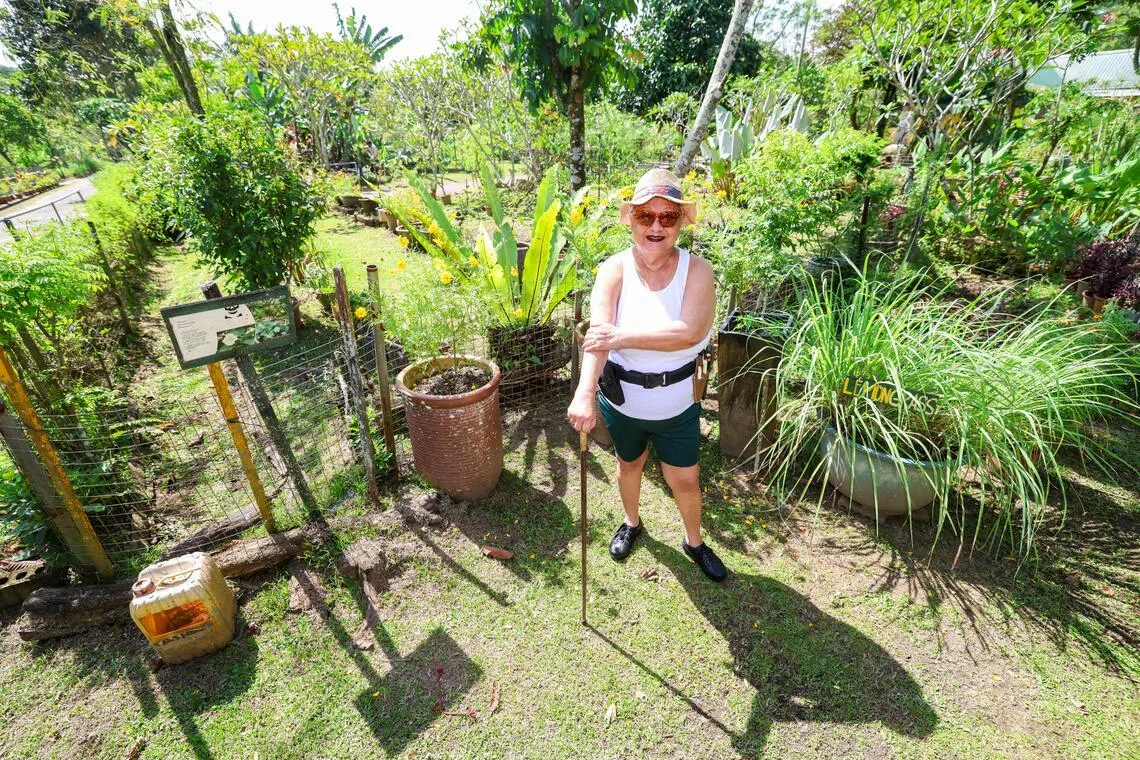
SINGAPORE – Bollywood Farms’ future is up in the air as the two-decade-old farm faces the prospect of having to close its Neo Tiew Road space when its tenancy expires at the end of 2026.
The farm, started by Mrs Ivy Singh-Lim and her husband, Mr Lim Ho Seng, was originally known as Bollywood Veggies, and had a 20-year lease that began in April 2001. Two short-term tenancies were granted beyond that, with the latest extension set to expire on Dec 31, 2026.
The 4ha farm has been a fixture in tours to the Kranji and Lim Chu Kang area over the past two decades, giving visitors a glimpse of traditional farming techniques and a chance to buy the farm’s produce.
An eatery at the farm named Poison Ivy Bistro is also popular, with its dishes prepared using ingredients grown on site.
Ms Lynn Ee, a general manager at Bollywood Farms, said the company has appealed to the Singapore Land Authority (SLA) – its landlord – for a further extension beyond 2026.
The company had on April 8 posted on Instagram about an online petition that called for signatories to back its appeal for a longer stay.
Responding to queries from The Straits Times on April 18, the Singapore Food Agency (SFA) – which oversees the country’s agri-food sector – and SLA said that Bollywood Farms had been informed in 2020 that its original lease would not be renewed.
“Following the lease expiry in 2021, at Bollywood Farms’ request, the Government granted Bollywood Farms short-term tenancy extensions on a goodwill basis to facilitate its transition,” said the two agencies in a joint reply.
SFA and SLA said requests for extension are “considered carefully on a case-by-case basis, taking into account factors such as land use plans, operational considerations, and the lessee’s transition plans”.
“In this case, the extensions granted were only to facilitate the farm’s transition,” they added.
Mrs Singh-Lim, 77, who has lived on the farm with her husband since 2002, said she hopes for a further extension of about three years, which will allow her to operate the farm until she retires at 80.
She said she is open to supporting staff who want to take over the business after that.
“The business does not make money but we contribute a lot to society,” she said, adding that the farm works with special education schools and that it costs about $40,000 to run the business monthly, including paying her employees good salaries and ferrying them to and from the farm.
“Children come and they get a very different learning experience from when they visit a park,” she added.
“There, they cannot pluck anything, but how are they going to learn if they cannot touch? Here they can touch this, touch that, and they can even do paddy planting.”
Mrs Singh-Lim added that the experience of visiting a countryside farm is very different from that of a park or a high-rise vertical farm, and that Singapore stands to lose such an experience if Bollywood Farms is closed down.
Mr Yap Kok Cheng, vice-president of the Kranji Countryside Association, said there are few areas in Singapore that offer a suburban experience and “something different” for people to visit on the weekends, adding that there has been a gradual reduction of businesses that combine agriculture and education over the years.
For instance, several other farms and businesses in the area that were open to the public, such as Jurong Frog Farm and Green Circle Eco Farm, have vacated their sites in the past five years, after lease extensions were not granted by the authorities because of redevelopment plans.
Even as the authorities work on plans to make Lim Chu Kang a food production hub for Singapore, said Mr Yap, food productivity should not be the only goal for the area.
“Some of these farms that offer agro-tourism experiences are well-maintained and well-known,” he said. “If there is no urgency for redevelopment, they should be allowed to continue.”
In 2020, SFA said about 390ha of land in Lim Chu Kang – including Bollywood Farms’ site – will come under a masterplan to create a “high-tech, highly productive and resource-efficient agri-food cluster”, but it was later reported in 2024 that developmental work for the masterplan, which was to begin that year, was delayed.
SFA and SLA said in the joint reply to ST that agri-land must be used “productively and sustainably”, with less than 1 per cent of Singapore’s land designated for agricultural production.
They added that SFA regularly launches sites for tender under the Singapore Agri‑Space Sales Programme, and farmers who wish to continue in the trade after their tenancies or leases expire can take part in these tenders.