
SINGAPORE – At $154.7 billion, Budget 2026 is the largest budget in Singapore’s history.
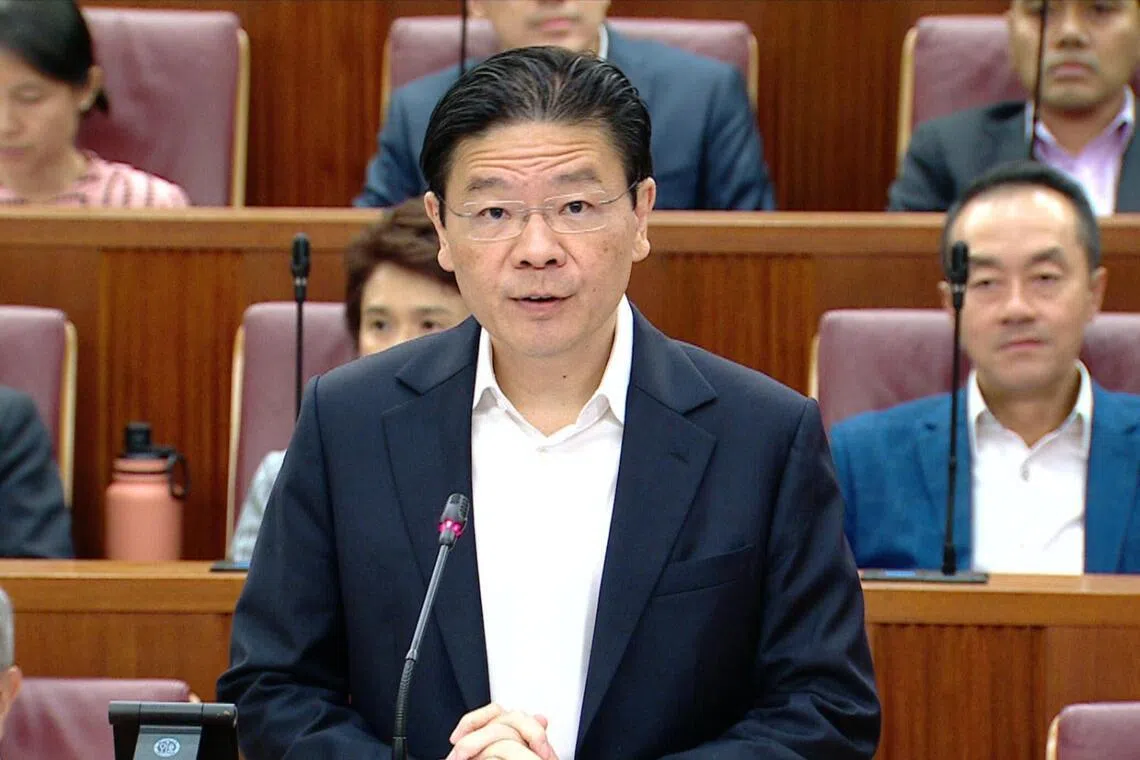
Prime Minister and Finance Minister Lawrence Wong said when wrapping up the Budget debate in Parliament on Feb 26 that it is larger than the combined total of the five budgets rolled out in 2020 to help the country fight the Covid-19 pandemic.
But this year’s spending plan is not just about the numbers. Against the background of global uncertainty, it is also an action plan to help Singapore progress in a profoundly changed world.
In his Budget statement on Feb 12, PM Wong warned about increased geopolitical tensions worldwide, which are testing the resilience of the global system severely.
He also spoke about the huge changes wrought by technology, noting that artificial intelligence was advancing at a remarkable speed and would bring both opportunities and challenges, as with previous technological waves.
There was immense potential to raise productivity, unlock new discoveries and transform lives, but also worry among workers that AI will displace jobs and worsen problems like misinformation, he said.
In such a world, standing still is not an option, he said.
“We cannot wait for conditions to turn more favourable. Nor can we fall back on strategies designed for a previous era,” he said.
“We therefore have a full agenda in this term of Government to refresh our strategies and strengthen our social compact. Budget 2026 is the first step in this effort, to secure our future in a changed world.”
The warnings proved prescient, as the global situation worsened shortly after the Budget statement was delivered.
On Feb 20, the US Supreme Court struck down US President Donald Trump’s Liberation Day tariffs – wide-ranging import levies – which, though a blow to him, triggered a fresh round of economic uncertainty.
Just over a week later, the United States and Israel attacked Iran, sparking yet another conflict that has since escalated into a regional war, even as war and violence continue apace in Ukraine and Gaza.
Iran retaliated with missile and drone strikes against US interests and allies in the Middle East, and shut down the Strait of Hormuz, a critical shipping route through which about a fifth of global crude oil passes.
With energy flows severely disrupted, oil prices have surged by some 50 per cent to more than US$100 a barrel.
Analysts have said a prolonged war could tip the global economy into a downturn.
For a small and open economy like Singapore, the knock-on effects will be felt keenly. Already, the supply crunch in oil and liquefied natural gas has begun to affect the daily costs of living for Singaporeans and businesses.
But beyond the economic consequences, the developments also mean a further weakening of the multilateral system and international laws, which could embolden countries to pursue unilateral action, making the world more fragmented and dangerous.
Budget 2026 addresses both the population’s immediate needs and the long-term challenges of a more contested world.
To help households manage cost pressures, a Cost-of-Living Special Payment of $200 to $400 in cash was announced in the Budget for Singaporeans earning up to $100,000 in assessable income with no more than one property.
All Singaporean households also received $500 in CDC Vouchers, while eligible families living in Housing Board flats will also get additional U-Save rebates of up to $570 this financial year, to help with their utility bills.

For businesses, a corporate income tax rebate of 40 per cent was announced for the 2026 year of assessment, capped at $30,000.
These near-term measures make up about 5 per cent of the overall budget.
About 95 per cent is dedicated to longer-term and structural initiatives that will lay the foundation for the future as Singapore moves into its next phase of development after 60 years of independence.

Job seekers at the launch of an initiative to address job security concerns surrounding AI disruption during the NTUC Career Festival at Sands Expo and Convention Centre on Feb 13, 2026.
PHOTO: ST FILE
The push to harness artificial intelligence for strategic advantage and position Singapore as a leader in this area is one such measure to strengthen the country’s ability to compete amid the shifts in global trade.
PM Wong said Singapore will have to chart its own path and not just follow what others are doing.
“Our advantage does not lie in building the largest frontier models. It lies in deploying AI effectively, responsibly, and at speed,” he added.
A new National AI Council, which PM Wong will chair, will drive this AI agenda and accelerate the adoption of the technology by businesses and workers.
For a start, it will oversee a set of National AI Missions that will drive transformation in four key sectors of the economy, including advanced manufacturing, connectivity, finance and healthcare.
A new Champions of AI Programme will support firms looking to transform their businesses through the use of AI, for instance, to overhaul operations or train workers, by providing help that is tailored to each company.
This is part of the broader effort to help businesses prepare for the future as the economy transforms.
With deliberate and disciplined investment, AI can also help Singapore overcome structural challenges such as its limited natural resources and ageing workforce.
Besides harnessing AI to future-proof the economy, the Budget provides $37 billion under the Research, Innovation and Enterprise 2030 plan to help Singapore establish leadership in frontier areas.
By anchoring cutting-edge investments in Singapore, the Republic can become a place where frontier technologies are developed, tested and commercialised. This gives Singapore a role in shaping how these industries develop, said PM Wong.
Companies in various stages of growth, from start-ups to those working towards a public listing, will also have more funding and support.
For instance, the Startup SG Equity scheme, under which the Government provides seed capital to stimulate private funding for promising start-ups, will be boosted with $1 billion and expanded to cover not just early-stage but also growth-stage companies.
More is also being done to help companies venture farther afield. Grant schemes that help companies to internationalise will boost support, with up to 70 per cent for small and medium-sized enterprises and 50 per cent for other companies.
Along with these changes are initiatives to help level up the workforce, including several to strengthen AI literacy and fluency among workers.
The TechSkills Accelerator, a tripartite training initiative aimed at the infocommunications and technology workforce, will be expanded to non-technology occupations to help workers build practical AI capabilities.
Complimentary access to premium AI tools will also be provided for participants of selected SkillsFuture AI courses for six months.
To better help workers proactively plan for their careers in an era of rapid technological change and frequent career transitions, SkillsFuture Singapore and Workforce Singapore were merged into a new statutory board.
The new entity will serve as a one-stop shop for skills training, career guidance, and job matching services.
Even as Singapore pursues economic transformation and growth, another major priority in the Budget is to make sure that the growth will be inclusive.
Several initiatives were announced to support lower-wage workers and narrow the wage gap to keep social mobility alive.
While Singapore does not have a minimum wage, the local qualifying salary – the minimum that local employees must be paid in firms that hire foreign workers – will be raised from the current $1,600 to $1,800.
This effectively raises the wage floor for Singaporean workers in firms that hire foreign workers.
Enhancements to the Progressive Wage Credit Scheme, which co-funds wage increases for lower-wage Singaporeans, will also see lower-wage workers get higher increments.
To qualify for the co-funding, companies will have to raise their workers’ wages by at least $200, up from the current $100.
To help businesses defray the costs of paying the higher wages, the Government is also raising co-funding for the scheme from 20 per cent to 30 per cent for this year. In addition, the scheme will be extended for two more years until 2028.

Budget 2026 initiated a marriage and parenthood reset, backed by $7 billion in funding for initiatives designed to create the right conditions for young couples to confidently start families.
PHOTO: ST FILE
With Singapore’s total fertility rate dropping to a historic low of 0.87, Singapore faces an existential demographic challenge compounded by a rapidly ageing population.
To mitigate this trend and ensure a sustainable future, the Budget initiated a marriage and parenthood reset, backed by $7 billion in funding for initiatives designed to create the right conditions for young couples to confidently start families.
Among the key concerns of young couples is the cost of raising children. To help defray day-to-day household expenses, families will receive $500 in Child LifeSG Credits for every Singaporean child aged 12 and below, PM Wong announced.
Measures were also announced to keep early childhood education and after-school care affordable.
The monthly household income threshold to qualify for pre-school subsidies will be raised to $15,000, which is expected to benefit more than 60,000 families.
The income threshold to qualify for Student Care Fee Assistance will also be raised to $6,500.

PM Wong, acknowledging that it would be tough to reverse the declining birth rate, said: “But we will not stop here. We have not given up. We will not give up.”
At a time when societies worldwide are becoming more divided and polarised, the Budget also sets aside $50 million for the SG Partnerships Fund to support ground-up initiatives that benefit the community.
PM Wong said the move was part of Singapore’s investment in strengthening the ties that bind Singaporeans together. The sense of togetherness has carried the country through uncertainty, and Singapore will continue to thrive if people look out for each other and put the common good first, he added.
Noting that Budget 2026 builds on Singapore’s strengths of a strong economy, a cohesive society and sound public finances, PM Wong said when wrapping up the Budget debate: “It is a collective commitment – that we will do what it takes to thrive in a more demanding world; that we will stand together when pressures mount; and that we will continue pushing forward to seize new opportunities on the horizon.
“The world may be more uncertain. But we are prepared. We are united.”
The primers cover a wide range of subjects, such as the business of sport, how nations manage the evolving nature of crime and adaptation strategies for climate change. Each primer includes a local perspective to help students draw links to the issues’ implications for Singapore. The primer articles are part of The Straits Times-Ministry of Education News Outreach Programme, which aims to promote an understanding of local and global issues among pre-university students.