
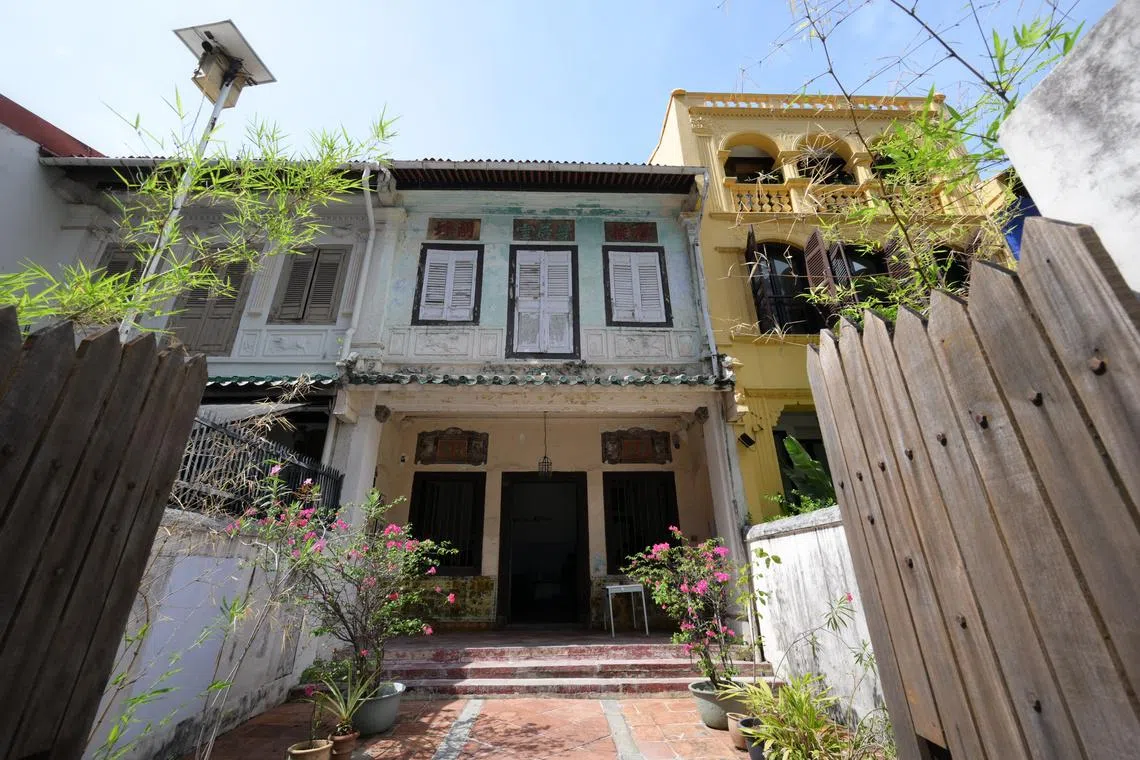
SINGAPORE – A decades-old townhouse in Neil Road is set to become the first conserved building in Singapore to be energy self-sufficient in end-2027, after repair and upgrading works on the building are completed.
Its occupant, the National University of Singapore’s (NUS) Architectural Conservation Laboratory (ArClab), aims for it to be the first historical building to be retrofitted to achieve net-zero operational energy.
This would show the way for other buildings of a similar vintage to achieve similar energy efficiencies, said Dr Nikhil Joshi, principal investigator at the research and training centre within the university’s architecture department.
The townhouse at 141 Neil Road is among more than 7,200 buildings in Singapore that have been conserved thus far. Of these, about 6,500 are shophouses, which have similar characteristics to the townhouse in Neil Road, which was built in the 1880s.
As at February, the Building and Construction Authority has certified 13 buildings in Singapore as “net zero” under its Green Mark scheme, which means the buildings consume as much electricity as they produce. The scheme assesses buildings’ performance, including their energy efficiency, among other factors.
None of the 13 buildings are conserved.
ArClab was officially opened in November 2022. Since then, researchers have learnt about the building’s conditions, such as air flow, temperature, humidity and solar radiation, and studied how to repair the building in a manner that retains as much of its original character as possible.
Outcomes from research will guide the repair and upgrading project when it begins in May, said NUS in a statement.
One example of research applications will be the building’s new roof tiles.
Dr Joshi previously told The Straits Times that sensors placed on the building’s existing V-shaped roof tiles had recorded temperatures of up to 58 deg C, which he said suggests that the tiles are absorbing sunlight and not reflecting enough heat.
In collaboration with partners in Japan, ArClab will be developing new roof tiles for the property inspired by handmade V-shaped tiles that were likely used on the building originally.
The new tiles will have a degree of porosity, allowing some rainwater to be trapped in them.
Mr Gabriel Choon, a conservation specialist at construction firm Bautec Pacific, which is one of ArClab’s collaborators, said the idea is for heat to be released over time as the tiles dry, thus helping to cool the building.
To make the building easier to maintain in the longer term, said NUS, a digital twin of the building will be developed, adding that traditional lime-based repairs will be carried out on the building’s walls.
Strategies implemented at ArCLab “are designed to influence how future restoration projects can balance conservation principles with climate resilience and net-zero ambitions”, said NUS.
To this end, said Dr Joshi, the university is working with the National Heritage Board and the Urban Redevelopment Authority (URA) to develop more guidance documents that will help raise the standards of heritage conservation in Singapore.
One area being looked into is the deployment of solar panels on the roofs of conserved shophouses.
URA has granted ArClab more leeway in the installation of solar panels to test if the centre can achieve the net-zero target it has set for the building.
Conserved buildings similar to 141 Neil Road are typically allowed to have solar panels cover only up to 30 per cent of the rear slope of the main pitched roof and secondary pitched roofs.
Dr Joshi said that almost all of the townhouse’s secondary pitched roof, as well as a rear flat roof, will be covered with solar panels.

In collaboration with partners in Japan, ArClab will be developing new roof tiles for the property inspired by handmade V-shaped tiles that were likely used on the building originally.
ST PHOTO: NG SOR LUAN
He added that the building – which will be fully solar-powered – will generate about 13MWh (megawatt hour) of energy per year, which is more than the centre’s estimated operational energy consumption of 12.4MWh/year, based on planned operations.
The centre’s annual consumption over the past three years has been about 1.3MWh.
Asked if the work to be done on the townhouse can be easily replicated in other shophouses, he said: “It is very easy for anyone – whether it is a government agency looking after a national monument or a homeowner living in a historic building – to replicate what we have done here, trying to use materials and techniques which are slightly lost, and using some modern technology.”