
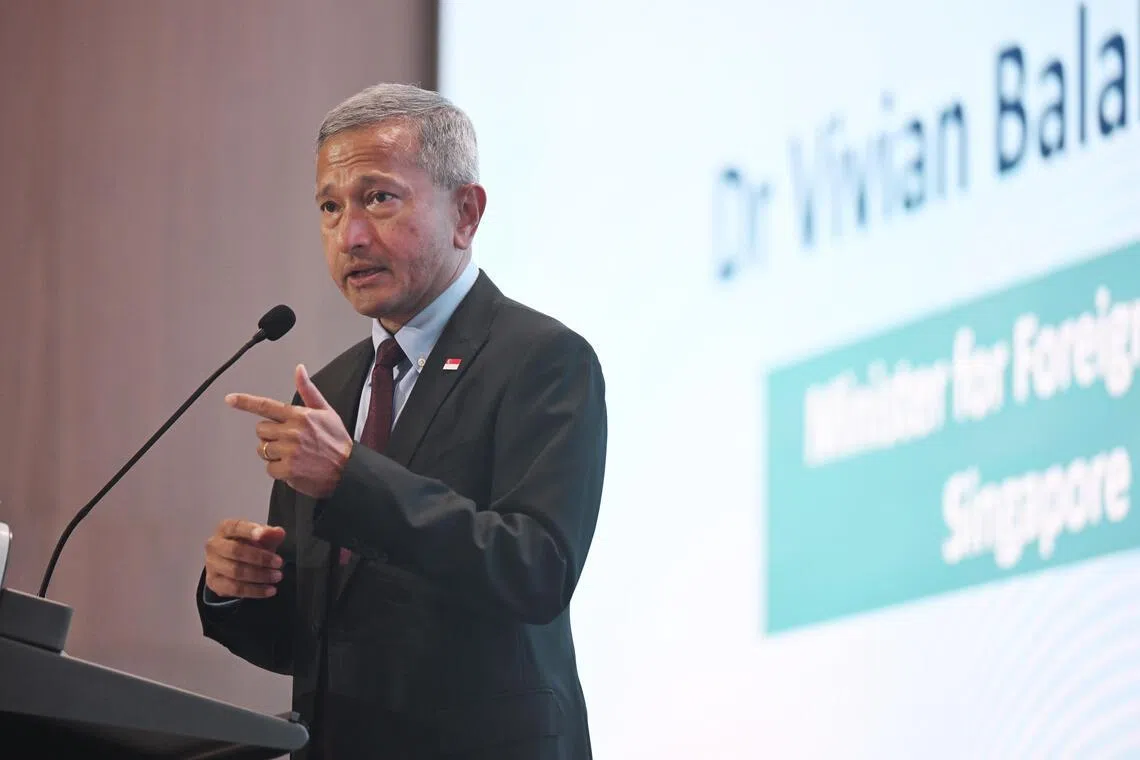
SINGAPORE – Domestic political discontent has led many nations to repudiate globalisation, turn inwards and weaponise interdependence, said Foreign Minister Vivian Balakrishnan.
Speaking at the opening of the Asia-Pacific Programme for Senior National Security Officers on April 21, he noted that technological advancements in areas such as artificial intelligence (AI) and digital technologies have further exacerbated these developments.
In such a climate, governments have to go beyond the traditional focus on conventional defence to ensure national security, and must also manage risks across multiple domains, he said.
This involves building resilience across internal, external and institutional fronts, he added.
Dr Balakrishnan was speaking to more than 70 national security officials, experts and scholars from 21 countries at the conference, which runs until 24 April at the Paradox Hotel in Clarke Quay. The event is organised annually by the Centre of Excellence for National Security at the S. Rajaratnam School of International Studies (RSIS).
Work in national security will only expand, as the Covid-19 pandemic has shown, he said.
“We have to avoid getting caught in a vicious cycle. We have to take the concept of national security in a far broader sense, work across silos, understand politics, economics, technology, defence in the broader sense of the word,” he said.
Navigating threats from multiple domains also requires breaking down institutional silos, and governments must foster closer coordination across different departments, he said.
He said the current war in Iran has made it very clear that security challenges go beyond the military and political domains, laying bare “the fragility of the global economy and our reliance on choke points”.
The conflict, now in its eighth week, led to the closure of the Strait of Hormuz – a vital global shipping route for oil, liquified natural gas and fertiliser, among other goods – and a global energy and supply chain crisis.
The resulting economic shocks will last long after the key phase of the conflict is over, Dr Balakrishnan said, putting pressure on some countries already under strain and further threatening domestic social cohesion.
“The point is that you see a vicious cycle because these global reverberations, in fact, will lead to further fissures in domestic cohesion and the resilience of our societies… If we are unable to put in circuit breakers, this vicious cycle will accelerate,” he said.
To guard against this, countries will need to build resilience internally by addressing domestic discontent, social security, education, jobs and inequality, he said.
In multiracial and multireligious Singapore, this requires carefully and actively managing diversity so that it remains a strength, he added.
This means stepping up integration efforts for new immigrants, creating meaningful opportunities for citizens to solve common problems, and for immigrants to build understanding and trust with local communities.
In Singapore, these efforts are not left to the “invisible hand” of free-market forces, given how foreign actors can exploit fault lines to shift public opinion and put governments under pressure, he said.
He noted that many global developments have the potential to stir up emotions and strain social cohesion, leading to polarisation in societies, radicalisation and terror attacks.
“All of us are just one incident away from a crisis. We need to strengthen our people’s awareness of and resolve to deal with such threats,” he said.
Appropriate legislation is also needed to counter foreign interference and respond in real time to hostile foreign information campaigns, he said.
At the same time, leaders must help people understand the government’s foreign policy positions and explain why certain views advocated by foreign actors are not in line with national interest, he noted.
“There is a balance to be struck here because we need to manage these sensitivities carefully, but we must also guard against a descent into nativism and isolationism,” he said.
Singapore cannot afford to cut itself off from the world at a time when its national interests demand the opposite, he added.
Dr Balakrishnan noted that the global zeitgeist has become increasingly inward-looking. As countries pursue narrow national interests at the expense of global rules and cooperation, a “market failure in diplomacy” could result, he warned.
What could happen is not just a thinner social safety net in international affairs, but countries laying “tripwires” could inadvertently worsen conflicts, he said.
“You think you are actually setting this tripwire to act as a deterrent against your neighbour or whoever your protagonist is, but actually, these tripwires eventually end up tripping yourself and locking you into a course of action which you may not want.”
This ultimately worsens the situation for everyone, added Dr Balakrishnan, warning of parallels to the period just before World War I.
At that time, shortly before the turn of the century, countries could have taken up options for a negotiated solution, but did not do so because of such “tripwires”, he said.
He warned that the situation could be worse now, with the potential for conflicts in the oceans, in the air, in outer space and even in cyberspace.
These geopolitical tensions are also being turbocharged by rapid advancements in technology, with the internet amplifying toxic tribalism and social media companies designing platforms that maximise revenue through inciting anger and outrage.
Amid this, a lack of trust has stopped countries from coming together to establish guardrails for emerging technologies, such as AI, which can now launch cyberattacks and are already being used in autonomous lethal weapons.
“And, so, we are going to be in this danger zone for many years to come,” he said.
He called on nations to build resilience externally by continuing to support international cooperation, so as to promote an open, rules-based and interoperable system that will create strategic space.
Since geopolitical fragmentation will not result in a world conveniently divided into self-sufficient autarchic regions, countries must also balance self-reliance with interdependence, and work with like-minded partners to build trust, he said.
To this end, Singapore has upgraded relations with Australia, France, India, New Zealand and Vietnam over the past two years, established new strategic partnerships with South Korea and Japan, and expanded its footprint in Africa and Latin America, among other things. It is also working on mutually beneficial projects with Malaysia and Indonesia.
At multilateral forums, Singapore also continues to build consensus whenever possible, he said. For instance, Singapore had recently delivered a joint statement at the UN General Assembly on keeping sea lanes open, secure and accessible on behalf of Fiji, Jamaica, Malta and Singapore, countries that played a founding role in the conclusion of the United Nations Convention on the Law of the Sea.
“We need to share a common understanding that interdependence, interconnectivity, and making a wider zone of collective investment and free trade, are in our respective national security interests,” he said.
“This calls for cool, rational heads to prevail in the hurly-burly of politics and elections, who take a longer and wider view of our national interests.”
Earlier in the session, Ambassador Ong Keng Yong, executive deputy chairman of RSIS, said states are increasingly faced with a range of challenges in national resilience arising from geopolitical contestation, the weaponisation of interdependencies and extreme climate change, among others.
He added that “the key challenge faced by all states, including Singapore, is developing a deeper understanding of such risks and threats, and how to mitigate them collectively with like-minded countries”.