
SINGAPORE – Illegal modifications and unauthorised repairs remain longstanding safety concerns for electric vehicles (EVs).
And though these modifications pose risks to internal combustion engine (ICE) vehicles as well, repercussions could be more serious for EVs.
This was raised by BYD Singapore managing director James Ng.
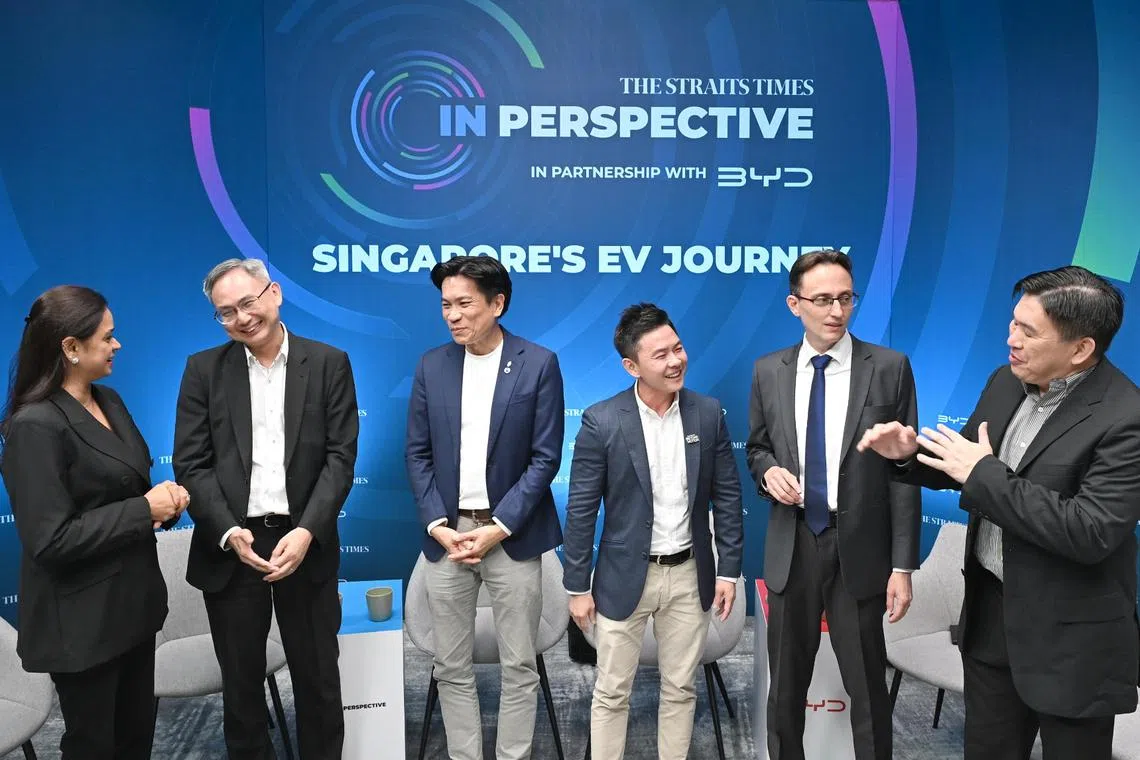
Mr Ng, who is also the managing director of BYD Philippines, spoke at a roundtable organised by The Straits Times on March 27.
He added that BYD has to be “very careful” to warn its customers to not engage an unauthorised party for modifications after they buy a BYD car.
And for EVs that get into accidents, unauthorised repairs could lead to safety risks as they could increase the possibility of the vehicle catching fire, said Mr Ng.
This is a concern because EV fires can burn more intensely and for longer periods than ICE vehicle fires, with a risk of reignition.
Mr Ng said clearer rules are needed to authorise workshops that can undertake repairs on EVs involved in accidents.
Other panellists at the In Perspective roundtable also flagged risks arising from EV fires, as well as methods to tackle them through compliance with charging standards and training of first responders.
Mr Lam Wee Shann, deputy chief executive of technology at the Land Transport Authority (LTA), said the agency pays a lot of attention to ensuring that chargers comply with national standards.
As of April 1, the standard for EV charging has been upgraded to pave the way for the safe operation and adoption of new technologies, including wireless charging, as well as battery charge and swop stations.
There are also new requirements for direct current EV chargers – which provide fast charging – such as stricter temperature controls, enhanced checks on cable insulation and a more precise power output.
Mr Lam said LTA is working closely with the Singapore Civil Defence Force to study the protocols for handling EV fires.
Through the National EV Specialist Safety programme, first responders and workshop technicians are trained to deal with EVs, he added.
In March, a new standardised and structured skills pathway for EV technical specialists was launched, benefiting more than 2,000 existing and new specialists for a start.
This will chart the progression road map for a career in EV maintenance, including the training available from institutes of higher learning, the Singapore Bus Academy and NTUC LearningHub.
Mr Lam noted that special equipment such as fire blankets and gloves will also be provided to these first responders.
EV fires can release large amounts of heat, toxic gases and chemical fumes that may pose serious risks to firefighters. First responders may also run into electrocution hazards when water comes into contact with complex electrical systems in EVs.
Describing this process as “constant work”, Mr Lam said LTA will stay ahead of new EV and battery technologies to make sure that safety is “not compromised at all”.
He noted that there are some 200 ICE vehicle fires every year, and “very, very few” EV fires, with an even smaller proportion of them having involved high-voltage fires.
Of the four EV fires in Singapore in 2025, only two involved high-voltage batteries. The other two were caused by an electrical component on the dashboard, and the rear compactor of an EV waste collection truck.
-
In Perspective is a research-led content programme by SPH Media that combines insight-driven storytelling with expert perspectives on key issues shaping society.