
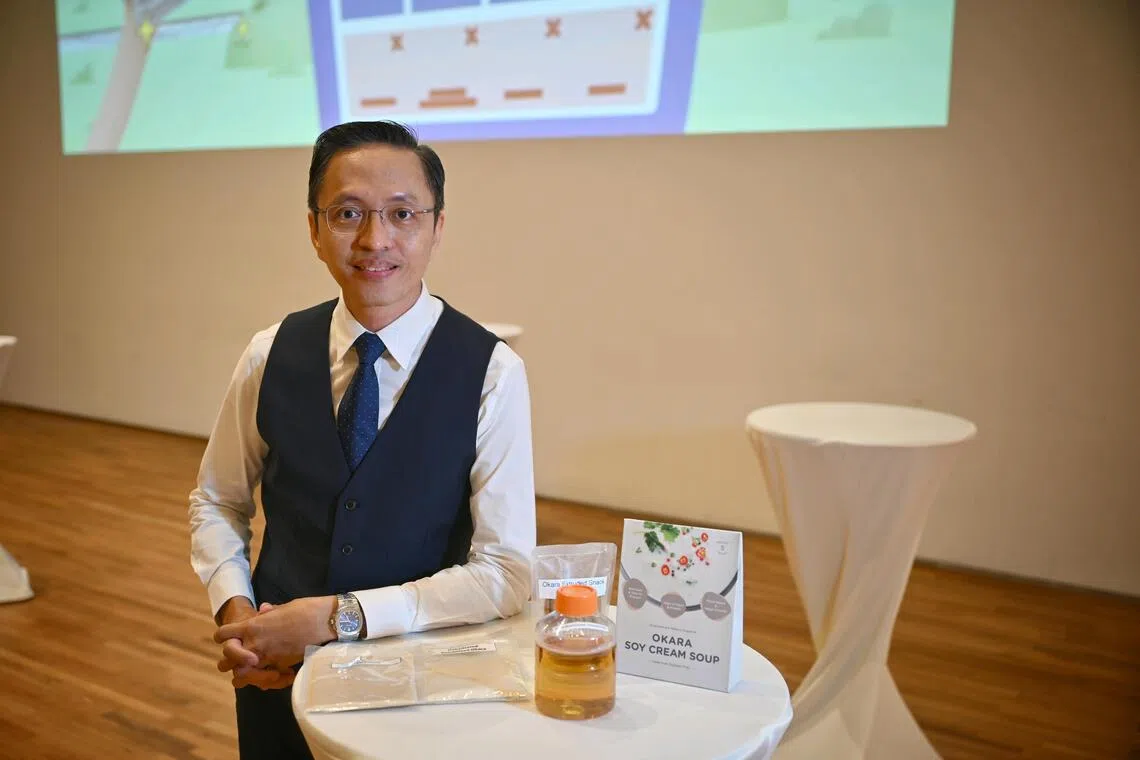
SINGAPORE – To squeeze value out of leftover soya pulp that would otherwise go to waste, food scientist Heng Kiang Soon developed ways to turn it into ingredients for human food and agricultural use, among other products.
The pulp, called okara, which is generated after producing soya milk and tofu, is rich in protein and fibre, but it is indigestible by humans and often discarded.
Determined to maximise “every resource we already have” in a resource-scarce country like Singapore, Heng developed a technology to make the ingredient soluble and turn it into 14 food and agricultural products like soya cheese, soya cream soup and plant boosters. The plant boosters, which are known as biostimulants, can enhance crop yield and quality.
Some of these products have been licensed for commercialisation, said the specialist in food innovation and lecturer at Republic Polytechnic’s School of Applied Science.
On Aug 18, Heng was among 14 people presented with the EcoFriend Awards, which recognise individuals from the private and public sectors, educational institutions, grassroots and NGOs for their significant contributions to making Singapore more sustainable.
He estimated that the production of plant boosters as well as soya cheese, instead of using commercial raw materials, could have substantial cost savings.
Converting by-products like this into useful products is not only environmentally friendly, but it can also help to generate new business opportunities and build stronger food system resilience, said Heng, who grew up on a farm in Malaysia.
“If we learn to see waste not as something to throw away but as a resource with untapped potential, we can unlock solutions that benefit both society and the environment,” added the 50-year-old, who is also looking to recycle other food waste like spent coffee grounds and fruit pulp.
Organised by the National Environment Agency, the 17th edition of the biennial EcoFriend Awards was held at National Gallery Singapore.
Minister for Sustainability and the Environment Grace Fu, who gave out the awards, said: “Their initiatives have strengthened community networks, encouraged resourcefulness and galvanised action to keep our shared spaces clean, green and resilient.”
A total of 510 individuals were nominated for the award, said Fu, with nominations exceeding 500 for the first time in more than a decade. She noted that this points to a sustained and growing interest in environmental sustainability.
In her speech, she also mentioned Arunraj Chidambaram, who leads a weekly food rescue initiative in Zhenghua in Bukit Panjang, saving and redistributing 100kg to 200kg of surplus produce each week.

Arunraj Chidambaram leads a weekly food rescue initiative in Zhenghua in Bukit Panjang, saving and redistributing 100kg to 200kg of surplus produce each week.
ST PHOTO: ARIFFIN JAMAR
Since launching the initiative in 2022, his project has grown from eight to 10 volunteers serving fewer than 60 residents to a weekly operation supported by 20 to 30 volunteers that now reaches over 150 residents each session.
Arunraj, who is the chairman of the Zhenghua Youth Network, said he finds it most rewarding when volunteers get others to join the initiative.
“There are bigger environmental problems to be solved. Exposure to activities like food rescue or litter-picking is a gateway for youth to open their minds and start thinking about solutions to other problems with their creative ways,” said the 31-year-old.

Boston Pek and some schoolmates from Westwood Primary School designed a robot vacuum cleaner using recycled and repurposed materials.
ST PHOTO: ARIFFIN JAMAR
The youngest award recipient in 2026 is 13-year-old Boston Pek. He and some schoolmates from Westwood Primary School designed a robot vacuum cleaner using repurposed materials, including recycled plastic, to help the school’s cleaners.
The remote-control-operated vacuum cleaner picks up small items like crumpled paper.
“I wanted to make this so that it can ease (the cleaners’) workload while helping to keep the environment clean,” said Boston, who is now studying at Juying Secondary School.
Another award recipient is Dazhong Primary School teacher Ong Xuan Wan, who created an experiential learning platform to spark her pupils’ curiosity about science and sustainability.
The platform features eco-trails and Pokemon-inspired mascots that guide pupils through hands-on learning to find out more about the fauna and flora in the school, as well as how to recycle, among other topics.
“Our environment belongs to the next generation. It is their belief and actions that will decide the future of Singapore and how well we care for our environment,” said the 39-year-old.
“I want to plant a seed in every pupil so that it will remind them of the impact of their action or inaction when they grow up.”