
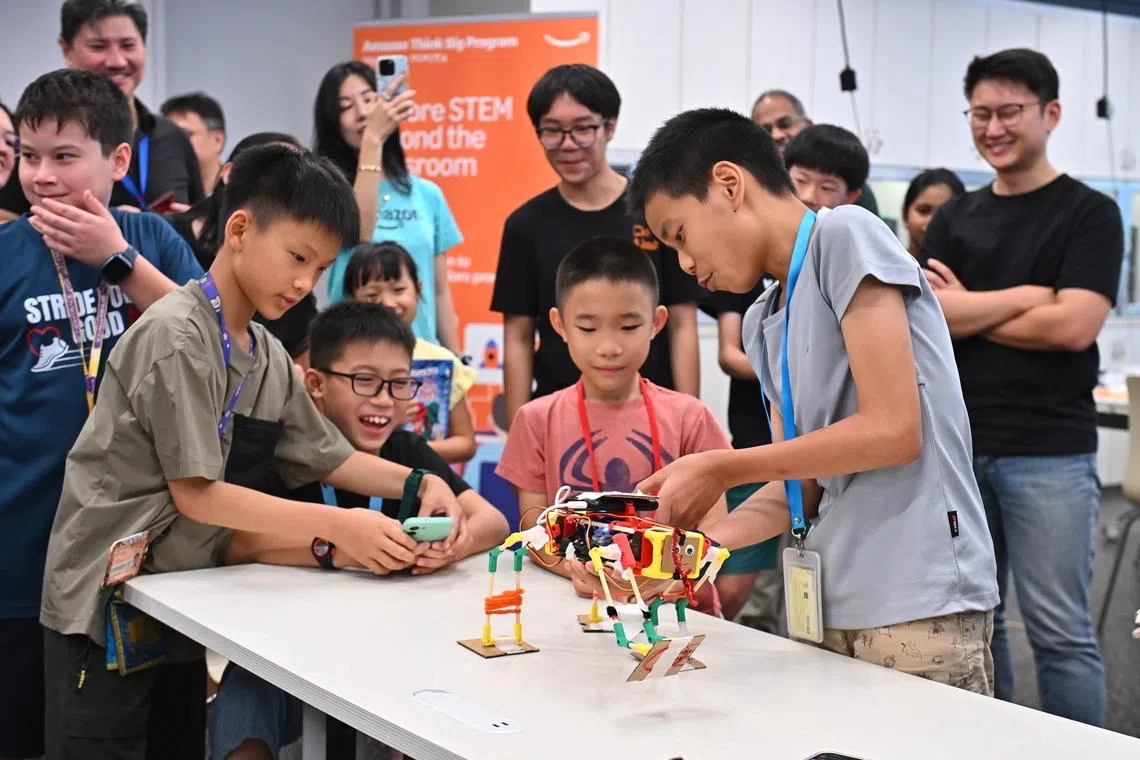
SINGAPORE – About 1,200 students, including those from underserved communities, will get a chance to delve into science, technology, economics and mathematics (STEM) under a new initiative focused on topics like artificial intelligence and robotics.
The Amazon Think Big Program is a global initiative to equip students with practical technical skills in a creative learning environment through 60 free workshops for students aged nine to 16.
These free workshops will focus on AI, cloud computing, coding and robotics. They also give students the chance to interact with Amazon engineers and learn more about careers in technology.
The workshops will be held at Punggol Regional Library till June, before moving to Jurong Library from July to December 2026. There will be four sessions each month per library, and students can sign up on the National Library Board’s (NLB) website.
Of the 1,200 spots available for students, 20 per cent of places will be set aside for students from Suncare SG, Chinese Development Assistance Council, Eurasian Association, Singapore, Self Help Group Student Care, Mendaki, and the Singapore Indian Development Association, to help broaden access for underserved groups.

These workshops will be held at Punggol Regional Library till June, before moving to Jurong Library from July to December 2026.
PHOTO: AMAZON WEB SERVICES
An additional 240 students will be engaged through the South East Community Development Council.
This programme, established by Amazon in partnership with NLB and social enterprise Vivita Singapore, aims to provide a place beyond the classroom for students to explore and cultivate interests in STEM-related careers.
In the coding workshops, students will learn computational thinking by building games, websites, and interactive programmes. For example, in a previous workshop, students coded their own “Flappy bird” type game, by learning about the mechanics behind the original game, and analysing the game loop and high-score system.
Participants programmed the two core functions, gravity and the “flap” user input, to create a complete, playable game in one session – picking up skills like game mechanics analysis, computational logic, variables for scoring and problem-solving through debugging in the process.
The robotics sessions will see students construct working gadgets and robots, while AI workshops, will touch on machine learning, large language models and how to use the technology responsibly. Students in cloud computing sessions will learn about data centres and how they support the applications that they use.
Each session will be facilitated by Vivita instructors and Amazon volunteers.
At the initiative’s official launch at Punggol Regional Library on April 18, Senior Minister of State for Education Janil Puthucheary said what excited him about programmes like these is “what happens when individuals realise they can build the future they want to see”.
“When a student assembles a robot, they’re not learning a skill in isolation,” Dr Janil said. “They’re discovering that technology isn’t something that happens to them, it’s something they can shape, command and use to solve problems that matter to them.”
Ms Elsie Tan, country manager for AWS’ Worldwide Public Sector Singapore, said she hopes the programme will spark curiosity and inspire innovation among young learners, helping them build confidence, creativity and foundational digital skills like coding, robotics and AI.
“Technology learning should be accessible,” she said. “We want students to see technology not just as something they consume but as something they can create and shape actively.”
For Seraphina Jerunisha, 11, from children and youth charity Suncare, she learnt a lot from the workshops, which were extra enjoyable as she could make new friends outside of school or tuition.

Seraphina Jerunisha, 11, from children and youth charity Suncare, said she learnt a lot from hands-on experiences at the workshops.
PHOTO: AMAZON WEB SERVICES
While the hands-on learning and active participation required was “more tiring”, it was ultimately “more exciting and interesting”, she said.
Science was once a subject that was confusing to her, she said. “But once I came here, I started to understand better.”