
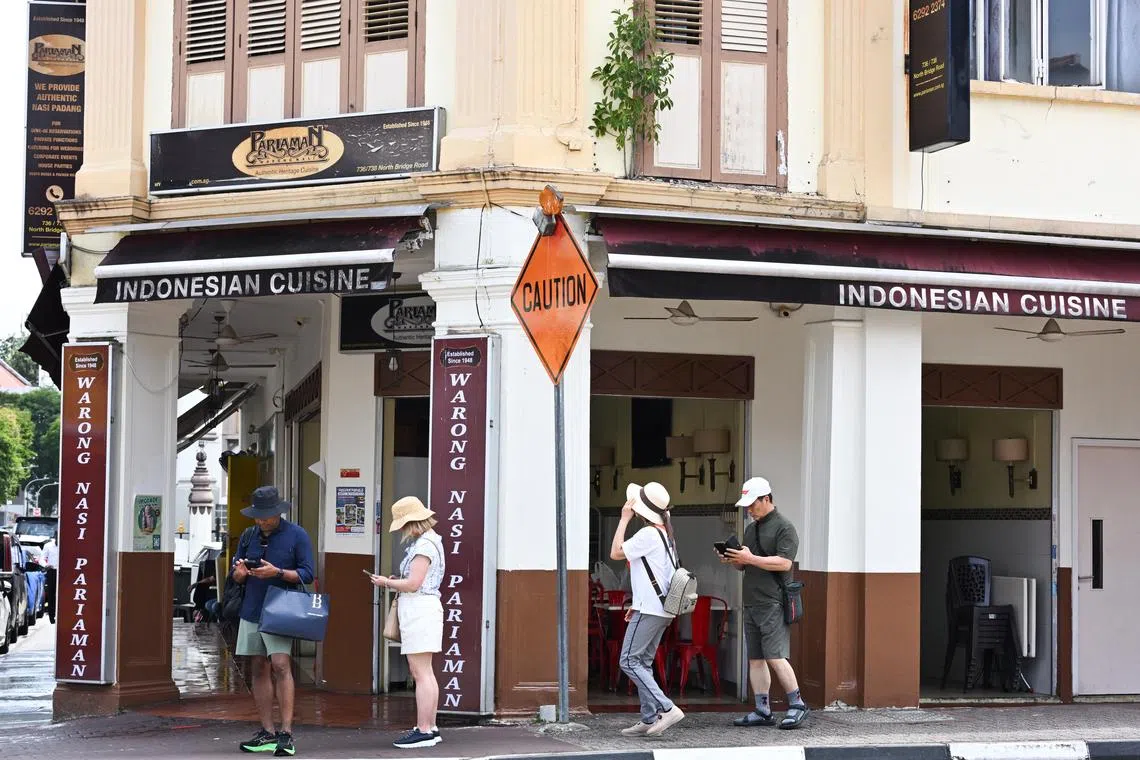
SINGAPORE – The Government has engaged the family which operates the
popular nasi padang eatery Warong Nasi Pariaman
to explore options to render greater assistance.
The Urban Redevelopment Authority (URA) said this on Jan 31, the day
the eatery will close after 78 years.
It is located in a shophouse at 738 North Bridge Road near the Sultan Mosque and its owners had said on Jan 21 that it would close permanently.
URA said its statement was in response to media queries on the challenges faced by heritage businesses.
It said median rents of shophouses in historic districts Kampong Glam, Little India and Chinatown have generally increased at a moderate pace over the past two years.
It cited these figures: around 2 per cent a year in Kampong Glam, roughly 2.5 per cent a year in Little India, and around 1 per cent a year in Chinatown.
These increases were comparable with rental increases of conventional retail space in the Central Area – which is around 2 per cent a year – and significantly below nominal Gross Domestic Product growth, which is around 6.7 per cent a year over the same period, URA said.
It added: “The Government recognises that heritage businesses, like all businesses, face a confluence of commercial challenges such as rising costs of labour and materials, manpower constraints and shifts in consumer demand and preferences – while trying to maintain the unique attributes of their offerings.”
It also recognises the importance of heritage businesses in contributing to the identity and character of Singapore’s historic districts, and that the operating environment for these businesses has become more challenging over time, it added.
There are various measures in place to support heritage businesses, URA said.
These include an
inter-agency task force
for heritage business, traditional activities and cultural life formed in 2025 and chaired by Acting Minister-in-charge of Muslim Affairs Faishal Ibrahim and Senior Minister of State for Culture, Community and Youth Low Yen Ling.
The taskforce brings key agencies together to study ways to support heritage businesses.
It also works closely with local stakeholders to review and update land use policies to facilitate a better mix of uses to sustain the character of historic districts while providing different offerings that cater to the evolving preferences of visitors, URA said.
It added guidelines were updated in June 2025 to disallow new souvenir shops within the Kampong Glam historic district, in response to feedback by stakeholders on how the proliferation of such shops could negatively impact the character and mix of uses in the district.
Said URA: “This is in addition to disallowing new bars, pubs, nightclubs and karaoke lounges, as well as western fast-food restaurants in the core areas of all three historic districts.”
URA added the National Heritage Board has also launched schemes to give such businesses marketing and consultancy support, as well as business transformation grants for upskilling and digitalisation.
URA also cited a pilot by the Kampong Gelam Alliance (KGA) in collaboration with the Government to support the retention of selected heritage restaurants by facilitating their relocation inside the district.
The KGA – a voluntary group of residents, cultural institutions, business organisations, property owners and hotels in the area – has also with URA developed a plan to enhance the area’s heritage offerings and visitor experience.
URA said the Government is committed to sustaining and promoting heritage businesses, traditional activities and cultural life in Singapore’s historic districts.
It added: “We encourage heritage businesses to approach agencies should they require assistance, and will continue to engage stakeholders to ensure that support measures remain responsive to their needs.”
It added that the continued public support of loyal customers, along with the sharing of their unique offerings can help sustain these heritage businesses and reflect the richness of multi-cultural Singapore.