
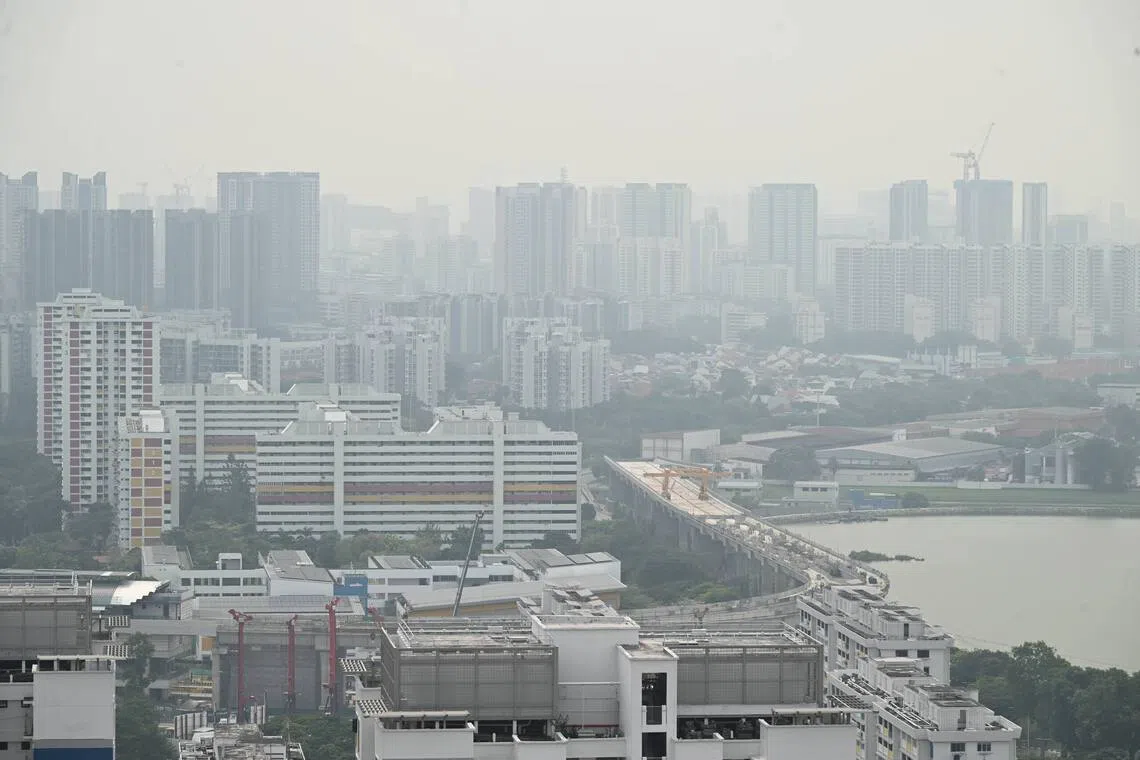
SINGAPORE – The air quality across most of Singapore remained in the unhealthy range early on Oct 6, with the north (107), east (112), west (117) and central (130) regions all above the 101 threshold at 6am on the 24-hour Pollutant Standards Index (PSI).
Only the south (95) remained in the moderate range.
Air quality is considered unhealthy when the PSI – a 24-hour rolling average of six key air pollutants and used in planning for outdoor activities the next day – is in the range of 101 to 200.
PM2.5 readings, which are used as a gauge for immediate activities, were elevated in three of the five regions – the east (56), west (59) and central (60).
The PM2.5 remained at the normal levels in the south (35) and in the north (48).
An hourly PM2.5 reading between 56 and 150 indicates an elevated concentration of fine particles.
Between 9pm and midnight on Oct 4, the entire island was shrouded in unhealthy air, with the peak being a 136 reading on the PSI at midnight in the central region. The central and west regions are the only two regions to lie in the unhealthy range for at least 24 hours.
In its daily haze advisory on Oct 5, the National Environment Agency (NEA) said that with the prevailing winds expected to blow from the south-east or east-south-east, the 24-hour PSI is forecast to be in the “high moderate to mid unhealthy” range.
Dry conditions are expected to persist over Kalimantan and southern Sumatra in neighbouring Indonesia, where moderate to dense smoke plumes were observed to be drifting towards Singapore.
The PSI crossed into the unhealthy range four weeks ago, hitting 101 in central Singapore on the morning of Sept 4. In the days that followed, readings in the central, eastern and western parts of the island occasionally crossed into the unhealthy range.
The highest reading of the year – 164 in central Singapore – was recorded on Sept 29.
The developments in September mark the first time since October 2023 that the PSI in Singapore hit unhealthy levels because of haze, with the authorities earlier warning of the risk of haze between June and October as a result of warmer and drier conditions brought on by both El Nino and the Indian Ocean Dipole.
Some experts have predicted that the haze in Singapore in 2026 could last for a longer period due to this year’s “Godzilla” El Nino event, which could reduce rainfall and result in higher temperatures over October-November, compared with non-El Nino years.
During non-El Nino years, the dry south-west monsoon season usually tapers off by September, and the start of the rainy north-east monsoon season tends to set in around late November.
The Meteorological Service Singapore (MSS) told The Straits Times that El Nino events, particularly strong ones, tend to delay the retreat of the dry season for much of the southern ASEAN region and that the MSS, is expecting a transition only during late October or early November for Singapore, later than in the previous two years.