
SINGAPORE – Singapore’s household water consumption in 2025 dropped slightly, with each resident using 141 litres of water, one litre less than in 2024, said PUB on March 17 as it launched its annual water conservation campaign.
However, sustained hybrid working arrangements, rising temperatures, and smaller household sizes continue to place upward pressure on household water consumption, the national water agency added.
Under the Singapore Green Plan 2030, the Republic targets to achieve household water consumption of 130 litres per person a day by 2030.
The lowest consumption per person in the past 10 years is 141 litres, recorded in 2025, 2018, 2019 and 2023.
“This highlights the need for continued water-saving efforts at home, alongside stronger emphasis on improving water efficiency in the non-domestic sector, where future demand growth is expected,” said PUB.
To further help households save water, PUB launched a programme to help selected 1- to 3-room HDB households adopt water-saving interventions.
Dubbed SG Water Saver Programme, the initiative includes interventions like complimentary home water audits, leak repairs and the replacement of inefficient fittings.
The initiative is expected to benefit about 1,500 households in the first two years.
PUB will progressively reach out to eligible households to share more details.
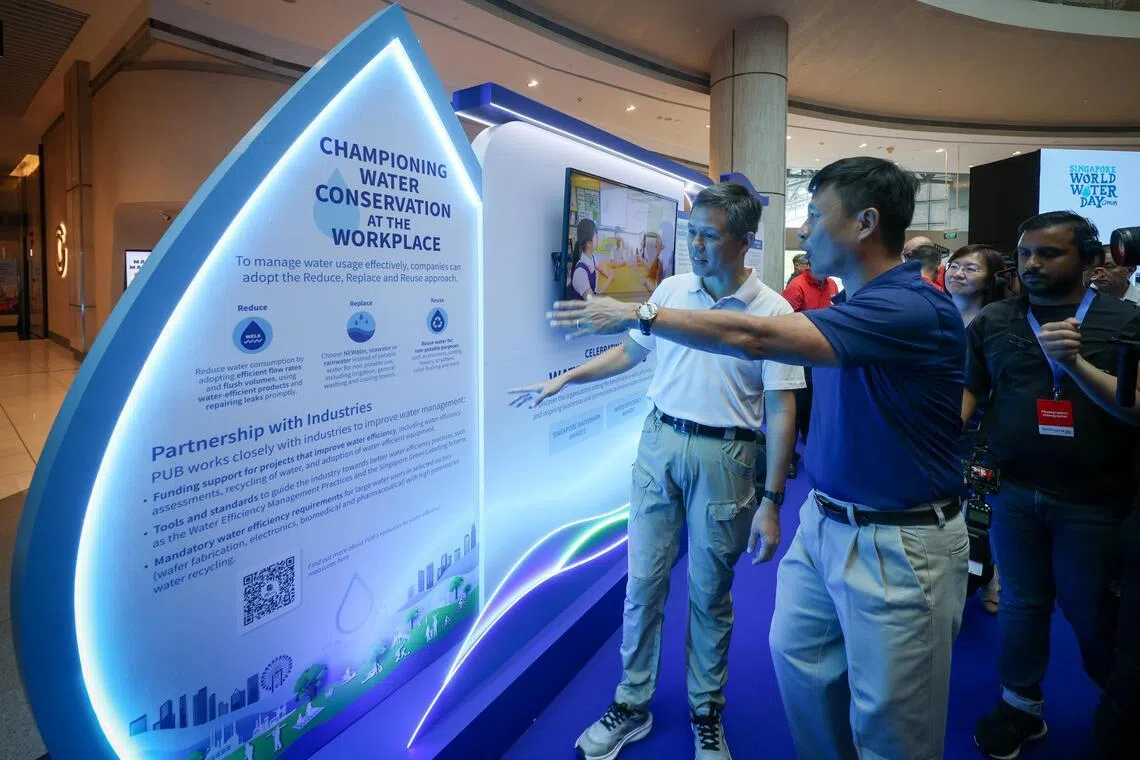
Speaking during the campaign launch at Suntec City Atrium, Coordinating Minister for Public Services Chan Chun Sing emphasised the need for water technologies to be more energy-efficient as well as the importance of managing water demand.
Mr Chan noted that while Singapore has the technology to meet its water needs, such technology hinges on energy.
“We have shifted our water dependency to energy dependency,” he said. “It is not just the recent wars and conflicts that should make us think about a more efficient way of producing water…Over the longer term, with climate change, how to get clean, sustainable renewable energy is a big challenge for Singapore.”
“If water has been the existential challenge for the last 50 years, clean renewable, sustainable energy will be our existential challenge for the next 50 years,” he said.
“If we can get clean, sustainable renewable energy in quantity, we will hopefully be able to solve our water challenge.”

Coordinating Minister for Public Services Chan Chun Sing emphasised the need for water technologies to be more energy-efficient as well as the importance of managing water demand.
ST PHOTO: JASON QUAH
Mr Chan, who is also Defence Minister, strongly encouraged businesses to manage their water demand. He said that there is a competitive advantage when firms change their industrial processes to be much more water efficient or much less water intensive.
Businesses can also strengthen water efficiency through measures such as regular reviews of water use, adopting water-saving technologies, and fostering a water-conscious workplace culture.
Minister for Sustainability and the Environment Grace Fu, who was also at the event, said that it is a “no regret” strategy for businesses to look at how they can reduce their water usage and increase water efficiency while reducing costs.
“We are in a very uncertain world… So we are seeing from climate change (that) water is becoming an important issue, either too much water when there’s rain…or too little water when there’s drought,” she said. “How do we adapt to such an uncertain world is something that we want to look at for this year.”
Singapore’s total water demand is projected to almost double by 2065, with the non-domestic sector accounting for about two-thirds of demand, up from about 55 per cent in 2026, said PUB.
Among businesses that have stepped up their water conservation efforts is semiconductor firm Micron Technology.
Its corporate vice-president and Singapore country manager Joshua Lee said that the firm in Singapore deploys advanced water-recycling and reclamation systems on site, as well as collects rainwater.
Such efforts have enabled the firm to use 98 per cent recycled water in its operations and recycle 43 per cent of used water in-house, he added.
Mr Chan also noted funding programmes by PUB, such as the Water Efficiency Fund, for supporting businesses in becoming water efficient.
Launched in 2007, the programme encourages organisations to seek efficient and innovative ways to manage their water demand.