
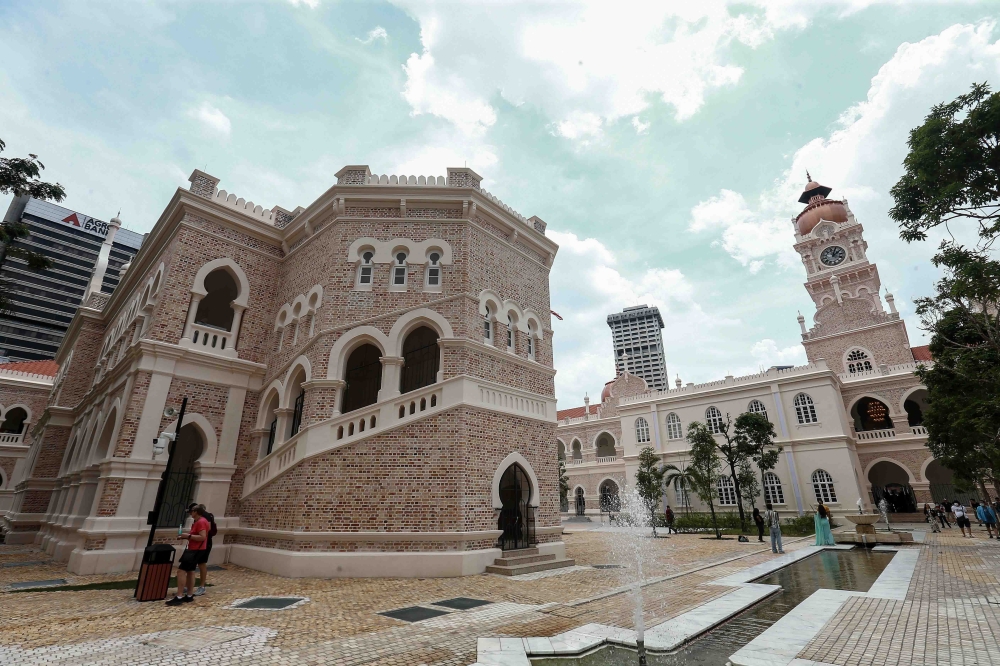
KUALA LUMPUR, June 4 — Malaysia is home to a treasure trove of heritage sites that stand as lasting reminders of the country’s history, but conserving these centuries-old buildings is not as simple as repairing cracks or repainting ageing walls.
Months of research, careful workmanship and strict adherence to the National Heritage Act take place behind the scenes when restoring historical landmarks to their former glory.
The National Heritage Act, introduced in 2005, legally protects anything gazetted as a national heritage in Malaysia and places them under the federal government’s purview.
The law protects both tangible heritage such as physical objects, monuments and sites, including underwater structures, as well as intangible heritage assets such as language, music, arts and traditional beliefs.
Even living persons can be gazetted as national heritage under the Act.
The Act also formally created the role of a Commissioner of Heritage, who is responsible for determining the designation of heritage sites and the registration of objects and underwater cultural heritage.
Besides establishing and maintaining the National Heritage Register, the Commissioner also oversees the conservation, preservation, restoration, maintenance, promotion, exhibition and accessibility of heritage.
Why is the Act crucial for restoring heritage buildings?
With the National Heritage Act in place, developers or property owners cannot simply modify or repurpose a heritage building as they wish.
Structural Repairs executive director Yong Zi Lip said the law requires conservation workers to preserve the original character of a heritage building through minimal intervention.
Structural Repairs is a Malaysian specialist contractor that has spearheaded various conservation works for nearly 40 years.
Some of the company’s notable restoration projects include conservation works at St Paul’s Church and the A Famosa Santiago Gate in Melaka, Istana Hulu in Perak, as well as St Mary’s Cathedral and Masjid Negara in the capital.
“Conservation works should involve the least amount of alternation necessary to stabilise and preserve the building,” Yong told Malay Mail.
“The goal is to retain as much original fabric and material as possible.
“Where practical, conservation works should also follow the principle of reversibility, meaning future restoration specialists should be able to remove or modify repair works without damaging the original heritage structure,” he added.
To meet these strict requirements, conservators like Yong hire skilled workers, source compatible materials for restoration and meticulously document each step of the work.
However, adhering to the National Heritage Act’s standards comes with its fair share of challenges.
As most heritage buildings have limited or incomplete original drawings, Yong said heritage conservators would conduct a detailed assessment of the building before deciding the best way to restore it.
The assessment usually involves non-destructive testing, defect mapping, drone inspections, thermographic assessments and structural evaluations before determining the best restoration method.
Besides deploying drones with infrared imaging and mapping capabilities, Yong’s company also uses 3D laser scanning technology to generate accurate as-built digital models of heritage buildings and architectural components such as domes, finials, façades and ornamental elements.
“In many heritage projects where original drawings are incomplete or unavailable, 3D scanning helps establish precise geometrical documentation of the structure,” Yong said.
Smaller-scale local heritage still vulnerable
Badan Warisan Malaysia president Lim Wei Ling credited the National Heritage Act for its effectiveness in safeguarding high-profile and nationally prominent landmarks such as Bangunan Sultan Abdul Samad and Seri Negara.
However, she said smaller-scale heritage assets in small towns, districts and villages that are culturally significant to local communities do not necessarily enjoy the same level of recognition or protection.
“One area that could benefit from greater clarity is the criteria used to determine whether a site is worthy of being recognised as a ‘tapak warisan’.
“While the Act outlines criteria for National Heritage designation, it does not sufficiently address how state or local heritage should be identified and protected.
“As a result, major heritage landmarks are more likely to receive attention and protection, whereas smaller-scale heritage assets may be overlooked despite their importance to local identity and collective memory,” Lim explained.
Lim also called for a transparent process and criteria for degazettement to be incorporated in the Act, since some provisions in the law imply that a heritage site can potentially be degazetted.
While lauding the Act for requiring approvals and oversight for interventions on heritage buildings, Lim said clearer guidelines and stronger requirements for maintenance — not just restoration — could safeguard heritage buildings from deteriorating.
“Another area worth considering is incentives, both financial and technical, to encourage private owners to conserve heritage properties, alongside greater public engagement and awareness,” Lim said.