
In today’s fast-evolving economy, roles that did not exist five years ago are now in demand, while many current jobs are being redefined.
As a result, graduates are expected to possess more than just academic knowledge: Soft skills like adaptability, real-world experience and global awareness are increasingly important prerequisites across many industries.
It is against this backdrop that Nanyang Polytechnic (NYP) is rethinking how it supports its students, moving away from a one-size-fits-all model towards an approach that reflects each learner’s strengths, interests and goals.
Starting in the new academic year this April, NYP will launch its Go Beyond initiative, which features three pathways that allow students to customise their diploma journey in line with their academic and career aspirations.
Importantly, these pathways are integrated into the curriculum, with no increase in hours. This means students do not need to take on additional modules or extend their studies beyond the standard three-year diploma programme.

From April, NYP students will get to choose from three enhanced learning pathways to determine how they want to learn and develop their skills for the future economy.
PHOTO: NANYANG POLYTECHNIC
Depending on their chosen pathway, students will gain real-world experiences through internships and overseas exchange programmes, as well as earn relevant industry-recognised certifications. As most of these are assessed on a pass-or-fail basis and excluded from Grade Point Average (GPA) computation, students can fully immerse themselves in the experience without worrying about attaining a specific grade.
At the heart of this new initiative is the recognition that students have different ambitions and definitions of success.
NYP principal and chief executive officer Russell Chan explains: “Our learners come from a diverse profile, and have their own aspirations, needs and wants. For instance, there are a fair few who seek to work prior to going on to university. Others will want to build international networks and experiences during their three years in the polytechnic. The idea is that we will have choices that align to what is important to them and they can embark on these pathways while in NYP.”
To cater to this wider range of needs, NYP has developed the Professional, International and University pathways, each designed to provide support and guidance, while still allowing students to keep their options open.

NYP students team up with peers from the Singapore University of Technology and Design (SUTD) to build an electric vehicle using additive manufacturing (EVAM) during their final year project – part of the University pathway programme.
PHOTO: NANYANG POLYTECHNIC
For those who plan to progress to further studies, the University pathway offers support such as scholarships advisory, interview preparation and portfolio development. Following that, students will pursue one of three specialised options that may provide module exemptions, foundation-level preparation for university matriculation or conditional university offers.
Others who are keen to gain practical experience can opt for the Professional pathway, which focuses on extended industry exposure. This includes internship opportunities that allow students to gain real-world working experience before graduation. Students will also earn industry-recognised certifications that strengthen their workplace readiness.
There is also the option to undertake internships ranging from 12 weeks to a year. Those who go on 12-week internship will also complete a final year project or Teaching Enterprise Project. All experiences in the Professional pathway contribute to graduation requirements, and are included in the GPA.
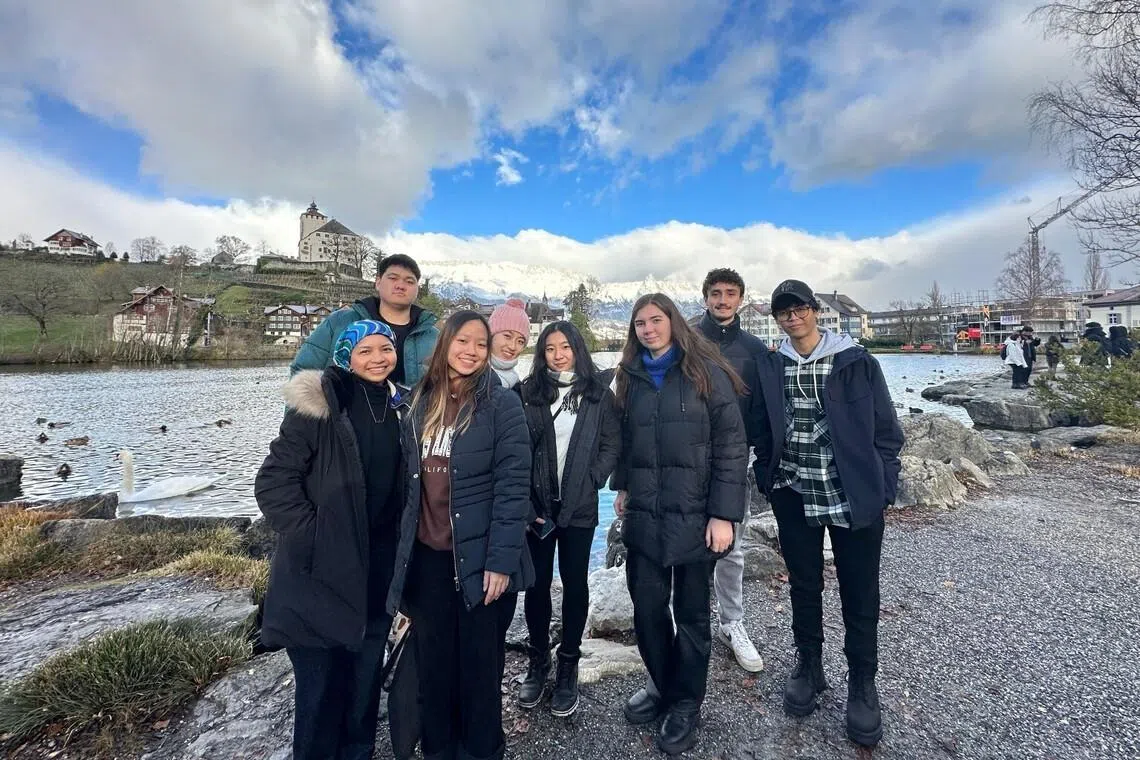
Those with global aspirations can embark on the International pathway, which offers overseas exchange or internship opportunities with more than 60 overseas university partners across 17 countries, including France, Finland, Switzerland, South Korea and Japan.
These programmes are typically undertaken in the second or third year, when students have sufficient grounding to fully benefit from the experience.

Students can opt for overseas internships lasting between 12 and 24 weeks with a company or an NYP partner university.
PHOTO: NANYANG POLYTECHNIC
For those who opt for the overseas internship, they will undergo a 12- to 24-week overseas internship placement at an NYP partner company, gaining exposure to diverse work cultures while strengthening their global outlook and employability.
With Go Beyond, students can explore experiences across all three pathways and choose one or more that support their individual ambitions. This flexibility helps them discover what suits them best.
Find out how
Go Beyond
gives students greater flexibility and future-ready pathways at the
NYP Open House
from Jan 8 to 10.
