
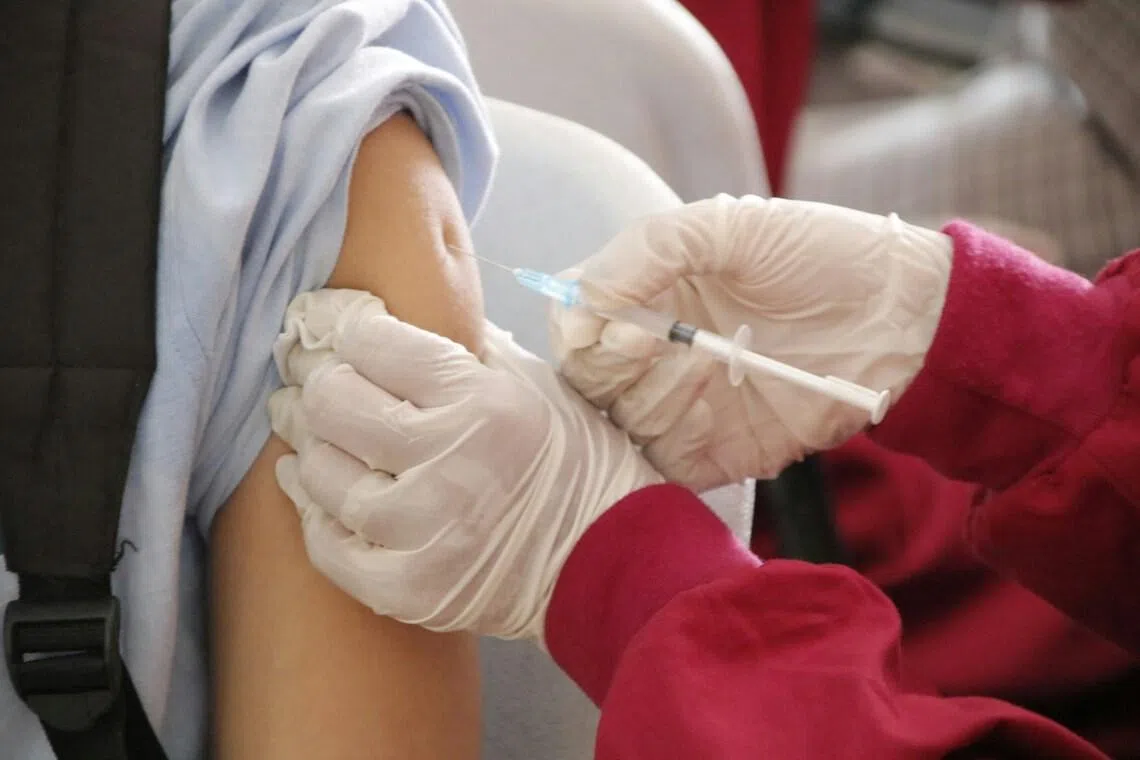
SINGAPORE – Some clinics in Singapore are seeing an increasing number of males saying yes to getting the human papillomavirus (HPV) vaccine, driven by a greater awareness of benefits such as the reduction of the risk of contracting several cancers.
This comes as a growing number of countries recommend the vaccine for both genders.
HPV is one of the most common sexually transmitted viral infections in the world, with more than 80 per cent of sexually active adults estimated to contract at least one type of HPV in their lives, according to a 2019 study by the US Centers for Disease Control and Prevention.
Though it is usually asymptomatic and clears up on its own without treatment, some types of genital HPV can lead to cervical cancer in women.
While the HPV vaccine has been available for men and boys in Singapore since 2020, only girls and women aged between nine and 26 are strongly recommended to get the HPV vaccination to prevent cervical cancer.
Parkway Shenton medical director Lim Wee Peng said that in 2025, males accounted for about 30 per cent of those getting the HPV vaccine at its clinics, up from 20 per cent in 2024.
Dr Tay Kian Wei, a family physician at Raffles Medical, said “a few” of the company’s clinics have seen an uptick in males receiving the HPV vaccine, though this number is still significantly lower compared with the figures for women.
Men’s health clinic Hisential now sees about 30 patients getting the vaccine each month, compared with about five patients monthly a year ago, said its founder and resident physician Anthony Stanislaus.
Singapore does not have official figures on HPV vaccination rates for men and boys.
The take-up rate among eligible males is estimated to be lower than 5 per cent, based on sales data from MSD, which manufactures the Gardasil 9 HPV vaccine, as well as doctor’s prescriptions and consumer market research.
Doctors chalked the rise in vaccinations to rising awareness of the vaccine’s benefits for both genders.
More people are understanding that the HPV jab is not just a “cervical cancer vaccine”, Dr Tay said.
“HPV vaccination can reduce the risk of several cancers in men, including anal and penile cancers, as well as certain cancers of the mouth and throat,” he noted.
He added: “It also protects against genital warts, which are relatively common, contagious and can cause significant psychological distress.”
Dr Stanislaus said those aged between 20 and 35, who tend to be more sexually active, are more willing to learn more about how the vaccine can protect them. “When you explain the benefits to them, they actually go ahead and get it,” he added.
Dr Lim said vaccinating males can help reduce HPV transmission in the community, which strengthens overall public health protection.
He noted, however, that HPV-related diseases are still less widely discussed, and there is still a misconception that the vaccine is only for women.
Affordability may also be a concern, Dr Lim said, describing the vaccine as a “significant out-of-pocket expense”. This is especially so if three doses are required, which is especially so for those aged above 15.
In Singapore, only the HPV2 vaccine – which protects against HPV types 16 and 18, which account for 70 per cent of all cervical cancers – is subsidised.
In 2019, schools here began offering the HPV2 vaccine for free to female lower-secondary students as part of the school health vaccination programme. The Ministry of Health noted in 2022 that more than 90 per cent of each year’s cohort received the vaccine.
The vaccine is fully subsidised for all female Singaporeans aged between nine and 17, and partially subsidised for those between 18 and 26.
The HPV9 vaccine, which provides protection against nine HPV strains, is available for both males and females, but is not subsidised for either gender here.
Each dose of the HPV9 vaccine, marketed under the brand name Gardasil 9, costs about $250 here. MediSave cannot be used for the HPV9 vaccination.
Still, getting vaccinated can be cheaper than seeking treatment, said Dr Stanislaus, noting that genital warts can recur, even after a person is treated.
He cited the example of a patient who spent thousands of dollars on genital wart treatments before deciding to get the vaccine.
Many other countries recommend HPV vaccination for both females and males, with Australia among the first countries in the world to provide public funding for the vaccine for both genders.
In 2024, the Society for Men’s Health (Singapore) recommended that the national vaccination programme include routine HPV vaccinations for men.
Dr Stanislaus said it would be great if the Government could subsidise the HPV9 vaccine for both genders. He suggested that if cost was a concern, the authorities could instead consider subsidising the cheaper HPV4 vaccine, which provides protection against four strains of HPV, in addition to genital warts as well as anal, vaginal, vulvar and penile cancers.
Still available in other countries, the HPV4 vaccine was previously on the market here, but has been phased out in favour of the HPV9 alternative.
In January, Health Minister Ong Ye Kung reiterated that HPV vaccination is not nationally recommended for males, with the incidence of HPV-related cancers being “many times lower” than that of cervical cancer among women and girls.
“Nevertheless, males who feel that they are at high risk of getting HPV may consult their doctor on HPV vaccination,” Mr Ong said in a written response to a parliamentary question by Aljunied GRC MP Fadli Fawzi.