
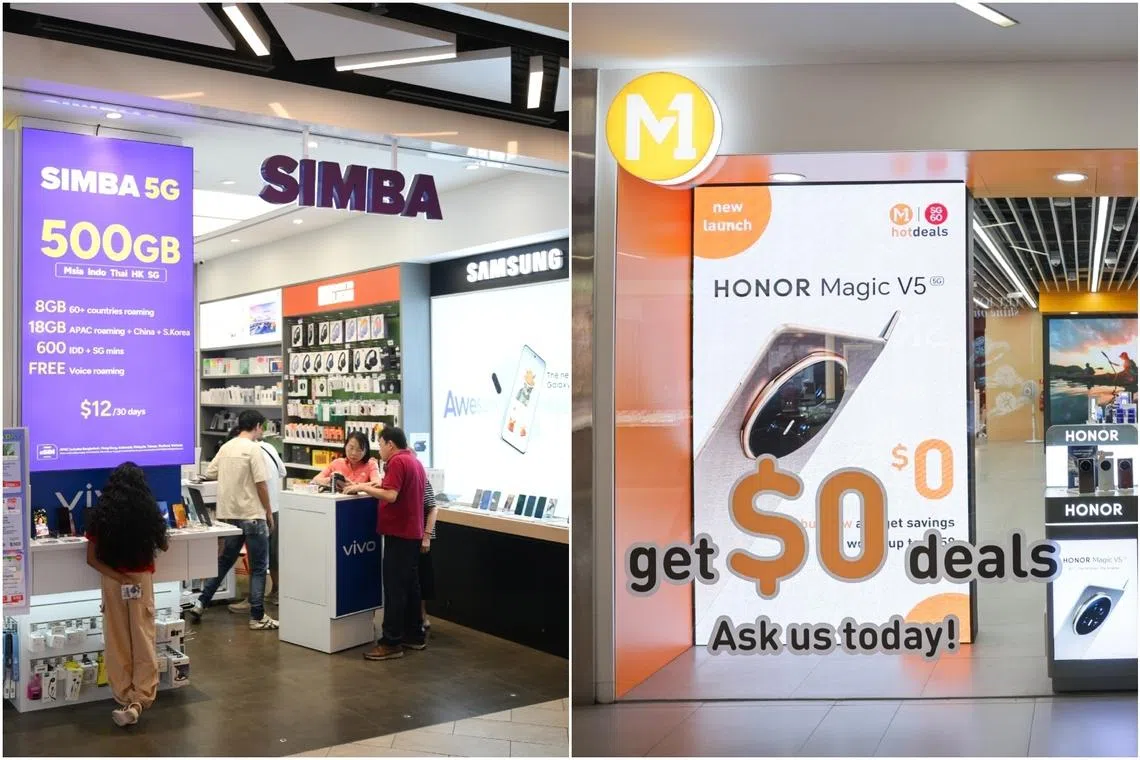
SINGAPORE – Sector regulator the Infocomm Media Development Authority (IMDA) has suspended its review of Simba Telecom’s aggressive $1.43 billion bid for M1’s telecommunications business.
This comes amid an investigation into allegations that Simba was using certain radio frequency bands to provide mobile services without authorisation, IMDA said in a statement on May 18.
The regulator has been evaluating whether the consolidation would significantly lessen competition or raise public interest concerns. The review also includes ensuring that the operation of critical telecoms infrastructure meets the stringent cybersecurity requirements necessary in a heightened cyber risk landscape, IMDA said.
“Since M1 (the target of the acquisition) operates large mobile and broadband networks in Singapore, the assessment has necessarily been detailed and thorough,” the authority said.
“While the review was in progress, IMDA learnt that Simba could have been using radio frequency bands that had not been assigned to them to provide mobile services.”
This would constitute unauthorised use of frequency spectrum, which is a breach of the Telecommunications Act 1999 and the conditions of Simba’s facilities-based operations licence, said the authority, adding that it is investigating the matter and will take enforcement actions if necessary.
The review has been suspended until the investigation concludes.
This comes mere days before the lapsing of a long-stop date of May 21 for Simba’s share purchase agreement. The original long-stop date for the deal was March 26.
A long-stop date is the contractual deadline by which conditions, including regulatory approvals, need to be satisfied or waived, or else the parties involved can walk.
Singapore-based asset manager Keppel first announced its intention to sell the telecoms business of its subsidiary M1 to rival Simba Telecom in August, in what would be the first telco consolidation in Singapore’s history. Simba is owned by Australia-listed firm Tuas.
In a statement on May 18 on the Australian Securities Exchange, Tuas said that its board will be reviewing Simba’s alleged unauthorised use of radio frequency bands.
“At this time, discussions with the counterparties to the Share Purchase Agreement are ongoing. Tuas will keep the market advised as developments occur,” said Tuas.
On the same day, Keppel said that it will begin carrying out a “Plan B” in case it retains majority ownership of M1.
The company’s shares tumbled when trading opened on May 18, and were down 4 per cent at $10.18 at 9.28am.
The company will be focusing on enhancing M1’s efficiency through rightsizing the company and reducing costs without adversely affecting customer experience, said Keppel, adding that this is done to combat “significant challenges” facing Singapore’s telco industry.
“We have a 90-day plan to drive M1’s efficiency which we will activate with immediate effect,” said Keppel.
“This would include reducing technology platform costs and network costs, using AI for automation, as well as product rationalisation.”
If the deal is approved, the new Simba-M1 entity is expected to service more than three million mobile subscribers, with numbers just behind Singtel which has around 4.5 million subscribers.
This deal follows years of liberalisation within the telco industry that saw the lowering of mobile broadband and fixed broadband prices.
In their proposal to IMDA, Simba and M1 had pledged to continue to offer their popular $10 and $12 mobile plans to new subscribers for at least two years after the merger is completed.
They had also committed to retain current prices for existing mobile subscribers for at least two years after the consolidation is completed.
M1 had also undertaken to honour all existing commitments and contracts, according to the proposal that was published online in October. For instance, current subscribers of M1’s Mobile Virtual Network Operators (MVNOs) will also not be affected.
MVNOs provide mobile services without owning a physical network by leasing capacity wholesale from host telcos such as M1, StarHub, Singtel or Simba Telecom.
The telcos had said subscribers will be covered by both Simba and M1’s mobile antenna sites. An early goal would be to pair Simba and M1’s 900MHz spectrum bands to allow deeper and wider coverage, and better penetration of mobile signals within buildings.
Subscribers will also be able to receive customer support at the stores of both telcos after the consolidation is completed, the telcos said. Collectively, they have more than 20 shops and service centres across Singapore.