
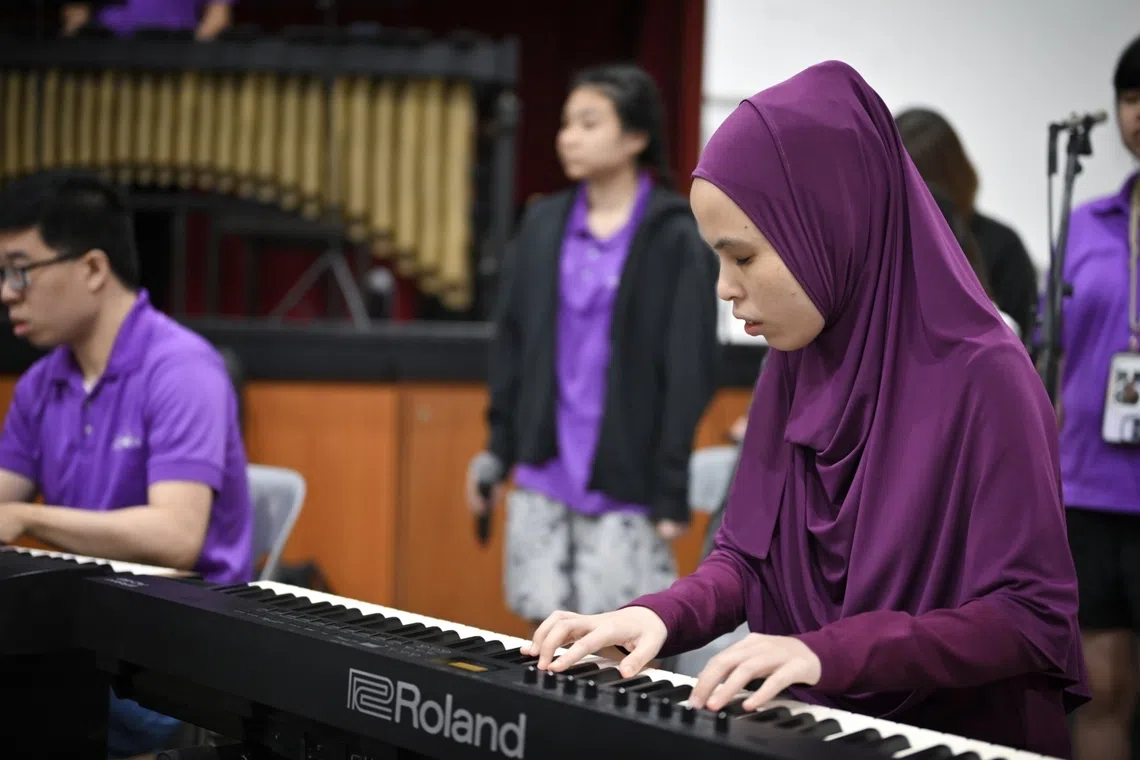
When Ms Siti Sakinah Zainal sits at the piano, fingers poised on its keys, she begins not by looking at the conductor’s purple baton, but by listening intently.
She focuses on the sound of his slow, measured breath, amplified through his microphone. On cue, she starts Georges Bizet’s Carmen Suite No.1, launching the rest of the over 80-strong orchestra.
Born seeing only some light and shadows, the conductor’s breath is among the cues guiding Ms Sakinah through the music as a blind pianist. She started playing the piano at six.
“A musician once asked how can I start (a song) if I cannot see. Excuse me! (Some) people think we (always) need help with music, but that’s wrong,” the 29-year old administrative assistant says.
As the sole pianist of The Purple Symphony (TPS), Singapore’s largest inclusive orchestra, she performs alongside musicians with and without disabilities aged 11 to 79. Around half of its members are persons with disabilities.
Started in 2015 by the Central Singapore Community Development Council (CDC), TPS blends Asian and Western instruments from five key musical sections: Strings (Plucked), Strings (Bow), Wind, Percussion and Choir.
More than 80 members of TPS’ over 120-strong ensemble thrilled audiences at its second full orchestra performance overseas in Kuala Lumpur on Nov 26.
The group rehearsed weekly since September to prepare for the concert at the over 800-seat Dewan Filharmonik Petronas concert hall, in a performance presented by Temasek Foundation, Raja Zarith Sofiah of Johor Foundation and the Central Singapore CDC.
They were invited by the Queen of Malaysia Raja Zarith Sofiah, who hosted their first overseas concert in Johor Bahru in 2023.

Over 80 musicians from The Purple Symphony play a repertoire of seven songs at the Dewan Filharmonik Petronas concert hall in Kuala Lumpur on Nov 26.
PHOTO: CENTRAL SINGAPORE COMMUNITY DEVELOPMENT COUNCIL
“Fusion sound has become our signature and (reflects) inclusiveness,” says TPS’ artistic director and founding member Quek Ling Kiong, 58. He is also Singapore Chinese Orchestra’s (SCO) principal conductor.
“We (welcome) different instruments and talents,” says Mr Quek.
Through TPS, Ms Sakinah has grown close with percussionist Nurul Natasya, 27, and flutist Lawrence Gabriel Villar Angel, 21, who are also blind.
They meet weekly outside rehearsals, bonding over their shared experiences and love of music, meals and walks islandwide.
Ms Sakinah, a self-taught pianist, joined TPS in 2017. She was previously a solo pianist and prefers the orchestra’s fuller sound and fun, supportive community.
Mr Angel, a music undergraduate at the Nanyang Academy of Fine Arts, and Ms Nurul, a waitress at a dine-in-the-dark restaurant, often guide Ms Sakinah in music theory.
Double bass player Joyce Goh, 17, is the trio’s close friend and among the volunteer musicians playing alongside musicians with disabilities. These volunteers form nearly half the ensemble.
Ms Goh, a student, joined the orchestra in 2017 after watching rehearsals where her mother interpreted sign language for a deaf percussionist.
“Inclusivity doesn’t just mean talking about wanting to involve people of all abilities, but truly knowing them, showing real care, learning how we can help and how they can help us too,” says Ms Goh. “(Playing here) made me more empathetic.”
Her two brothers also came on board: Jordan, 12, joined as a French horn player in 2024; Jonathan, 20, previously played the clarinet.

Musicians and guests of honour share the stage at a Nov 26 concert in Kuala Lumpur, presented by Temasek Foundation and Raja Zarith Sofiah of Johor Foundation.
PHOTO: TEMASEK FOUNDATION
Weekly rehearsals at the Jalan Besar Community Centre unfold in a supportive setting, with volunteer musicians and musicians with disabilities seated alternately. Instructors move among them, playing notes or guiding with cues.
Families record sessions for home practice and keepsake, share snacks during breaks, and build a supportive parent community.
Thirty-six caregivers accompanied the orchestra to Kuala Lumpur.
Inspired by a video of a British para‑orchestra, Ms Denise Phua, Mayor for the Central Singapore District, envisioned an ensemble of musicians of all abilities in Singapore.

Ms Denise Phua (centre, standing), Mayor for the Central Singapore District and adviser for The Purple Symphony, speaks to the orchestra’s musicians at one of its rehearsals at the Jalan Besar Community Centre ahead of the Nov 26 performance.
PHOTO: CAROLINE CHIA
That vision came to life in 2015, when the Central Singapore Community Development Council (CDC) started The Purple Symphony (TPS). The initiative unites over 120 musicians of all abilities. Central Singapore CDC, one of five CDCs, serves areas spanning Jalan Kayu to Queenstown.
As TPS’ adviser, Ms Phua – also the grassroots adviser for Jalan Besar GRC – saw its audience grow from 150 at its July 2015 debut to over 1,500 across its November preview and main performance in Kuala Lumpur.
The dream is to become Singapore’s third national orchestra, says the Mayor, alongside the Singapore Symphonic Orchestra and Singapore Chinese Orchestra.

Temasek Foundation executive director and chief executive officer Ng Boon Heong (left), greets Raja Zarith Sofiah, Queen of Malaysia (second from left), at the Dewan Filharmonik Petronas concert hall in Kuala Lumpur on Nov 26.
PHOTO: TEMASEK FOUNDATION
“We are delighted to once again partner a like-minded organisation, Raja Zarith Sofiah of Johor Foundation, for TPS’ second overseas performance,” says Temasek Foundation executive director and chief executive officer Ng Boon Heong. The two organisations presented TPS’ first overseas concert in Johor Bahru in 2023.
“(TPS) shows us what true inclusion looks like, providing an opportunity for musicians with and without disabilities to showcase their talents and grow in confidence on an international stage,” says Mr Ng.
“We hope this partnership will continue to inspire audiences beyond Singapore and encourage more inclusive opportunities across communities.”
Among the caregivers is Mrs Michelle Teo, 62, who attends nearly every rehearsal to watch her daughter, Bronwyn Teo, 24.
Ms Bronwyn Teo, who is on the autism spectrum, had no prior musical training and learnt the traditional Chinese flute dizi after joining TPS in 2016.

Mrs Michelle Teo (centre, standing), 62, accompanies daughter Bronwyn Teo (centre, seated), 24, during a rehearsal for The Purple Symphony’s performance on Nov 26, where Ms Bronwyn Teo plays the Chinese mouth organ zhongyin sheng.
PHOTO: CAROLINE CHIA
“She really persevered; I think that helps her in life too,” Mrs Teo says.
Patience is key in the pursuit of musical excellence, Mr Quek says.
“We have to build confidence and support to show they’re talented. They’re talented not because they’re special, but (when) they’re talented and special on top of that, it’s the talent that shines,” he adds.

Ms Bronwyn Teo, 24, who plays the Chinese mouth organ zhongyin sheng, joins The Purple Symphony’s second full orchestra performance abroad on Nov 26 in Kuala Lumpur.
PHOTO: CENTRAL SINGAPORE COMMUNITY DEVELOPMENT COUNCIL
Musicians with vision loss, he says, memorise the music so precisely that they know their own and others’ parts.
Ms Nurul used to braille her scores, but now commits them to memory.
Nearing a performance, Ms Sakinah listens to rehearsal recordings and practices alongside the musical instrument digital interface, the songs’ digital rendition for precise practice, daily before and after work.
Mr Angel, whose parents discovered his perfect pitch at four, wants to be viewed simply as a good musician, and not a blind musician who can play.

Flutist Lawrence Gabriel Villar Angel (front row, fifth from left), 21, performs with over 80 musicians from The Purple Symphony at a Nov 26 concert in Kuala Lumpur.
PHOTO: CENTRAL SINGAPORE COMMUNITY DEVELOPMENT COUNCIL
“Without The Purple Symphony, I won’t really have an orchestra opportunity. Let’s face it, (many) other orchestras (may) not accept us yet,” he says.
As their music fills the hall, the trio’s talent and grit challenge the boundaries. Their music, they say, stands alongside, and even surpasses, many who can see.
Mr Quek Ling Kiong was initially hesitant when Ms Denise Phua, Mayor for the Central Singapore District, invited him to lead an inclusive orchestra in 2015.
Then a resident conductor (now principal conductor) of the Singapore Chinese Orchestra, his experience with musicians with disabilities had been limited to a small percussion group.
But he responded to the Mayor’s call, believing in the transformative power of music that steadied him through his restless teenage years.
Over time, Mr Quek and his team of Mr Quek and his team of 11 instructors devised creative cues to help musicians perform with confidence.

The Purple Symphony’s artistic director, Mr Quek Ling Kiong (centre), 58, leads musicians across five key musical sections: Strings (Plucked), Strings (Bow), Wind, Percussion and Choir.
PHOTO: CAROLINE CHIA
For those with visual disability, a deep breath or the strike of a triangle after a long pause signals entry, “done artistically,” the 58‑year‑old says. Vocalists are encouraged to imagine vivid scenes as they sing.
He uses exacting instructions, sometimes written on a whiteboard, as many with autism thrive on structure. His team also simulates stage conditions to prepare performers.
He recalls working with a deaf musician who used a hearing aid that can amplify and isolate specific sounds during performances.
Mr Quek has seen growth beyond music. Many who initially avoided his gaze now greet him warmly, even exchanging phone numbers. “They want to interact,” he says.
He hopes more musicians will join the ensemble and more community performances will follow, allowing The Purple Symphony (TPS) to give back and share the beauty of music.
Find out more about TPS on its
and
Instagram.