
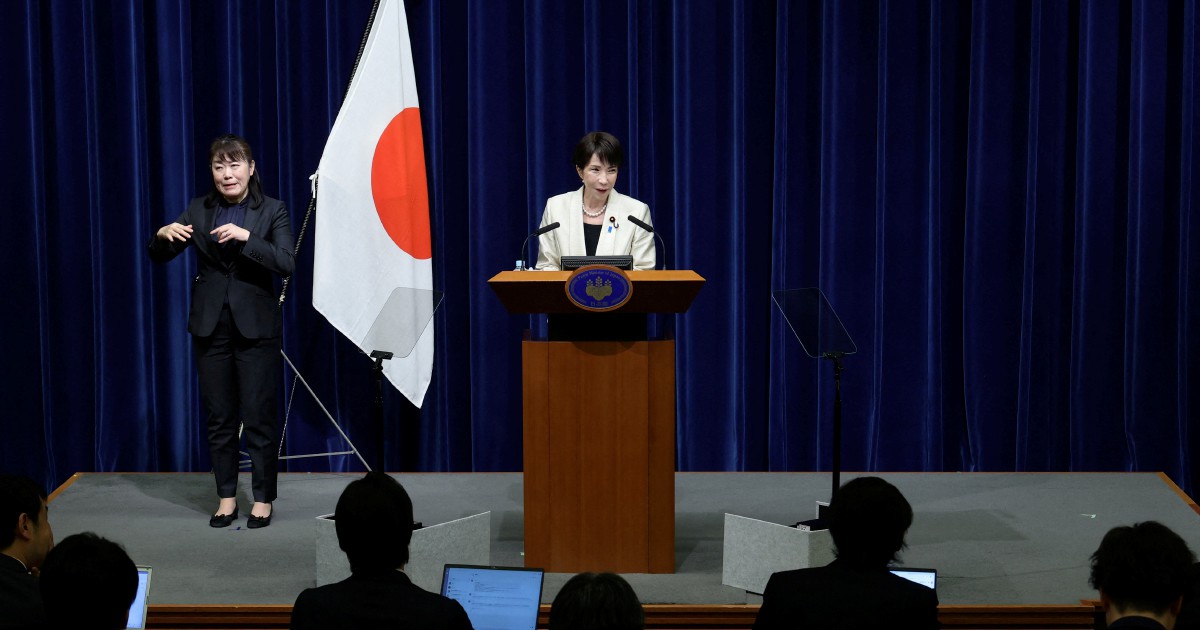
JAPAN Prime Minister Sanae Takaichi’s plan to rearm in a big way is set to revive historical trauma, not reassurance in parts of Southeast Asia.
Although a strong Japan does not automatically signal renewed aggression, in a geopolitically volatile region, perceptions shaped by history and optics often matter.
A Takaichi-led military hard power to reclaim nationalist credentials and reviving its failed Imperial past risks squandering its soft power strategic capital.
It will also spiral an arms race in the region. China will become more assertive. South Korea may opt for nuclear weapons.
North Korea under Comrade Kim Jong Un may build more nuclear warheads and expand its missiles capabilities. Indonesia is to acquire an aircraft carrier from Italy.
Singapore will acquire eight additional F-35 Fighter jets, four new Boeing P-8A Poseidon maritime reconnaissance plane and two new submarines.
Takaichi’s remilitarisation plan will accelerate the nuclearisation of the region as Seoul and Tokyo watch Australia taking delivery of 18 nuclear-powered submarines under AUKUS from US and UK.
Seoul and Tokyo are monitoring closely the proliferation of nuclear technology via the AUKUS model.
With a stockpile of plutonium and an advanced civilian nuclear industry Japan awaits only a political greenlight before going nuclear. Takaichi has just given the greenlight to go ahead.
Their “neither confirm or denial policy” will not hinder their resolve to have nuclear weapons if push comes to shove.
For many Asians especially in China, South Korea and Southeast Asia — Japan’s wartime legacy is not history but an unforgivable past.
Just as Japan keeps alive the trauma of Hiroshima, Nagasaki, and Tokyo inflicted upon their societies, the families of Japanese war victims in some parts of Southeast Asia, Nanjing and other places, will continue to remind their societies of the atrocities committed by Imperial Japan.
It is true that a stronger Japanese military will help enhance the US power projection against China and embolden Washington to take a stronger position on Taiwan and North Korea.
The cost of rearming Japan may delay efforts for economic reforms in a grossly indebted nation whose debt to the gross national product ratio stands at 230 per cent, exceeding the US at 125 per cent and Great Britain at 115 per cent.
While in theory a strong Japan can balance China’s dominance, in the long run, its quest for parity can do more damage to Japan’s own security with Washington shifting its focus to Latin America under the new “Donroe Doctrine”.
With the budget of US$58 billion (nine trillion yen) the Japan Self Defence Forces will add more guns but less of the much-needed butter for Japan.
The JDSF has one of the world’s most sophisticated Navies complete with advanced submarine fleets and autonomous under- surface- killer- systems and several batteries of long- range missiles.
According to defence analysts, the JSDF that possesses lethal conventional and non-conventional counter strike capabilities, consistently ranked among the top five global defence spenders for more than two decades.
Unknown to many Japan has one of the world’s sophisticated military industrial complex, with advanced manufacturing facilities in ship building, precision engineering, semi-conductor and electronics industries and robotics., among others.
Besides this, Japan boasts a world-class supply chain. Many believe the MIC that supported the Imperial Army like the Zaibatsu conglomerates (Mitsubishi, Matsui, Sumitomo and Yasuda) are still intact.
Contrary to speculations, they were not disbanded after the War.
Rather than rearming, Tokyo should leverage on its grand strategy of pacifism and soft power diplomacy. It was its military power that brought the nation to its knees in 1945.
A militarised Japan will reopen old wounds and trigger a new security dilemma.
* The writer is former Fellow at ISIS Malaysia and Adjunct Professor at National Institute on South China Sea Studies, Hainan, China
© New Straits Times Press (M) Bhd