
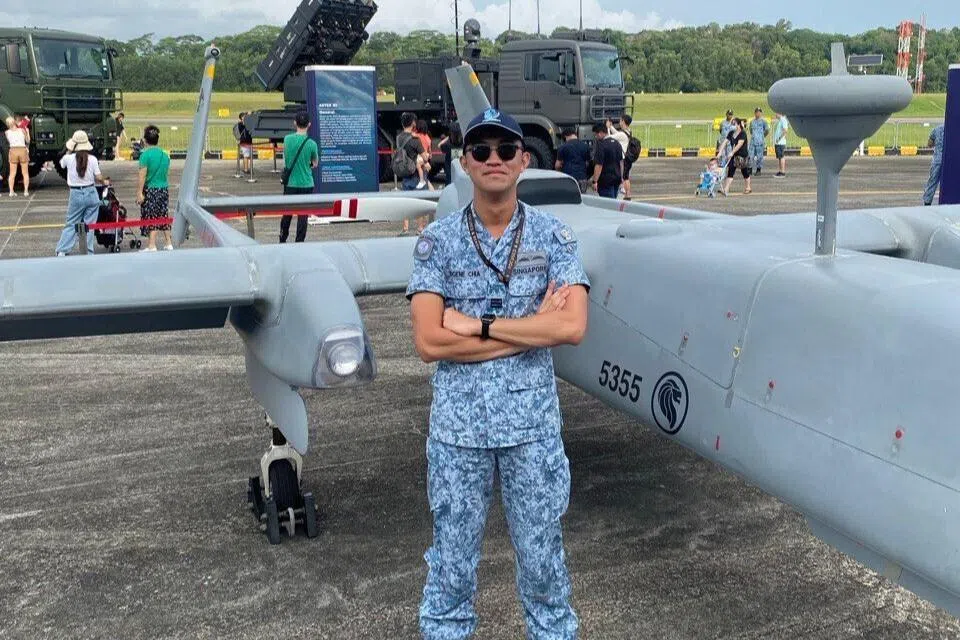
Like any pilot, he sees the sky and what lies around it.
However, in place of where a clear polycarbonate canopy would be in most aircraft, Captain (CPT) Eugene Chia’s field of vision is dominated by two large screens full of constantly scrolling data and panoramic camera feeds that offer a glimpse of the outside world – along with whiteboards and computer systems that his four-man crew steadily update.
He is actually stationed at the ground control station (GCS) of the Republic of Singapore Air Force’s (RSAF) Heron 1 unmanned aerial vehicle (UAV).
The 26-year-old UAV pilot and his team fly the Heron 1 remotely, controlling the drone from up to 200km away via a secure telecommunications channel.

Exterior of the Heron 1 ground control station – the mission hub where a four-man crew, comprising two flying crew and two air imagery intelligence specialists, operates unmanned aerial vehicle (UAV) missions.
PHOTO: REPUBLIC OF SINGAPORE AIR FORCE
The UAV can remain in the air for over 24 hours at a time without refuelling, something traditional aircraft cannot do.
They provide ground commanders with real-time intelligence on terrain and military assets, supporting both peacetime surveillance and reconnaissance requirements.
Because of the specialised nature of its reconnaissance work, the UAV community – made up of UAV pilots and air imagery intelligence experts – is particularly tight-knit, working closely with each other to achieve mission success.

With his parents at the RSAF Combined Graduation Ceremony in 2023, then-Lieutenant Chia earned his wings as a UAV pilot after six months of training.
PHOTO: COURTESY OF EUGENE CHIA
The strong camaraderie is especially evident during overseas exercises, such as Exercise Forging Sabre in the United States or Exercise Cope Tiger in Thailand, when the entire community, including the air crew and air force engineers, comes together to carry out a mission.
These moments never fail to fill CPT Chia with pride.
“We take the time to engage one another and understand each other’s roles,” he says. “This helps us see the bigger picture – the entire chain of work involved to enable UAV operations.
“Every time, these exercises and deployments reinforce my decision to sign on as a UAV pilot.”
Like many other Ministry of Defence (Mindef) scholarship recipients, CPT Chia’s first exposure to the RSAF was through the Mindef Experience Programme. It is a four-day introductory programme for polytechnic and junior college students to interact with active in-service personnel from each of the Singapore Armed Forces’ (SAF) branches.
At Paya Lebar Air Base, the roar of scrambling F-16 afterburners thundered through his chest, and with it, a conviction to join the RSAF in 2018 upon receiving
The SAF Scholarship
.
“It really drove home the fact that the RSAF has a very high emphasis on real-time operations,” he says.
But it was only after interacting with several UAV community members that his interest was piqued in flying UAVs instead.
“Many seniors and commanders had shared that this was a domain that was rapidly evolving and on the cusp of expanding,” CPT Chia, then just a recruit, recalls. “I wanted to be directly involved in contributing to this change and evolution of air warfare.”

The RSAF, including the UAV team, trained alongside the Royal Thai Air Force and United States Air Force – a contingent of over 2,000 personnel – during the 2023 trilateral mission Exercise Cope Tiger in Korat, Thailand.
PHOTO: COURTESY OF EUGENE CHIA
CPT Chia went on to read history and philosophy of science at the University of Cambridge, then completed a master’s in science and international security at King’s College London.
Studying overseas taught him to work with people from diverse backgrounds and to grasp cultural sensitivities quickly, skills he now relies on during exercises and exchanges with foreign militaries.
But it also made him more aware of how quickly the world is changing, from geopolitics to technology and cross-border risks. Events in recent years have also proved how forward-looking his superiors’ words had been.
In ongoing conflicts on the other side of the world, drones have been used in far greater numbers than ever before, thanks to lower cost and ease of deployment.
In his current posting as a strategy officer in the RSAF, he works on integrating aerial systems (UAS) into the RSAF’s capabilities – not just how to use them, but just as importantly, how to defend against them.
“The kinds of things you use to deal with drones are not the same as those you use to deal with conventional aircraft threats,” says CPT Chia.

At Exercise Forging Sabre 2023, the RSAF UAV team performed cooperative lasing drills, during which the crew rehearsed precision targeting and joint fires under realistic, high-tempo conditions.
PHOTO: REPUBLIC OF SINGAPORE AIR FORCE
Up until one or two years ago, very few air forces in the world were equipped to deal with the proliferation of drones in the airspace, he continues.
“We recognised that this area needed attention. Consequently, we created this new office to develop the capabilities for the SAF to stay agile in managing this rapidly evolving threat.”
The unit he refers to is the
SAF Counter-UAS Development and Operations group
, which was unveiled by then-Defence Minister Ng Eng Hen at the Committee of Supply debate in March 2025.
Playing a pivotal role in one of the SAF’s most critical air defence developments has been a definitive highlight of CPT Chia’s career.
“We’ve used UAVs in a certain way up until now, but that might not hold true in future,” he says.
“It’s something we need to be cognisant about, and not constrain ourselves to what we’re familiar with, when we look at how UAVs can contribute to the air campaign.”

Unmanned aerial vehicle pilots, air imagery intelligence experts, and logistics and maintenance crew posing after the Exercise Cope Tiger 2023 detachment in Korat, Thailand.
PHOTO: COURTESY OF EUGENE CHIA
As an unmanned aerial vehicle (UAV) pilot, Captain (CPT) Eugene Chia does not feel the pull of gravity in tight turns or the rumble of jet engines.
But that does not make the job easier. In fact, it demands something else entirely. Flying a UAV presents its own set of unique challenges, the greatest of all being what CPT Chia calls the absence of “air sense”.
Air sense, he explains, is the awareness that a pilot of a manned aircraft has of their aircraft. Being physically within an aircraft gives a pilot immediate spatial awareness and tactile feedback, he adds.
As such, if there is a sudden change in their flying environment or a malfunction in the aircraft’s systems, the pilot can respond much quicker.
A UAV, on the other hand, offers no such feedback. UAV pilots can rely only on real-time camera feed and the stream of telemetry data being fed back to them at the ground control station.
“Since you don’t get a feel for how the aircraft is performing, you have to be very deliberate in scanning your aircraft parameters,” CPT Chia says.
For this reason, UAV training emphasises precision, composure and situational awareness. The mental agility required is just as rigorous as that expected of fighter pilots.
Trainees begin their journey at the Air Force Training Command, where they study the same aviation theory as manned-aircraft pilots, before moving on to platform-specific training at the Republic of Singapore Air Force’s UAV Training School in Murai Camp.
“We also need to have the same fundamental understanding of aviation, for instance, on meteorology and aircraft components,” says CPT Chia. “Flying a UAV is fundamentally also operating an aircraft.”
Following that is the simulator training. There, instructors create challenging flight scenarios, observe how students react under pressure and ensure they have a robust understanding of the UAV’s systems.
“If you don’t know the flying and system logic of the aircraft well enough, you won’t know the remedy actions,” CPT Chia says. “The lack of system knowledge is what gets most people.”
Those who do make it through emerge not just as UAV pilots, but as calm, analytical problem solvers.
Find out how The SAF Scholarship can kickstart your career in the RSAF.
