
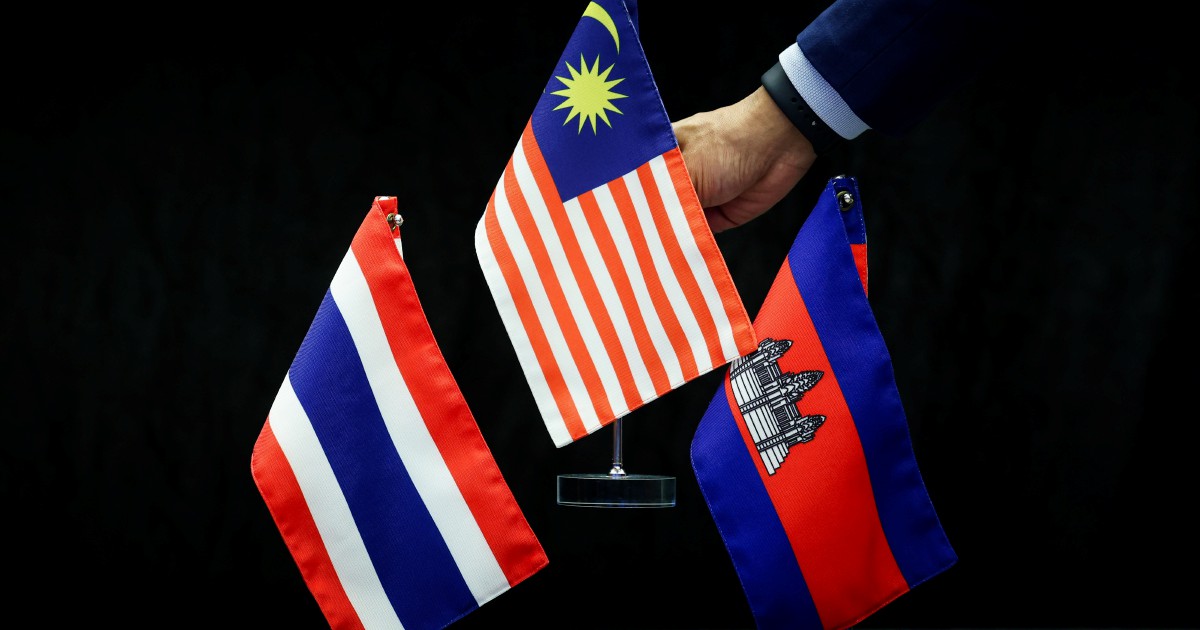
THE war between Thailand and Cambodia is accelerating into a humanitarian, political and emotional disaster. Villages are emptied. Border markets are collapsing.
Naval exchanges in the Gulf of Thailand are no longer rare incidents, but recurring signals that both sides believe force is the only language that matters.
In these conditions, it is tempting to blame someone else. Thus, Asean becomes the favourite target. Malaysia becomes the convenient scapegoat.
The chairmanship “failed”, the diplomatic machinery “hesitated”, the Kuala Lumpur process “could not impose peace”. But this narrative misrepresents institutional realities and misdirects political anger.
Regional organisations do not end wars when member states refuse to cooperate.
The North Atlantic Treaty Organisation could not stop Turkiye and Greece from clashing in the 1970s. The African Union could not prevent Ethiopia and Eritrea from returning to war. The European Union could not stop Serbia from shelling Dubrovnik.
Asean is a regional convenor without a punitive instrument. It has no standing army, no sanctions regime, no Chapter VII coercive authority. It cannot force Thailand to halt artillery fire, nor can it compel Cambodia to withdraw troops from contested zones.
Sovereign states do not surrender military decisions to multilateral committees — not in Southeast Asia, not anywhere.
Malaysia, as Asean chair, is doing what diplomacy permits — convening dialogue; pushing for humanitarian pauses; proposing observer missions; structuring ceasefire terms; and, keeping channels open.
These are political tools, not enforcement tools. A chairmanship cannot legislate restraint into two leadership circles that see concession as political humiliation.
The current war is fuelled less by territorial logic than political insecurity. Thailand faces electoral unpredictability and coalition fragility.
No faction wants to appear weak towards Cambodia. Phnom Penh operates under the shadow of historical grievance and the presence of senior figures who already distrust Thai intentions.
When militaries decide momentum equals leverage, diplomacy becomes a nuisance, not a guide. No Asean capital can override that psychology.
But responsibility for this lies with Bangkok and Phnom Penh, not Asean. The two sides entered every ceasefire with caveats and preconditions.
One demanded unilateral de-escalation while the other insisted on parallel concessions. Each portrayed restraint as surrender. Neither accepted third-party verification without suspicion.
Even the proposal of a demilitarised humanitarian corridor was slowed by operational distrust among commanders.
Diplomacy is not a magic wand. It is consent-based. A ceasefire is about compliance. Malaysia can draft language, but cannot compel discipline.
Critics forget, Asean members never agreed to transfer coercive authority to the regional level.
The so-called “Asean Way” emerged precisely because member states preferred voluntary consensus to supranational intrusion.
Asean’s “will” was based on persistent trial and tribulations to prevent the embers of war from catching on. In the main it succeeded until the Thai-Cambodian border conflict ruptured in 2008, 2011 and this year.
To now blame Asean for lacking powers that states refused to grant would be intellectually dishonest.
When Thailand requests a unilateral Cambodian ceasefire and Cambodia insists Thailand fired first, no chairmanship can adjudicate truth without evidence and consent.
When both sides treat artillery as negotiation pressure, no mediator can force political maturity.
Malaysia has not misunderstood the stakes, warning that escalation will damage Asean centrality, frighten investors, disrupt supply chains and revive anxieties across mainland Southeast Asia. But warnings cannot substitute for political courage.
Wars end when leaders decide costs exceed advantages. Indonesia learned this during its Konfrontasi in the 1960s.
Vietnam learned this after its occupation of Cambodia in the 1980s. Thailand and Laos learned this after their naval clashes in Ban Rom Klao.
In all those cases, exhaustion — not external pressure — produced settlement. Blaming Malaysia or Asean is therefore emotional, not rational.
It avoids the uncomfortable truth that two governments are choosing escalation because neither wants to appear conciliatory.
Malaysia’s task is to keep the diplomatic space alive — to ensure that war does not eliminate the possibility of a political landing point. Kuala Lumpur can build the room for peace, but Bangkok and Phnom Penh must choose to walk into it.
If the next negotiating rounds fail, responsibility will sit where decision-making resides — in the war cabinets of Thailand and Cambodia. Win, lose or fail, peace is a sovereign decision. And so is war.
* The writer is professor of Asean Studies and Director of the Institute of International and Asean Studies, International Islamic University of Malaysia
© New Straits Times Press (M) Bhd