
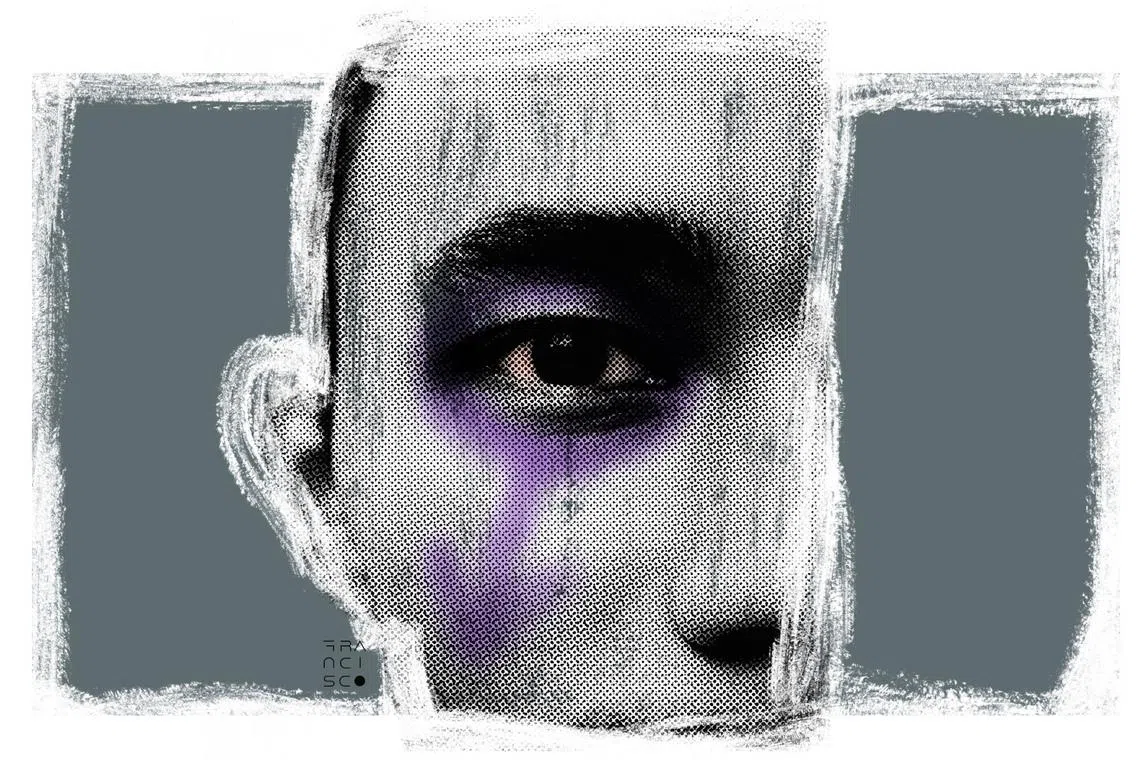
SINGAPORE – Having witnessed his father beat his mother repeatedly, Marcus (not his real name) swore he would never become an abusive man.
He did not expect to be abused by his wife decades later.
The man, in his 40s, said that his wife hit and lashed out at him, and pressured him to cut off contact with his friends and family for more than a decade.
The couple have since divorced. Marcus said: “It was really torture.”
More cases of spouses being abused
were reported in 2024, with new spousal abuse cases rising 6 per cent to 2,136, from 2,008 in 2023.
The Ministry of Social and Family Development’s (MSF) Domestic Violence Trends Report on Dec 10, 2025, did not provide a breakdown of these cases by gender.
An MSF spokesman said after the report’s release that about 75 per cent of personal protection order applicants between 2021 and 2024 were women. Such orders are given by the court to victims to restrain abusive family members from harming them further.
The spokesman said: “While fewer men sought help, this does not mean that men do not experience abuse. Some may find it harder to recognise or speak about their experiences because of stigma or societal expectations.”
Ms Yasmine Neo, a counsellor at The Other Clinic, said there has been a slow and steady increase in the number of male survivors of family violence coming forward, but the trend is likely under-reported.
“Men are often taught to endure, to be a provider and protector, and not be ‘weak’. Many clients fear being ridiculed, or worry they will automatically be viewed as the perpetrator. As a result, many suffer silently for years,” she said.
The Lutheran Community Care Services (LCCS) supported eight male survivors of family violence in 2025, up from six in 2024, and three each in 2023 and 2022.
Mr Josiah Yeo, a social worker there, said men still find it tough to seek help for fear of being disbelieved. He said: “They tell their friends, but some laugh and say: ‘Who doesn’t have (to endure) suffering from the wife?’”
One of his clients carried around a medical report detailing the injuries he suffered to convince sceptics.
Marcus claimed his ex-wife tracked his movements and mobile phone messages.
She pressured him to cut contact with his friends and family, and would pick fights if he wanted to meet them. He claimed she scratched and slapped him, and threatened to harm herself. He filed for divorce when her verbal and physical abuse towards their two school-going children intensified.
Marcus said: “I had to put a stop to this. I cannot let (my children) go through what I went through.”
He sought help from a social worker.
He said: “I felt relieved because it was the first time I managed to talk about this to someone.”
The Other Clinic’s Ms Neo said the most common forms of abuse faced by male survivors are emotional and psychological violence, such as persistent belittling and humiliation.
She said: “Over time, many men describe feeling like they’re walking on eggshells, anxious, unable to sleep, (and) constantly anticipating the next outburst.”
Some experience coercive control such as isolation from friends and family, and threats involving their children and false abuse allegations.
Ms Neo added that while physical violence does occur, men often downplay it by telling themselves “it wasn’t that serious”, or “I should be able to handle it”.
Ms Neo said there are common reasons for family violence, regardless of the perpetrator’s gender.
“Clinically, the key is not to reduce it to ‘men versus women’, but to understand the function behind the behaviour. These can include control, retaliation or conflict escalation, which then determines the safety response and the kind of intervention needed.”
The Other Clinic educates clients on abuse dynamics and building communication skills, such as practising responses for difficult interactions with their partners.
AWARE’s deputy executive director Bharathi Manogaran said men can come to it for help.
Ms Bharathi, who has met abused men over more than two decades as a social worker, said people around them can help by offering unconditional support. She added: “It helps when people hear that this is abuse, this is violence, and this does not sound right.”
Since 2022, LCCS has had four runs of a
support group programme for male victims of domestic violence
, named Men Kinship Circles.
So far, 20 men have attended group sessions sharing their experiences.
LCCS’ Mr Yeo said: “A lot of strength comes from the fact that they realise they are not alone.”
-
National Anti-Violence & Sexual Harassment Helpline: 1800-777-0000 (24 hours)
-
AWARE Helpline: 1800-777-5555 (weekdays, 10am to 6pm)
-
Care Corner Project StART: 6476-1482 (weekdays 10am-1pm, 2pm-5pm; except public holidays)
-
TOUCH Family Support: 6317-9998
-
Lutheran Community Care Services: 6441-3906 /
connect@lccs.org.sg
-
National Mindline: 1771 (24 hours) / 6669-1771 (via WhatsApp)
-
Samaritans of Singapore: 1-767 (24 hours) / 9151-1767 (24 hours CareText via WhatsApp)
-
Singapore Association for Mental Health: 1800-283-7019
-
Silver Ribbon Singapore: 6386-1928
-
Chat, Centre of Excellence for Youth Mental Health: 6493-6500/1
-
Women’s Helpline (Aware): 1800-777-5555 (weekdays, 10am to 6pm)
-
The Seniors Helpline: 1800-555-5555 (weekdays, 9am to 5pm)
-
Tinkle Friend (for primary school-age children): 1800-2744-788
-
Touchline (Counselling): 1800-377-2252
-
Touch Care Line (for caregivers): 6804-6555
-
Counselling and Care Centre: 6536-6366
-
We Care Community Services: 3165-8017
-
Shan You Counselling Centre: 6741-9293
-
Clarity Singapore: 6757-7990