
Follow our Parliament live coverage here.
SINGAPORE – Centralised kitchens are not intended to replace the traditional canteen model, which 95 per cent of schools in Singapore still use, said Minister of State for Education Jasmin Lau in Parliament on Feb 3.
She said the Ministry of Education (MOE) will explore the model only in schools facing challenges in securing enough stallholders. “We have no intention to scale this to all schools, nor do we have a target in mind.”
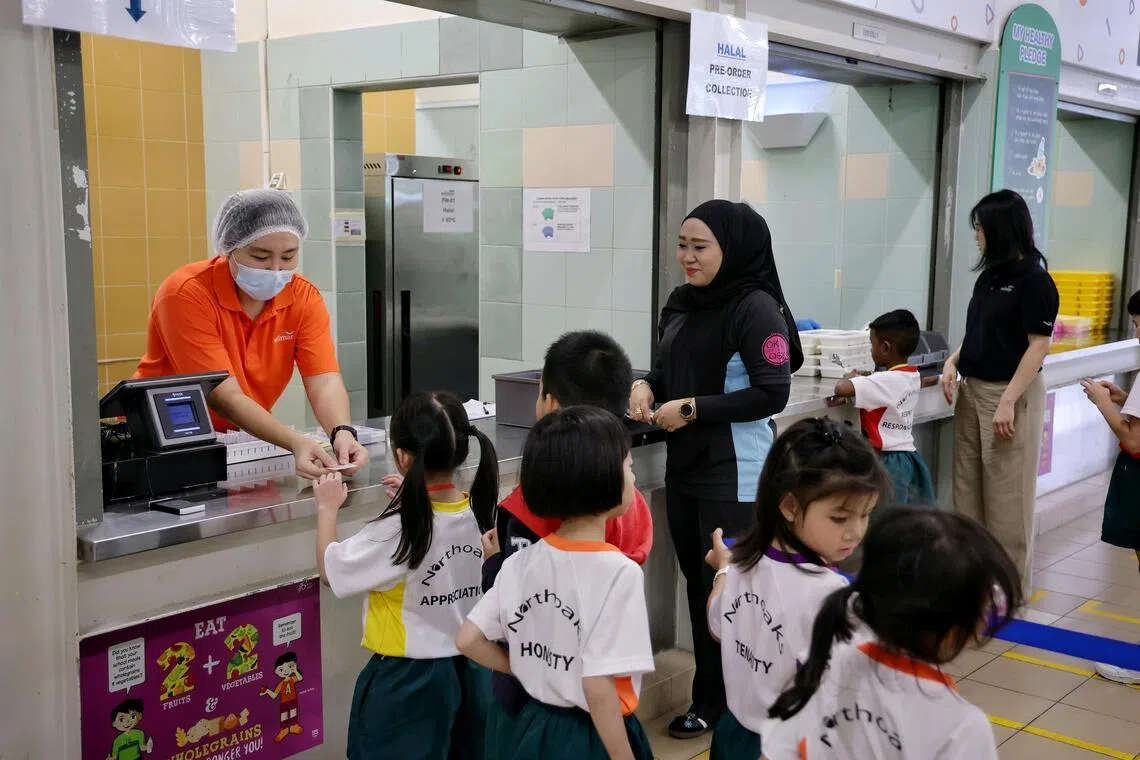
The ministry adopted the central kitchen meal model in a bid to explore alternative models to help schools that were struggling to attract stallholders and had severe shortages of functioning stalls, she said.
She was responding to several questions from MPs on centralised kitchens and food safety, which drew attention after some
some schools rolled out the model in January 2026
.
Ms Lau noted that an increasing number of schools are struggling to fill vacant canteen stalls, leaving students – especially those with dietary needs – with very limited options.
“In some cases, these students may have to eat the same dish for weeks. And as parents, all of us would want our children to have a better experience,” she said.
Several MPs asked questions ranging from whether stall holders would receive help, to how many schools will adopt the model, and its connection to recent gastroenteritis cases.
The central kitchen meal model was rolled out to 13 schools in January 2026. Since then, sixty pupils from River Valley Primary School were
reported to have gastroenteritis symptoms
after having lunch provided by the school’s central kitchen meal model operator on Jan 14.
For Hwa Chong Institution which separately adopted a hybrid model – that combines on-site stalls with pre-packed options from a central kitchen – meals provided by airline caterer SATS had
sparked some criticism on the quality of the food
, after images of the bento sets were posted online on Jan 3.
Mr Foo Cexiang (Tanjong Pagar GRC) asked whether MOE would consider paying individual hawkers to set up stalls in canteens, if the objective is to give students a positive school experience, where the canteen and school is a “microcosm of society, of the hawker centers, the public spaces”.
Ms Lau said: “We are open to all possible models, including paying the stall holders, if need be, to ensure that our students have good access to healthy and affordable food.”
She said MOE continues to welcome applications from anyone interested in operating school canteen stalls, including private entities for schools with persistent vacancies.
Ms Lau added that MOE provides substantial support to stall holders as it believes that “their food and their presence can add to the positive school experience for our students”.
Rentals for canteen stalls are capped at between $5 to $15 per month, and are also waived during school holidays when there are no customers. The MOE also seeks preferential electricity tariffs through demand aggregation, and the savings are passed to stall holders, she said.
Ms Lau said MOE will continue to look at different options that best serve students’ needs, and refine the central kitchen meal model based on feedback.
Responding to questions on the recent gastroenteritis cases, Ms Lau said the Singapore Food Agency (SFA), Communicable Diseases Agency (CDA), and MOE are still investigating the causes for the incidents in both River Valley Primary School and
North View Primary School
.
She noted that River Valley Primary School currently uses a central kitchen operator, while North View Primary School has traditional stallholders.
She said both schools immediately stepped up the cleaning and sanitisation of their canteens and premises. The schools maintained close communication with parents, and continue to work with SFA and CDA to monitor any developments, she said, adding that all affected pupils have returned to school.
Responding to Ms Lee Hui Ying’s (Nee Soon GRC) question on the number of gastroenteritis cases in schools, Ms Lau said such incidents have averaged six cases a year in the past three years across all food service models.
She said for schools using central kitchen operators, MOE has contingency protocols including the immediate activation of alternative central kitchens or food providers.
She said limiting each central kitchen meal model operator to serving just four or five schools not only contains the impact of operational issues, but also allows MOE to observe different operators’ performance and have backup options ready if needed.
She added that where food safety breaches are detected, SFA takes immediate enforcement action and requires rectifications. Operations may be suspended or terminated for severe food safety breaches or ongoing disease transmission, with other punitive actions considered based on findings.
Responding to a question on food safety in the central kitchen model, Senior Parliamentary Secretary for Sustainability and the Environment Goh Hanyan said SFA has stepped up checks since August 2025 on central kitchens supplying school meals.
She said central kitchens are graded under the Safety Assurance for Food Establishment framework, which ensures they have a proper track record of food safety.
In the event of a major food safety lapse, these kitchens will be downgraded upon completion of suspension or court conviction, and inspected more frequently, she added.
Ms Lau said: “While the central kitchen meal model operators have had some initial pre-ordering problems in the first few weeks, the situation has stabilised.
“We will continue to monitor the performance of the operators closely and also actively take in feedback from students, parents and teachers.”