
SINGAPORE – Patients living with eczema welcomed the Health Ministry’s plans to study whether to include the chronic condition in a scheme that will provide them with government subsidies and allow them to tap their MediSave savings for treatment.
Health Minister Ong Ye Kung announced in Parliament on March 5 that from January 2027, the Ministry of Health (MOH) will include hyperthyroidism and hypothyroidism in the Chronic Disease Management Programme (CDMP).
This would expand CDMP to cover a total of 25 chronic conditions, including diabetes mellitus, hypertension and stroke.
MOH is studying other chronic conditions, such as eczema, for inclusion in the CDMP, and will provide an update when it is ready, with a decision expected to be made in 2026.
Once a chronic condition is included in the CDMP, patients will be able to use MediSave for outpatient chronic care costs, up to the annual withdrawal limit. Besides their own MediSave savings, they can also tap the accounts of immediate family members such as their parents, children or spouse.
Government subsidies will also be rendered through the CHAS scheme, with additional subsidies provided to Pioneer Generation or Merdeka Generation cardholders.
According to information on the National Skin Centre’s (NSC) website, eczema or dermatitis refers to inflammation of the skin and varies from person to person.
In mild cases, the skin is dry, red and itchy while in more severe cases, it may ooze, crust or bleed. It may also become infected if there are cracks or breaks in the skin barrier caused by scratching.
Atopic eczema or atopic dermatitis is the most common type. It arises from a complex interplay of factors – genetic predisposition, immune dysfunction and environmental factors, according to MOH’s Agency for Care Effectiveness (ACE) in its clinical guidelines to manage mild and moderate eczema, published on Feb 27.
Referring to a 2018 study published in the British Journal of Dermatology, ACE said atopic dermatitis affects about 13.1 per cent of people in Singapore – rates in children were at 20.6 per cent, higher than the 11.1 per cent in adults.
Assistant Professor Yew Yik Weng, an NSC senior consultant, said about half of the children grow out of the disease, based on clinical observations in many countries, though there are no good scientific explanations for this.
Eczema is a chronic condition considered to be incurable, with common triggers including heat, sweat, dust, very dry weather and even stress, Prof Yew said.
Nevertheless, eczema can be well managed and controlled, and many continue to lead their lives with minimal or infrequent symptoms, added Prof Yew, who is a member of the expert group in charge of developing the ACE clinical guidelines.
Patients interviewed by The Straits Times said they have varied responses to treatments, and that the chronic condition brings about costs that go beyond medication.

In mild eczema cases, the skin is dry, red and itchy, while in more severe cases, it may ooze, crust or bleed. It may become infected if there are cracks or breaks in the skin barrier caused by scratching.
ST PHOTO: AZMI ATHNI
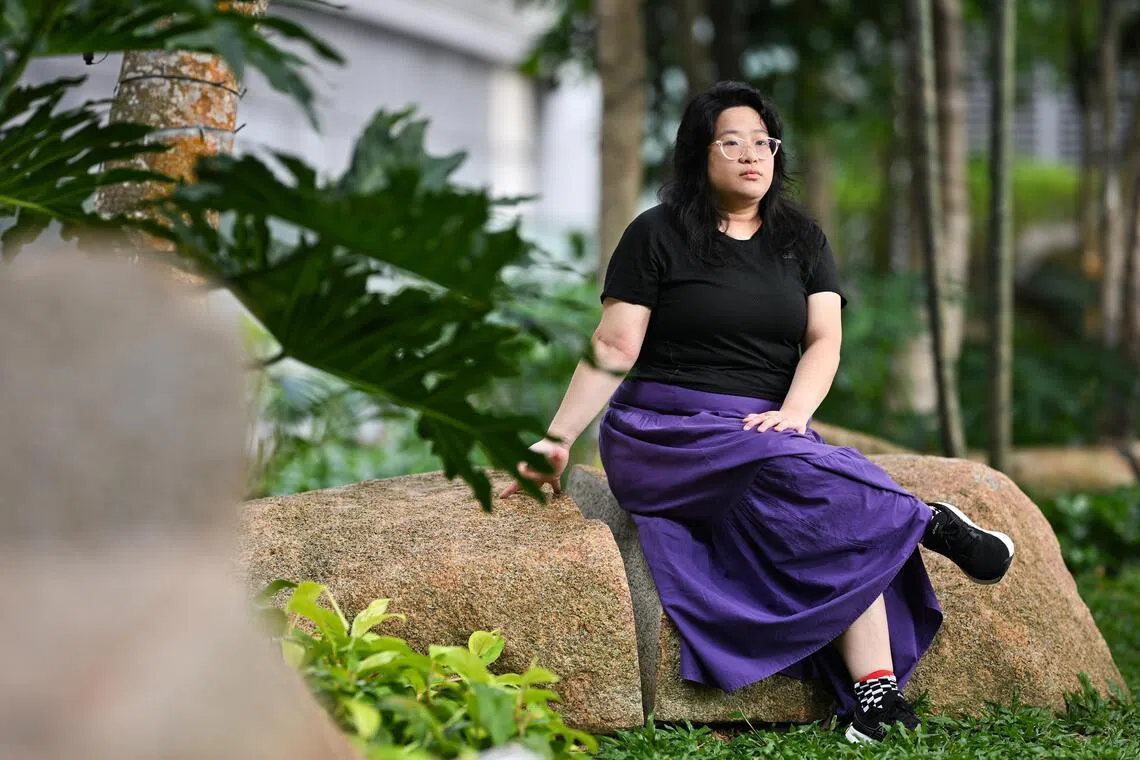
Ms Ursula Soh, 35, was among the patients who welcomed the study on whether to include eczema under the CDMP, as the cost of various items is generally rising.
Ms Soh, who was diagnosed with eczema when she was an infant, said her condition is generally well managed now. The freelance communications practitioner said she has learnt to coexist with the condition through self-experimentation over the years on how her body reacts to triggers.
For instance, she would try to stay in cooler and dust-free environments, and would choose swimming pools in hotels rather than public pools, as the lower chlorine levels in hotel pools are less likely to sting her skin and trigger flare-ups. When having seafood like prawns, her limit is five prawns before her immune system starts to react.
Ms Soh told ST that she is currently prescribed topical steroids by a polyclinic. She uses about one tube each month, which costs a few dollars. She also has moisturisers that are meant to be applied from head to toe each day, as well as other lotions and creams for anti-itch, and moisturising cream to be used after every hand wash. She estimated that these add up to at least $100 each month.
She also noted that members of the Eczema Support Group Singapore have raised concerns over the cost of other items, which may require other forms of support. These include the purchase of specific bedsheets and clothes, and maintaining a cooler living space with air-conditioning.
In 2012, Ms Soh set up the support group for people living with eczema to share their experiences. The online group has since grown to about 5,000 members.
Some of them have also shared their experiences of trying out newer therapies such as biologics, which are meant for moderate to severe eczema. However, cost continues to be a concern, as each injection costs at least $1,000, even in the public healthcare sector.
Online searches show there are currently at least three biologics available in Singapore – Dupilumab, Lebrikizumab and Nemolizumab. The first two work by inhibiting the proteins involved in inflammation associated with eczema. The last works by targeting the itch.
Even if eczema is included in the CDMP, a significant group of patients may not fully benefit from it, as they are currently not seeking care with healthcare professionals.
An online survey on eczema by the health information portal Medical Channel Asia found that among 197 respondents from Singapore, only 8 per cent are seeking treatment from a general practitioner and 33 per cent from a specialist.
Among the rest, 10 per cent are using traditional Chinese medicine (TCM) or alternative treatments, 44 per cent choose to self-manage the condition, and 5 per cent are not actively treating their condition.
Ms Yong Qiao Qing relies on monthly TCM sessions to relieve eczema for both her daughters and herself.
The 39-year-old marketing manager developed eczema in her 20s, but it is now relatively mild, with flare-ups on her hands when triggered by stress.
Her daughters have had eczema since they were infants. Her 10-year-old has a mild condition, with flare-ups on her limbs when exposed to dust and heat, while her six-year-old sister suffers from a more severe condition, as she has multiple food allergies that also lead to rashes and skin damage.

Ms Yong Qiao Qing (left) and her two daughers have eczema, but her six-year-old girl (right) has a more severe condition that requires significant lifestyle changes.
ST PHOTO: AZMI ATHNI
Ms Yong said the skin-prick test for allergies in KK Women’s and Children’s Hospital costs about $500 after government subsidies. They are recommended to take the test every quarter or half-yearly to monitor the situation.
The TCM sessions and herbal supplements to boost her and her daughters’ health cost the family more than $300 for each monthly session. If the girls fall sick, they would also go for paediatric tuina massage, at $50 per session.
They also spend around $300 to $400 each month on skincare products such as moisturisers, anti-itch solutions and body cleansers with natural or no added fragrances.
To cope with the multiple food allergies, she cooks fresh and whole food every day, with the natural or organic products adding to the household costs.
To help cope with the expenses, she set up a side business to sell clothes with protective sleeves and pants for children with eczema and sensitive skin.
Ms Yong hopes that health insurance can also cover TCM treatments and alternative medicines like bioresonance sessions by private chiropractors.
Her side business has grown into a community for mothers to connect over their caregiving experiences for children with eczema.
“We all know it’s a chronic disease which we will not be able to snap out of and walk away from… It is good to have the support of others,” said Ms Yong.