
Follow our live coverage here.
SINGAPORE – Private bus operators struggling to cope with surging diesel prices welcomed the temporary support announced by the Government on April 9, but some remain uneasy about their prospects in the longer term.
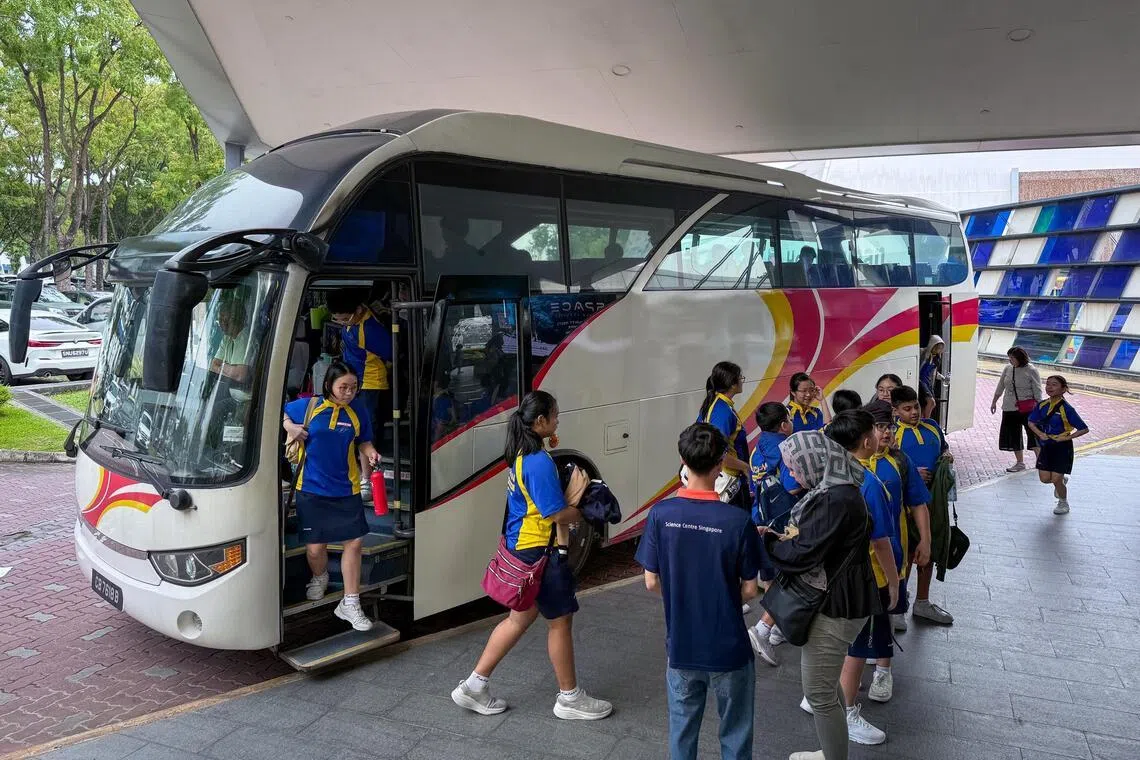
From April to June 2026, operators running certain essential bus services will receive funding that covers 13 per cent of transport fare revenue. They include operators running regular bus services to primary schools, special education schools and disability services.
Mr Colin Gan, president of the Singapore School & Private Hire Bus Owners’ Association (SSPHBOA), said that while the temporary support will help, it does not go far enough to support operators who have been suffering losses because of surging fuel prices in recent months.
Singapore School Transport Association (SSTA) spokesman Darry Lim noted that fuel prices have risen by much more than the amount of support given. The association represents mainly self-employed school bus drivers.
The two trade associations representing the sector warned that some smaller players may fold under the pressure of higher fuel costs, which in turn could affect the industry’s ability to fulfil contracts with schools and companies as larger operators rely on smaller firms as sub-contractors.
Large and small private bus operators interviewed by The Straits Times said they are losing money on every trip, and have been calling for help to cope.
Mr Lionel Lim, whose firm Bedok Transport has a fleet of 60 diesel-powered buses, said the fuel bill for March exceeded $100,000 – more than double that of the month before.
He is bracing himself for another big jump in April.
“I have been losing sleep over this,” he told ST.
The cost of diesel has gone up from around $2.50 a litre in late February to over $4 a litre so far in April.
The temporary support will help but a more sustained fix is needed, he said, suggesting a fuel surcharge framework integrated into existing contracts.
This will better equip the industry to weather the crisis, he added.
Diesel costs accounted for 10 per cent to 40 per cent of the total cost of running bus operations before prices surged due to the Middle East conflict, according to checks by ST. This has risen to more than half of the total cost of operations for some companies.
Costs like salaries, administration, vehicle depreciation and maintenance made up the rest.
Mr Gan, SSPHBOA’s president, said some of the smaller operators, colloquially known in the trade as “OMOs”, or one-man operators, will likely not be able to survive unless more is done to help ease the impact of rising fuel prices.
The association represents more than 700 bus operators with a collective fleet of around 2,100 buses.
Buses from owner-operators are critical to the industry, as most large operators rely on them to make up the total number of buses they need for contracts, he said.
SSTA’s Mr Darry Lim said owner-operators have been harder hit by the rising fuel costs.
Depending on the agreed terms, corporate clients can take months to pay for transport services, adding to their cash flow woes.
Mr Lim said that as diesel prices spiked, the credit term for some bus companies to settle their fuel bills was halved from 30 days to around two weeks.
Many owner-operators are already quite old, noted Mr Lim, who runs Hui Leong Bus with a fleet of 40 buses.
With the current challenge, some are considering retiring rather than make a loss, he said, adding that the announced support may not be enough to change the situation.
If retirements take place, some bus operators may give up their primary school contracts by the June holidays as they would not have enough sub-contractors to supply the buses they need, he noted. In such a scenario, school bus fares will rise to account for the higher cost.
While he had not expected the temporary assistance from the Government to fully cushion the industry from price hikes, Mr Voo Wei Keong, Woodland Transport’s executive director and head of bus operations, noted that the support essentially helps school bus operators for only two months as no fares are collected during the June school holidays.
He said the risk is that sub-contractors may pull out when schools reopen in July, leading to a shortage of buses.
To save fuel, Woodlands Transport, which has 300 buses, is reminding drivers not to leave engines idling while waiting for passengers.
The company also tightened its monitoring of drivers a few weeks ago to identify those with higher fuel consumption.
Mr Terence Ng, owner of Leisure Frontier, which has 150 buses, said his transport contracts are designed to enable his company to cope with cost increases of up to 20 per cent without losing money, based on costs set before diesel prices spiked. This hedge has been eroded by the cost hikes.
To cut costs, he has been looking at optimising bus routes by connecting trips in a way that avoids having the bus travel empty over a long distance to get to faraway pick-up points and incur unnecessary fuel costs.