
SINGAPORE – New proposed measures to help
ageing condominiums tackle maintenance problems
have been broadly welcomed by residents and managing agents, although they said the implementation may be difficult.
Some council members also warned that government co-funding of lift upgrades could encourage estates to delay repairs while they wait for subsidies.
Others noted that the interests of owner-occupiers and investors often diverge.
The
Government is reviewing the Building (Strata Management) Act
as more private residential developments in Singapore cross the 30-year mark. More than 1,000 of 3,750 such developments are at least 30 years old.
Some proposed changes include lowering the consent threshold for essential works, capping proxy representation per household, requiring council members to undergo mandatory training, and publishing the financial information of management corporation strata title (MCSTs) funds.
Second Minister for National Development and Finance Indranee Rajah, who announced the proposed measures in Parliament on March 4, also said the Government is studying whether to partially fund lift and escalator safety upgrades for condominiums and other private buildings.
While some residents said subsidising private estates was a bold move, a handful warned against becoming reliant on subsidies.
Mr Augustine Cheah, a condo resident who has had experience on several MCST councils, said co-funding could encourage some estates to defer maintenance works until they qualify for government support.
“For example, if the Government co-funds the lift upgrade of an ageing condominium, other MCSTs may say ‘Let’s wait until we meet the criteria and apply for the co-funding,’” said Mr Cheah, who is in his 60s.
“That way, the burden will eventually fall on taxpayers.”
Mr Cheah said a more sustainable approach may be to build reserves early. The Building and Construction Authority (BCA) could consider setting a minimum contribution to the estate’s sinking fund based on the long-term projected costs of maintaining it, Mr Cheah suggested.
“Managing agents could determine the amount required for long-term maintenance, while the law could require estates to collect a certain percentage of those costs in advance, ensuring funds are available when major works are needed,” he explained.
Mr Cheah noted that proxy voting is less of a concern today, after an earlier review by BCA reduced the number of proxies one person can hold.
Instead, he suggested it be made mandatory for home owners to attend annual general meetings to ensure the decisions made truly reflect their views.
Managing agent Hansen Tan said he supports lowering the consent threshold for essential works to get a higher chance for essential works to be done, adding that it would be beneficial to define what constitutes essential works to help estates make decisions more efficiently.
Currently, a special resolution of 75 per cent of owners’ voting share is needed for such improvement works. The BCA said it is prepared to reduce this to a 50 per cent simple majority or share value.
He also noted that only painting is defined as an essential service, which requires the MCST to repaint the estate every seven years, while other works, like lift maintenance and upgrading, fall under grey areas.
Lifts usually need replacing after 25 to 30 years, said Mr Tan, who is deputy managing director of Chambers International. But some owners view lift replacements or modernisation as “improvement works” and oppose them, making it hard for the council to get the necessary approval to upgrade these essential facilities.
He added that major infrastructure replacement can be extremely costly.
For example, replacing a lift typically costs between $200,000 and $300,000. In a development with five blocks and two lifts per block, the total price can be between $2 million and $3 million, said Mr Tan, whose firm manages 180 developments.
Ms Winnie Wong, senior managing director of property management at Savills Singapore, said in an earlier report that many MCST sinking funds are far from sufficient for major works, a problem likely to worsen in the next decade as more buildings age.
Ms Wong supports legislation or policy to ensure reserves are built up, including setting minimum contributions.
She said reducing the threshold to 50 per cent for essential repairs that involve upgrades or improvements would help speed up the decision-making at annual general meetings.
Mr Lim Ming Yi, 45, who sits on the management councils of DUO Residences in Bugis and Thomson Euro-Asia in Novena, said owner-occupiers are generally more supportive of maintenance works that improve the estate’s condition, while investors may be more concerned about the impact on rental returns.
“I think it is a very good step because I have been on four MCSTs in the past, and often the agenda and proper upkeep of the condo can be compromised by different interests,” he noted, adding that residents will usually accept and support such works, but investors not living there themselves may put up strong resistance.

DUO Residences in Bugis. Owner-occupiers are generally more supportive of maintenance works that improve the estate’s condition.
ST PHOTO: STEPHANIE YEOW
Mr Lim also said clearer guidance from the Government on what constitutes essential works could help build awareness and gain support, as councils would be able to show that the spending is required by law rather than discretionary.
However, Mr Cheah, a property investor, said the divide between investors and owner-occupiers is not always clear-cut.
In some cases, investors may be willing to contribute to maintenance works to keep property attractive to tenants, while owner-occupiers may be more reluctant to support higher maintenance costs since they do not benefit directly from higher rents or resale prices, he said.
All stakeholders The Straits Times spoke to said they support greater financial transparency to improve estate governance.
Mr Francis Poh, 73, who lives in Grandlink Square in Geylang, said that although there is a risk that making MCSTs financial information public could potentially affect property values, such a move would ensure fairness and accountability in how councils manage estate funds.

Grandlink Square in Geylang.
ST PHOTO: DESMOND WEE
Several residents said the proposed changes may not resolve the financial challenges faced by ageing estates.
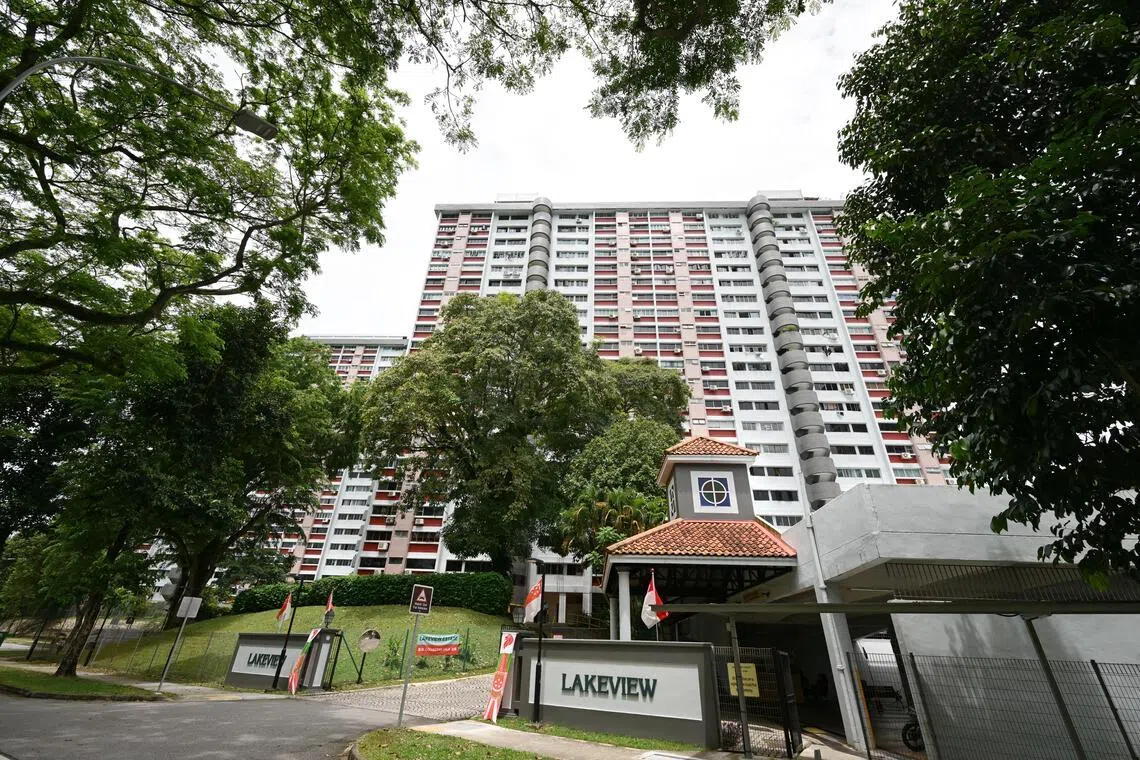
Mr Nallan Chakravarti Raghava, 73, a former council member of the Lakeview Estate in Upper Thomson, said older developments like his struggle with issues such as water seepage and frequent lift breakdowns but lack the funds to carry out major repairs.
It is difficult to get the funding for upgrading works in an estate
where many residents are retirees and a quarter of the 240 units are rented out.
“Lowering voting thresholds would help, but it would not solve the problem when many older estates do not have the funds and neither do the residents,” said Mr Raghava.
“It’s really a double whammy – the estate is ageing, and so are the owners.”