
SINGAPORE – Ahead of works to prepare for the Long Island reclamation off East Coast Park, parkgoers have appealed to the authorities to ensure that activities at local recreational haunts can continue even while works are ongoing.
These areas include fishing hotspot Bedok Jetty and a surfing haven known as “Longkang Point”. A timeline for when the works will commence has not been revealed.
This was a key theme of feedback submitted to the Housing Board (HDB), which on Sept 16 said that it had received 430 responses to an environmental study for preparatory works that was published more than two months ago.
Members of public had called for the recreational nature of East Coast Park to be retained and the impact on affected stakeholders to be limited.
In response, HDB reiterated that it will minimise disruption to existing recreational activities along the East Coast.
The preparatory works will be conducted at least 130m away from the shoreline and in phases starting in the waters west of Bedok Jetty. This means that public access and activities can still continue at beaches and shoreline facilities like the jetty.
The HDB also said it expects limited disturbance and minimal changes to wave conditions in the current surfing areas during the preparatory works.
It stressed that there will be close monitoring of key environmental conditions like water quality, suspended sediment levels, noise and dust, to ensure that impacts remain at acceptable levels for public use.
When completed in the coming decades, the reclamation of some 800ha of land for Long Island will protect low-lying areas from Marina East to Tanah Merah against rising sea levels, create an additional reservoir as well as land for future needs. The amount of land that will be reclaimed is about twice the size of Marina Bay.
Another key theme of the feedback revolved around concerns about the impact of the works on marine fauna like sea turtles, bottom-dwelling fish and coastal horseshoe crabs.
Members of the public had called for more information to show how these species and the vicinity’s natural habitats, including corals and seagrass, would be affected and protected from the development.
In response to these queries, HDB said it had updated its environmental study for the preparatory works that had been released on June 30 with more data to better characterise the fish communities within the study area and specific impact on coastal horseshoe crabs.
Even with inclusion of these data, the overall impact on fishes that dwell near and at the bottom of the sea, as well as the nesting habitat of coastal horseshoe crabs is unlikely to be significant, the Housing Board said.
It added that infill materials, which include sand, will be placed in a controlled manner using a pipeline system, minimising disturbance to shallow shoreline habitats.
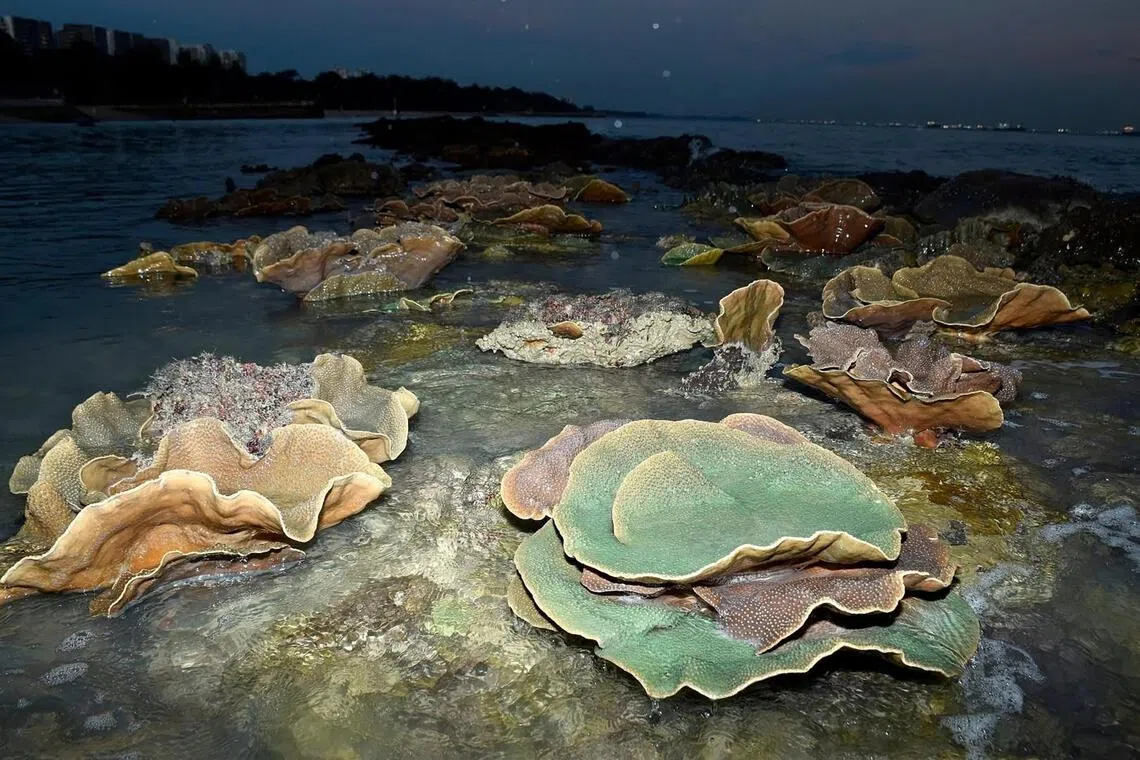
It noted that the works are not expected to affect most of the coral and seagrass in the East Coast Park area, or significantly affect recreational fishing or the fish and marine fauna community as a whole.
The HDB said: “Seagrass habitats are also generally resilient to periodic turbidity and are expected to recover without long-term degradation.”
With East Coast Park known to be a popular site for the critically endangered hawksbill turtle to nest, HDB said that agencies will work closely with experts to explore other measures to minimise the risk of harm to nesting turtles during the preparatory works.
This will be in addition to the National Parks Board’s efforts to search for turtle nests along the East Coast Park shoreline and re-locate the eggs laid there to a hatchery on the Sisters’ Islands Marine Park.

NParks staff attaching a satellite tracker on a critically endangered hawksbill turtle that crawled ashore to lay its eggs at East Coast Park on July 10.
ST PHOTO: LIM YAOHUI
The HDB noted that most feedback providers had recognised the need for coastal protection and asked if alternative coastal protection measures could be considered to retain the ecological and recreational value of East Coast Park and avoid the need for land reclamation.
It said agencies had considered building a new seawall of up to 3m in height fronting East Coast Park from Marina East to Tanah Merah, with tidal gates and pumping stations expected to take up the size of 15 football fields.
However, the HDB said this was ruled out as it will take up significant space within the existing East Coast Park and severely impede accessibility for recreational, sports and park users. This could also potentially create significant impacts on some ecosystems at the shoreline and intertidal areas along the East Coast.
The HDB said it will explore the feasibility of creating suitable habitats along the future coastline to support turtle nesting, as well as future recruitment of coral larvae and seagrass fragments.
The Housing Board will also assess the need for early transplantation of coral or seagrass communities ahead of the long-term plans for ‘Long Island’ to allow more time for marine biodiversity to grow and thrive.
While the formal consultation period for the preparatory works for ‘Long Island’ has closed, the Housing Board welcomed members of the public to continue sharing their feedback at this website.
It said the next phase of public engagement is planned to start from end-2026.
ST has contacted the HDB on when the preparatory works are scheduled to begin.