
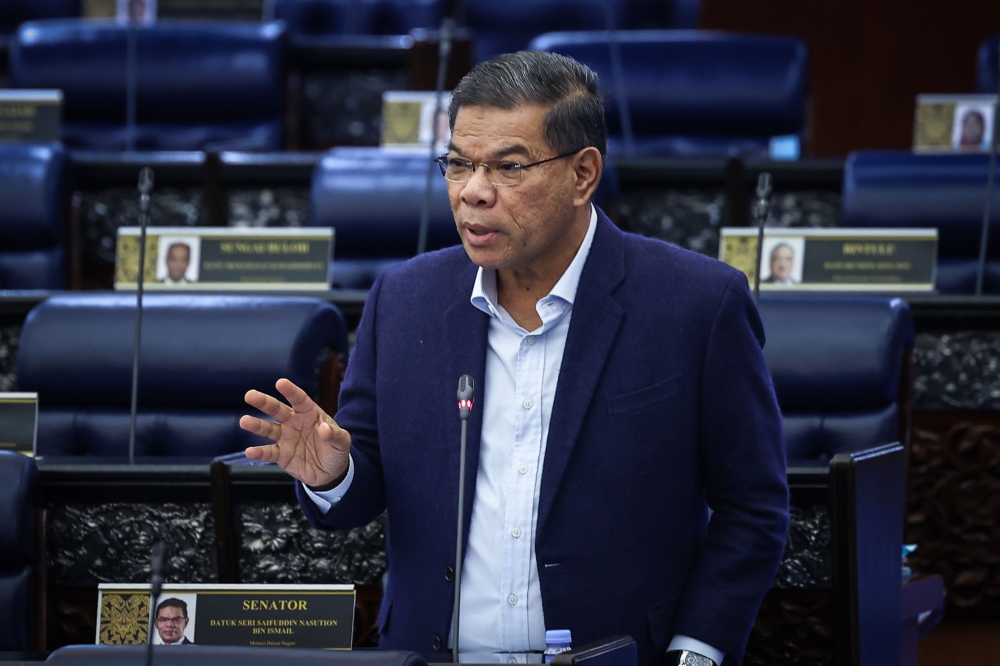
KUALA LUMPUR, Feb 10 — The Home Ministry is in the process of amending the Registration of Criminals and Undesirable Persons Act 1969 to introduce a “second chance” mechanism.
Home Minister Datuk Seri Saifuddin Nasution Ismail said this will include a system to deactivate certain criminal records after a crime-free period.
“The Home Ministry is currently in the process of amending the Registration of Criminals and Undesirable Persons Act 1969, or Act 7, which is the legal basis for registering individuals convicted of offences in the criminal registry.
“The proposal had been presented to the Cabinet, which agreed on May 21, 2025, to allow the Home Ministry to begin efforts to amend the Act,” he told Parliament during the Minister’s Question Time today.
Explaining further, Saifuddin said a key component of the amendment is the introduction of a “spent” mechanism — or deactivation system —which would allow certain individuals to have their criminal records treated as inactive after a specified period without repeating offences.
Under the proposed mechanism, he said individuals who have been convicted, exhausted all appeal processes, served their prison sentence or settled fines or compounds, and remain free from further criminal offences within a set timeframe may be considered as having a “spent” record.
“This means after they have completed their sentence and remain crime-free within the period we set — what we call a crime-free period — they may be regarded as having no record, unless it involves serious offences,” he said.
He said the “spent” mechanism is not intended to erase criminal history entirely, but to allow former offenders who demonstrate rehabilitation and compliance with the law to move forward without their past record continuously affecting employment, social reintegration and livelihood opportunities.
Saifuddin said serious crimes would likely remain excluded from the mechanism, while eligibility would depend on offence type, risk level and the individual’s conduct after completing their sentence.
He added that the amendment would formalise a structured legal pathway for rehabilitation, rather than relying solely on discretionary or administrative approaches.
“The proposal takes into account international good practices, including systems in the United Kingdom, Singapore, Brunei and Australia, which allow certain criminal records to be excluded after a crime-free period subject to conditions.
“The proposal is currently being reviewed by the Attorney General’s Chambers and is expected to be tabled in Parliament this year,” he said.
Responding to a supplementary question regarding employers hiring former prisoners and societal stigma, Saifuddin said to date, there are about 2.63 million criminal records have been maintained since 1969.
“When we profile this number, the largest group involves convictions under the Dangerous Drugs Act, particularly Section 15 involving drug consumption and Section 12 involving minor possession, followed by offences under Section 39A and others,” he said.
He said these categories make up almost half of the total and could be considered for the second chance mechanism if individuals do not repeat offences.
On addressing stigma, Saifuddin said the government is able to facilitate legal reforms to offer second chances, but he said the society also plays a role in changing perceptions and providing opportunities to former prisoners.
“Existing prison initiatives already reflect the second chance approach, including programmes allowing inmates convicted of minor offences to serve part of their sentence outside prison walls while undergoing skills training and employment placement.
“Malaysia currently has six such external placement facilities, including one in Pantai Merdeka that houses about 250 inmates.
“For every 800 inmates released under this initiative, only one decided to go back to old ways. This is a success story,” he said.
Saifuddin said acceptance among society and employers varies, and continuous efforts are needed to improve public perception.
On collaboration between the Prisons Department and entrepreneurship-related agencies, Saifuddin said Malaysia currently has 41 prisons housing about 87,000 inmates, of whom about 29,000 are remand detainees, while the rest are convicted prisoners who are eligible for training programmes.
Ongoing programmes include TVET training, textile weaving training such as at Marang Prison, carpentry and furniture-making using timber supplied by the Forestry Department, as well as bakery and food preparation training, particularly during Ramadan.
According to Saifuddin, prison-run food sales during Ramadan last year exceeded RM1 million.
“The inmates are also supported after release through transitional housing if families or communities are not ready to accept them back.
“We continue supporting them until their family and society have accepted them, this is beyond the normal scope of prison responsibilities,” he said.