
SINGAPORE – Hundreds of Built-To-Order flats with shorter waiting times will be launched in Sin Ming and Toa Payoh, with construction of the new homes underway and slated for completion by mid-2030.
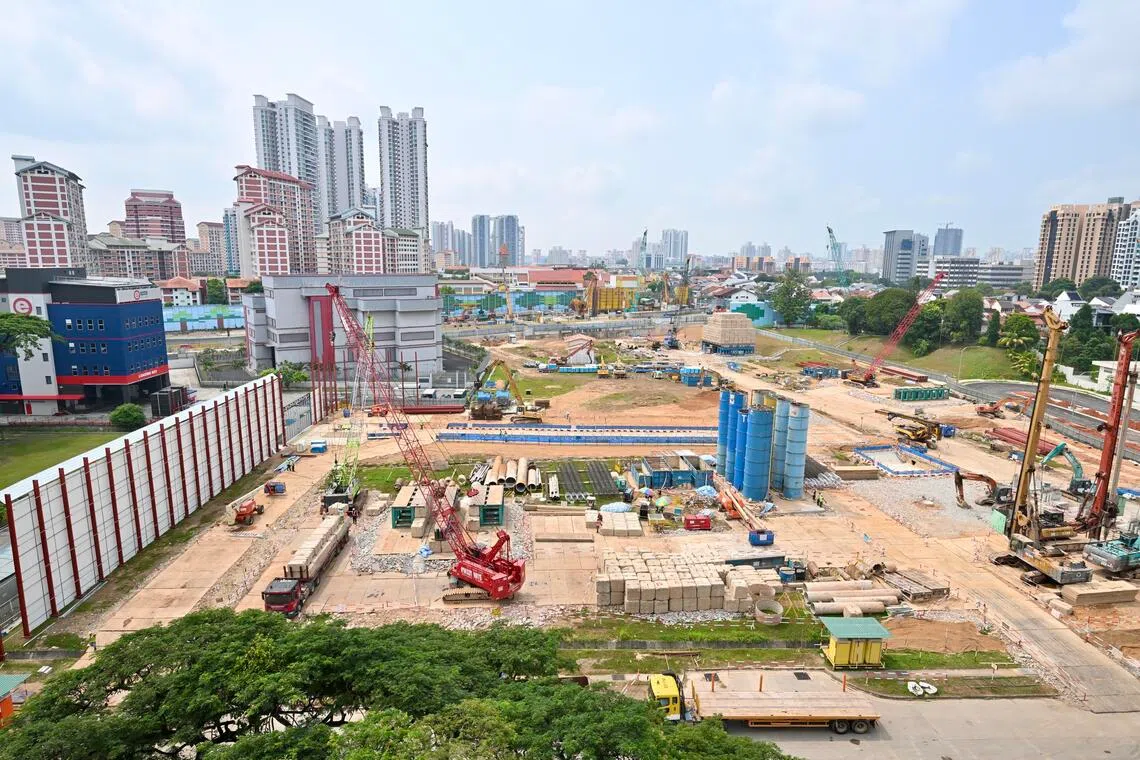
In Sin Ming Street, which is part of Bishan town, a 1,076-unit project that will include a childcare centre and a supermarket is currently being constructed across the road from Sin Ming Residences, a public housing project that is nearing completion with 984 units.
And in Lorong 4 Toa Payoh, work has started on a 40-storey HDB block comprising 193 units that will be accompanied by a multi-storey carpark with a roof garden, a precinct pavilion and other community facilities.
The Housing Board said in a statement to The Straits Times that the flats’ launch dates and estimated waiting times will be announced at a later date, although their projected completion date suggests that both projects will likely go on sale in mid-2027 at the earliest.
Flats with shorter waiting time have wait times of under three years, with construction work typically starting before these flats are launched for sale so buyers can move into their homes sooner.
HDB said it has been ramping up flat supply to meet higher demand, and noted that both the Sin Ming and Toa Payoh project sites are brownfield, meaning they have previously been developed.
“In staging these housing developments, HDB has been progressively redeveloping vacant or suitable brownfield sites for housing in the first instance, before considering other sites that are zoned for housing,” said the board.
The Sin Ming site was formerly occupied by an HDB rental block and several industrial buildings that have since been demolished, while the project in Lorong 4 Toa Payoh will occupy the site of an open-air carpark that sat between Blocks 62B and 66 Lorong 4 Toa Payoh, and Block 63 Lorong 5 Toa Payoh.
Asked why it had decided to develop homes at the Lorong 4 Toa Payoh site considering its relatively small area of about 0.78ha and its proximity to existing homes, HDB said: “Given our limited land, we must redevelop where we can to optimise our land use.”

The board noted that Toa Payoh has been built up progressively over the years and has limited land for new development.
It added that redeveloping suitable brownfield sites such as the former carpark enables it to provide more housing options in the town, including for those who wish to live near their families.
Analysts expect healthy demand for both projects due to their location, historical trends and shorter waiting times.
Wong Siew Ying, head of research and content at PropNex, noted that five BTO projects launched in Bishan since August 2020 – including Sin Ming Residences – were oversubscribed with at least three applicants vying for each flat.
Eugene Lim, key executive officer at ERA Singapore, added that resale flats in the town have also been highly sought after, with buyers willing to pay premium prices for them.
Lim said that, for instance, about a quarter of the 376 flats sold in Bishan in 2025 changed hands at at least $1 million, while 46 of the 230 flats sold on the resale market in the first seven months of 2026 crossed the same threshold.
Given that the number of HDB flats in Bishan has grown by about 11 per cent between 1996 and 2025, compared with 67 per cent nationally, said Wong, it is not a surprise that more flats are being added to the town.
“Having a larger resident catchment and greater vibrancy also line up with the Government’s proposed plans to redevelop Bishan town centre into a business and lifestyle hub under the Master Plan 2025,” she said.
Wong added that the new flats could be in the Plus category owing to their city fringe location. She noted that, like Kebun Baru Breeze – a recently-launched Plus project in Ang Mo Kio, the Sin Ming site is not at the doorstep of any MRT station, and is some distance from the town centre.
Plus and Prime flats are typically closer to the city centre, transport nodes and amenities. Owners of such flats must return additional subsidies to HDB when they sell their flats on the resale market for the first time.
Lim, meanwhile, said the site’s distance from an MRT station and its location “in the quieter part of Bishan” could push it into the Standard category.
Going by strong demand for two- and four-room units, Wong said it is likely that this flat type will form the bulk of the supply in the Sin Ming project, with three-room units – if offered – in the minority.
Notably, she said, the demand for this three-room flat type at Sin Ming Residences was muted, with 177 applications for 105 units, compared with 2,293 applications for 627 4-room flats. The remaining 252 flats in the project are rental units.
Lim added that the project is likely to appeal to parents with school-aged children as Ai Tong School and Catholic High School are within 1km of the site.
As such, to accommodate larger families, Lim suggested that HDB could include some five-room flats in the mix.
With new public and private homes in the pipeline and hundreds of households set to move into Sin Ming – a primarily industrial estate – both analysts said that the character of the area may change over time, although they noted that industrial developments will remain a fixture in the neighbourhood.
Meanwhile, the analysts said that the development in Lorong 4 Toa Payoh will likely be classified Prime or Plus if launched as a BTO project, owing to the site’s proximity to the town centre and an MRT station.

The project in Lorong 4 Toa Payoh is set to yield 193 flats.
ST PHOTO: KUA CHEE SIONG
Both said they expect a mix of two- and four-room flats to be built at the site.
Wong said that the project’s 193 units could make it the smallest BTO project in Toa Payoh since March 2012, when 188 units at the studio apartment block Golden Clover were put on sale.
She said that redeveloping the open-air carpark site is an opportunity for the HDB to offer what are likely to be well sought-after units located close to the MRT station, with few undeveloped larger sites available in the town centre.
Lim added that the planned multi-storey carpark and community facilities that are being built at the site will also improve existing residents’ living environment in the longer term.