
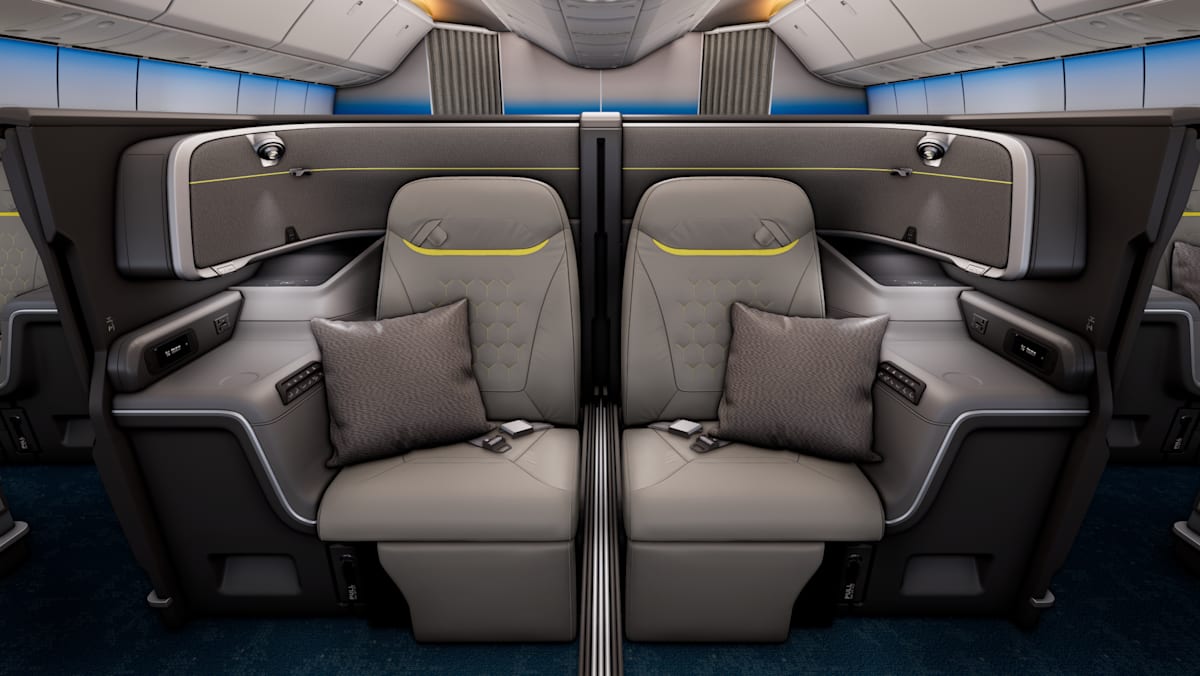
Mr Goh said that customer feedback had highlighted privacy as a key priority, prompting the airline to introduce doors and higher-than-average partitions.
“I would say the (doors are) higher than the average wall height for business class out there,” he said.
Beyond privacy, the new business class seats were also designed to offer greater space and comfort, with a tray table storage system that frees up additional room in the footwell.
Mr Goh added that convenience was another consideration, with charging points and storage compartments for personal belongings positioned within easy reach of passengers, even while they are seated or resting.
BACKLASH TO SIA’S NEW CABIN PRODUCTS
When SIA’s new cabin products were unveiled on Nov 6, responses poured in from customers and members of the public online.
Some likened the seats to dental chairs, while others felt the colours and finishes looked cheap and were not in keeping with the airline’s premium image.
However, others who tried the new seats praised their comfort, spaciousness and improved privacy features, including the addition of sliding privacy doors.
In response to public feedback, SIA said on Wednesday that the cabin colour palette for its the business class seats was “carefully selected” and were “designed to enhance comfort, privacy, and functionality, while supporting a more seamless travel experience”.
“The colours, materials, and finishes were carefully selected to create a fresh, contemporary, and refined ambience, complemented by adjustable in-flight LED lighting throughout the journey,” SIA added.
For the first half of its financial year, SIA Group saw its half-year revenue lift 16.8 per cent to S$11.3 billion (US$8.8 billion), fuelled by “robust growth” in passenger and cargo yields.
Its net profit, however, fell 43.9 per cent to S$134 million, largely due to a S$234 million decline in operating profit.
The airline said the drop was partially offset by lower losses from associated companies, mainly Air India, and lower tax expenses.