
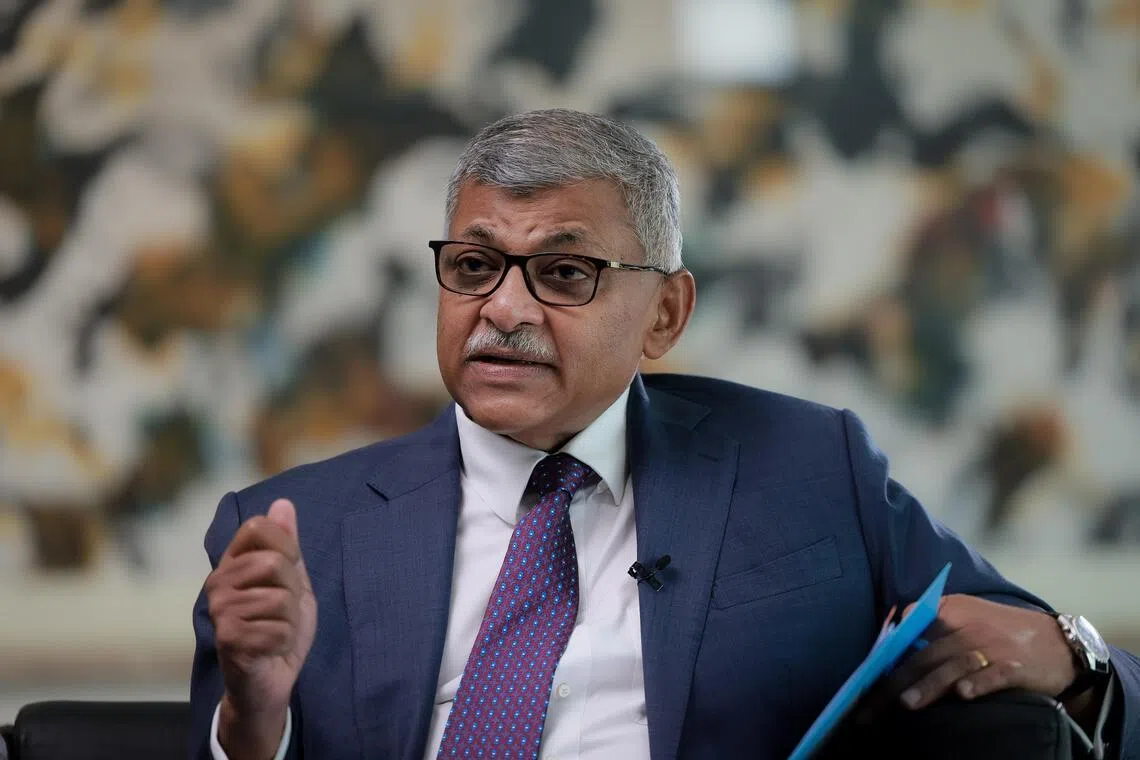
SINGAPORE – In an age of truth decay, where there is a blurring of the line between opinion and fact, many people comment on court decisions even though they do not know much about the case.
Chief Justice Sundaresh Menon said this breakdown of truth, due to factors such as the rise of echo chambers, poses a challenge for the courts, which are fundamentally truth-seeking institutions.
That is why it is critical that people believe the courts make decisions based on evidence, he said.
Because if most people believe, rightly or wrongly, the courts are making decisions in some other way, there would be a breakdown of confidence in the courts and a breakdown of order in society.
Speaking to reporters on May 22 to mark the 200th anniversary of Singapore’s legal system, Chief Justice Menon spoke on topics such as the impact of artificial intelligence on the courts and the high attrition rates among young lawyers.
He said the court’s business is to look at the evidence and to pronounce on what is true based on the evidence.
To mete out justice is one thing. But to explain it simply to the public is another.
Chief Justice Menon said that is why the Singapore judiciary is committed to giving reasons for its decisions and making these judgments available on its website.
He acknowledged that a long judgment of up to 100 pages may not be accessible to most people.
That is why case summaries are provided for many cases, which he said has helped people understand essential parts of the judgment in plain language.
He added: “I don’t do this often, but occasionally when I go and look at the social media feeds, I think there is still a large number of people who comment without even having read the summaries.
“They might have read a headline, and then, based on the headline, they jump to various conclusions. I don’t think there is anything we can do about that, and I don’t think it is widespread. I don’t think we should overreact to it.”
He added that surveys of court users show that people generally leave the courts feeling that they have had a fair hearing, which is important to preserving trust in the institution.
He added that Singapore is one of the few countries where trust in public institutions outranks trust in corporations.
“I think that that is a track record that we have to work really hard to preserve,” he said.
In recent years at public events, Chief Justice Menon has spoken extensively about AI.
In one of his earlier speeches at a sentencing conference in 2022, he said that while AI could help enhance access to justice in simpler civil cases, it was unlikely Singapore would adopt AI in criminal cases within the foreseeable future.
During the interview, he revealed that the judiciary has developed a “traffic light model”, using the colours of red, amber and green, for thinking about how to incorporate AI in the court system.
Red describes the areas which are not being considered, such as decision-making and providing predictions.
Amber describes the areas which are being cautiously evaluated, such as helping self-represented litigants present their arguments in a clearer and more structured way.
The use of AI to translate and summarise documents, which has proven useful for users of the Small Claims Tribunals, falls within the green zone.
Chief Justice Menon outlined the risks of AI, including concerns about accuracy, over-reliance and transparency.
He also explained why the judiciary’s governance framework for AI use emphasises personal responsibility instead of setting out prescriptive guidelines.
He said a choice was made not to be too prescriptive because the use of AI would be nearly impossible to police in a world where it was in commonly used computer software like Microsoft Word.
The sensible approach to take is that a lawyer or a self-represented litigant is deemed responsible for whatever they put before the court, he said.
He added that young lawyers will have to understand that working with AI will be a part of their reality.
“It is here to stay, and we need to figure out how to work with AI as teammates, how to incorporate it safely into our workflows and into our work patterns.”
Looking ahead, he said, the judiciary must focus on preserving trust, keeping a close watch on AI and making sure the profession can renew itself.
When asked about attracting the right mix of legal minds to the Supreme Court bench, he noted that it currently comprises lawyers who were in private practice, public servants such as former prosecutors, and academics.
He also pointed out that he was in private practice for about 20 years before he joined public service, and that the mix of experiences has changed his perspectives.
“I don’t think I am the same lawyer I was when I left private practice,” he said.
So, while there is value in diversity, the main thing is to get the best possible people with the right hearts into the judiciary, he said.
He added: “I am very thankful that certainly in my time, I have not been struggling to get the people I want onto the bench, and I hope that will continue.”