
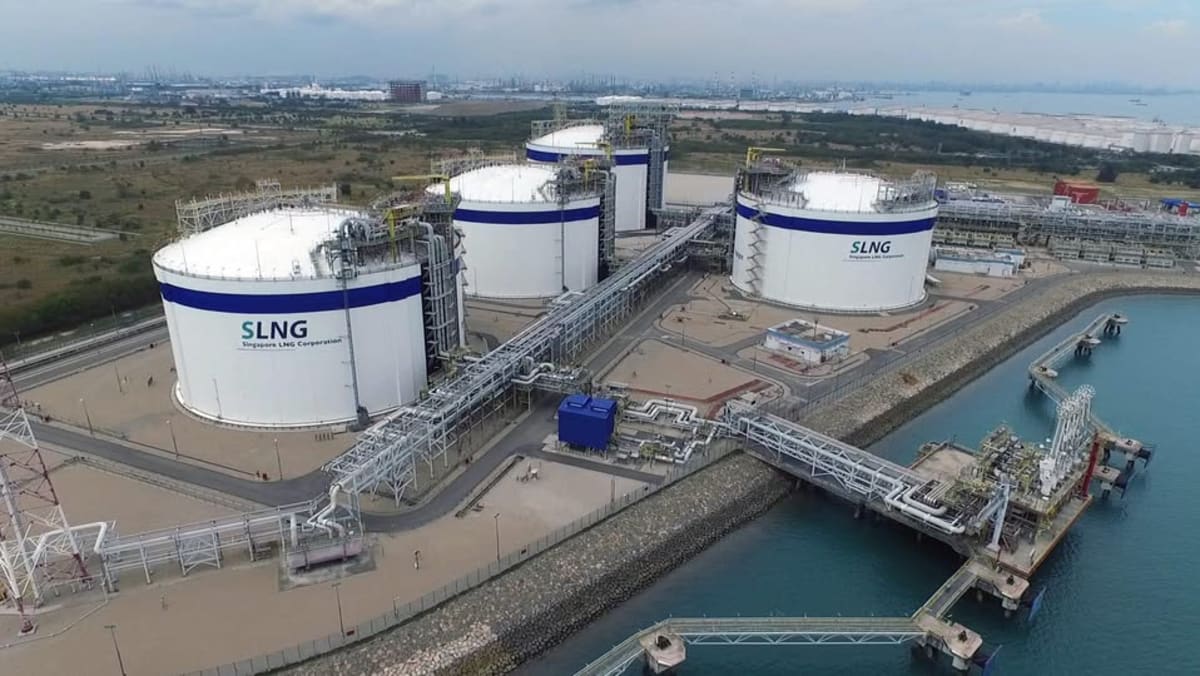
SINGAPORE: Singapore has multiple lines of defence to safeguard its energy security from the Middle East conflict, but people should expect electricity prices to increase in the coming months, Minister-in-charge of Energy and Science & Technology Tan See Leng said on Thursday (Mar 12).
Dr Tan noted that the closure of the Strait of Hormuz has impacted global imports of crude oil and LNG from the Middle East, which will likely result in higher global fuel prices in the near term.
“With the global environment becoming less certain and stable, fuel disruptions and price fluctuations are more frequent,” he said in a Facebook post.
“These effects are felt in Singapore, where we import all of the natural gas needed to fuel about 95 per cent of our electricity generation.”
Dr Tan noted, however, that Singapore has measures in place to ensure it has enough energy for its needs.
About half of the country’s gas is piped from the region and is unaffected, he said, adding that Singapore also diversifies the sources of imported LNG and is not overly exposed to the Middle East.
“Our LNG importers have a global portfolio of sources, such as the US and Australia, which they can tap on to replace cargoes originally from the Middle East. For the one LNG cargo from the Middle East, efforts are underway with the importers to find replacement cargos,” Dr Tan said.
Singapore also has established a fuel stockpile comprising a mixture of gas and diesel, which power generation companies can draw from if there is a severe disruption to gas supplies, he said.
Electricity-generating turbines in Singapore are also able to run on both gas and diesel, Dr Tan noted.
“EMA also regularly tests all power plants to ensure that they are able to switch to diesel generation if ever needed,” he added.
Still, with global gas prices rising due to the conflict, electricity prices are expected to increase in the coming months.
“The government also stands ready to support households and businesses as necessary,” Dr Tan said.
Eligible HDB households will receive 1.5 times the regular amount of U-Save rebates, or up to S$570 in the financial year, as announced in Budget 2026.
Households and businesses also have a part to play in offsetting some of this impact by conserving electricity and adopting more energy-efficient appliances, he added.
“As the situation in the Middle East is evolving, we are watching closely, especially for secondary effects of disruption,” Dr Tan said.
“This conflict is a reminder that we live in an unpredictable world, and we cannot take our energy security for granted. We must therefore do what we can to economise on our use of energy, and everybody has a part in this.”