
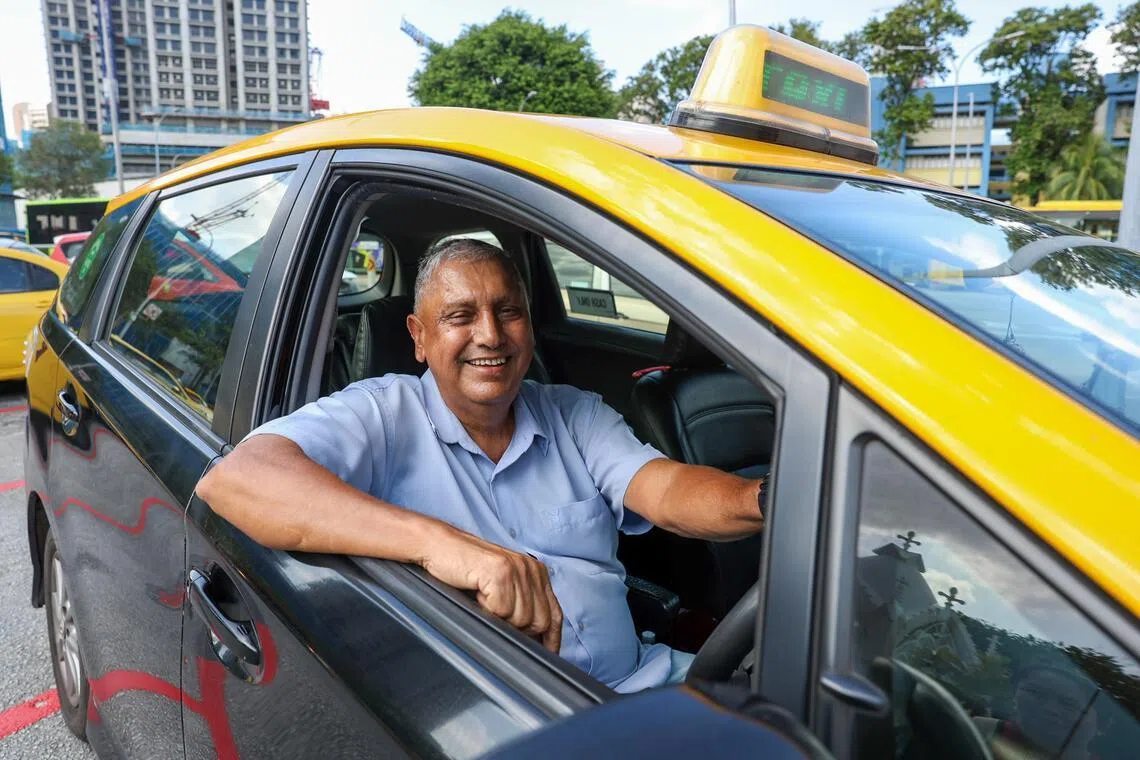
SINGAPORE – Once a common sight on Singapore’s roads, yellow-top taxis have dwindled to just five, with encounters so rare they can become a social media post.
Among the remaining drivers is 73-year-old Mr Chamkour Singh, who plans to hang up his hat by the end of the year.
“Last time, yellow-tops were the majority,” he said, gesturing at the line of taxis at Ban San Street Terminal in Bugis, where he spoke to The Straits Times earlier in March. “Now we are nothing.”
As at January 2026, only five such cabs remained out of more than 12,000 taxis here, according to Land Transport Authority (LTA) statistics, a steep fall from 114 in January 2017. In the 1960s, the black vehicles with their bright yellow tops were synonymous with taxis, with almost 4,000 on the roads.
Soon, they will be a bygone piece of Singapore’s transport heritage. With them will go a model of taxi ownership, as their drivers own and operate the cabs, unlike current taxis, which are all leased from operators.
Company fleets now dominate the landscape. ComfortDelGro operates 7,579 taxis under its Comfort and CityCab brands, and Trans-Cab 1,948. Other operators include Strides Premier, with 1,786 taxis, Prime, with 515, and GrabCab, with 345.
Yellow-tops were launched in 1933 by transport company Wearne Brothers – the predecessor of automotive dealer Wearnes – after a clampdown on mosquito buses sparked a surge in demand for public transport, said transport historian Eisen Teo.
Mosquito buses – so named for zipping through neighbourhoods – were small, privately operated buses in early Singapore that ran informal routes.
The decline of the yellow-tops began in the 1970s, when the Government stopped issuing individual taxi licences in favour of company-run fleets.
As the non-transferable licences of yellow-tops expire when drivers retire or turn 75, each exit permanently reduces their number.
With most remaining drivers now in their 70s, the last yellow-top cabs are expected to be phased out by around 2030.
Mr Singh is the last yellow-top cabby who still holds a cross-border taxi licence. He has been driving for 48 years, starting in 1978 after the timber company he worked for shut down. With help from friends, he bought his own yellow-top taxi for $30,000 – about twice the price of his flat at the time.
The job supported his family and put both his children through university. Mr Singh has owned five taxis over the years. His first car was a Datsun, and his final car – nine years old now – is a Toyota Wish.
When he does take to the road, he works 12-hour days from 8am to 8pm, often making a trip to Johor Bahru before ferrying passengers in Singapore. He earns about $1,200 to $1,500 a month, he said.

Mr Singh is the last yellow-top cabby who still holds a cross-border taxi licence.
ST PHOTO: JASEL POH
Yellow-top taxis follow the street-hail fare structure, with fares lodged with the Public Transport Council, comprising a flag-down sum, distance and waiting-time charges, as well as peak-hour, late-night and location surcharges.
At other times, Mr Singh steps away for weeks to “enjoy the last few years of my life”, spending Saturdays playing tennis and with his family. He is a father of two and has three grandchildren.
What has kept him in the trade is the independence and flexibility. “This yellow-top is your own taxi. You buy the car, work hard and finish your loan. That is all up to you,” he said. He could also take time off without worrying about rental costs.

Mr Singh works 12-hour days from 8am to 8pm, often making a trip to Johor Bahru before ferrying passengers in Singapore.
ST PHOTO: JASEL POH
The job has changed. Mr Singh now relies on ride-hailing apps for bookings, instead of waiting at taxi stands or driving around to look for passengers. But technology has also intensified competition, with private-hire cars eating into the taxi market.
He has watched the number of yellow-top drivers shrink as his friends died, retired or stopped driving due to health issues.
He plans to retire at the end of 2026. “I will go for morning walks, swimming, meet friends… then have happy hour,” he said, with a laugh.
Mr Cheng Siu Yong, who turns 75 in 2026, chose to retire his cab early.

Mr Cheng Siu Yong with his yellow-top taxi in the 1980s.
PHOTO: COURTESY OF MR CHENG SIU YONG
He got a yellow-top taxi licence in 1979 and started driving in 1980, buying a second-hand cab with his father for $15,800. They shared the vehicle – his father drove nights, while he took the day shift.
Mr Cheng could have driven until June 2026, but stopped in early December 2025 and scrapped his taxi. “The car was not in good condition, and I’m almost 75,” he told ST in Mandarin.
He had six cars over the years, his first being a Morris Marina. He has also driven a Nissan Cedric, and his last car was a Toyota Axio.
“It is a pity that there will be no more of such taxis,” he added.
Like Mr Singh, he valued independence. “No need to (pay) rental, more freedom,” he said, adding that the job allowed him to put his two children through university. It also allowed him to ferry his children, and then five grandchildren, to school and attend to family commitments.
But in recent years, work had become harder. Mr Cheng did not use ride-hailing apps and relied on street-hail passengers, whose numbers have dwindled. Competition from private-hire cars also reduced his earnings.
Now retired, he plans to spend his afternoons at a senior activity centre and take life at a slower pace.
But he feels a sense of loss. “A bit unwilling to part,” he said. “If I could drive a few more years, I would be happy.”
Both men believe that when the last yellow-top taxi disappears, something unique will be lost.
Mr Singh said that when he picks up passengers, many are excited to sit in his taxi, saying: “Whoa, so long I have not seen a yellow-top.”
They also take pictures of his car to post on Facebook, he said.
Mr Teo, the historian, noted that the rise of transport giants such as ComfortDelGro and SMRT, alongside ride-hailing platforms like Grab and Gojek, has reshaped the industry.
The consolidation, while improving efficiency, made yellow-top taxis a “historical oddity” of individually owned public transport, reflecting an earlier era of driver independence, said Mr Teo, author of Jalan Singapura: 700 Years Of Movement In Singapore.
For now, Mr Singh remains on the road, one of the last of a vanishing trade. From about 2030, the yellow-top will likely exist only in photographs.

Mr Singh plans to retire at the end of 2026.
ST PHOTO: JASEL POH
-
Additional reporting by Esther Loi