
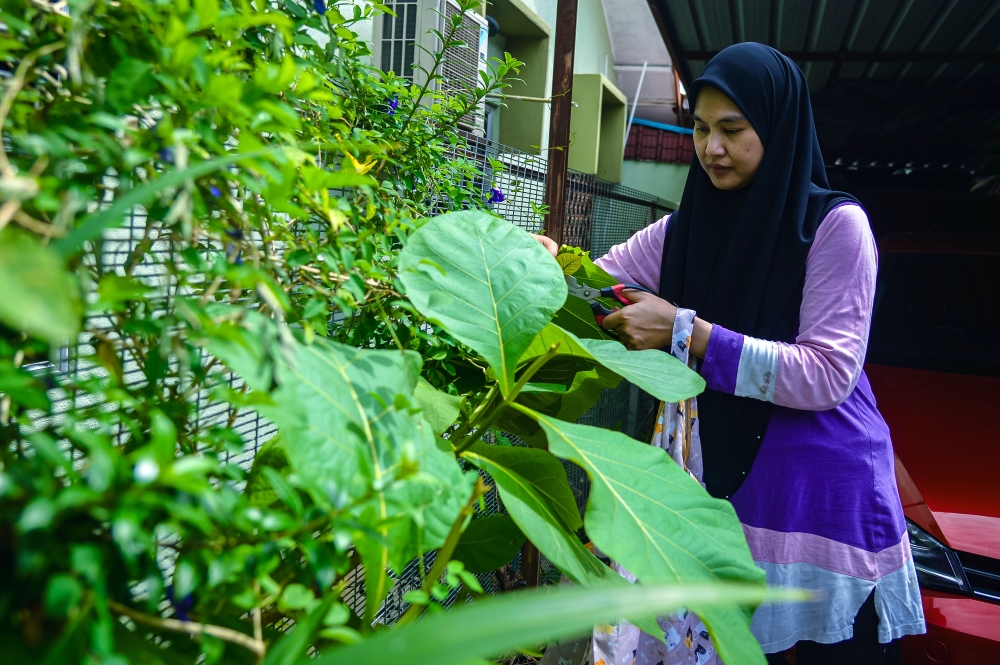
KUALA LUMPUR, Sept 24 — As a child, Siti Nuraznie Ibrahim would often explore the forest behind her kampung in Kulim, Kedah, foraging for and collecting any plant that struck her fancy for her small garden.
Under her care, the plants thrived.
“Even my mother was amazed. She said she had been growing them for years, but they never flowered. Yet when I planted them, they all bloomed,” she told Bernama with a laugh.
She carried this habit to Kuala Lumpur, where she moved with her late husband Azhar Ahmad, a cartoonist who was also known as Tembakau. Everywhere they lived, she would grow plants with seeds she brought from her kampung or found locally.
The love of gardening became a lifeline when life threw her a curveball in 2018, three years after they moved into their house in Sentul, here. Her husband, who was 46 then, suffered a heart attack and soon passed, leaving her with three children, the youngest of whom was four at the time, and little support.
Unable to secure a salaried job that paid enough to cover childcare and other expenses, Siti Nuraznie, known to friends as Aznie, took gardening to the next step, morphing it into an eco-printing home business to make ends meet, albeit with an uncertain future.
Freedom
Creating eco-print textiles — produced by pressing leaves, flowers and other natural substances onto natural cloth like cotton and linen, rolling the cloth and then steaming it — is something Aznie, 46, does at least once a month. She told Bernama that she gets five to six pieces of eco-printed cloth done per process.
Among the leaves and flowers she uses for her eco-prints are daun jati, daun lemuni, lemuni flowers, daun ulam raja and daun beko/lanang.
The work is back-breaking and time-consuming. Aznie usually starts early in the morning, gathering leaves and flowers from her garden or along the way to her son’s school or her clients’ locations or while running errands.
On a hot Sunday morning, Bernama met Aznie at her home in Sentul to observe how she and her friends produced eco-prints. She had been up early, picking leaves and flowers from her garden and along the roadside for the process.
Around a long table, she and her friends sorted through the morning’s haul — daun ketapang, bunga telang and various other flora — before washing and drying each piece carefully. They then soaked a piece of cloth in iron sulfate before laying it flat and arranging the leaves and flowers on it.
“Turn it over. Don’t let it all be the same,” Aznie directed her friend, who obediently flipped over a leaf.
Once satisfied with the arrangement, Aznie rolled the fabric tightly around a length of PVC pipe, sandwiching the plant matter between layers of cloth so the natural tannins and pigments would transfer under heat during the steaming process. The bundle was then bound with string, as tightly as the group could manage, before being lowered into a large steamer pot over a gas stove. It would stay there, hissing quietly, for close to two hours.
There is no way to know exactly how a piece will turn out until the cloth is unrolled, cooled and hung to dry. Even after two years of doing this, Aznie said she still feels a sense of anticipation each time, although she is no longer afraid of making a mistake.
In the past, the mistakes she made were costly and upsetting. Today, she has learned to accept them and incorporate them into the design, creating a layered pattern that has proven popular with shoppers.
Although eco-printing has a long history in all cultures, the modern iteration has been gaining popularity in Malaysia in the last 12 years, said textile expert Datin Seri Dr Rusmawati Ghazali from Universiti Teknologi MARA. She said eco-printing is more suitable for people who need creativity and flexibility in their work.
“Making eco-prints is quite flexible. Even housewives can do it because they can work on them alongside their usual household chores,” she said.
Another benefit of the art is its safety record with the environment. Synthetic dyes may produce rich, deep colours and last longer, but they are bad for the environment. They also come with health risks.
“With synthetic dyes, we also have to be careful when disposing of them. We have to wear a mask and gloves when working with the dyes… the mask is to prevent us from inhaling the fumes. But with eco-printing, we don’t have that concern. The only thing is that our hands may get dirty sometimes from the sap from the plants. That’s about it,” Rusmawati said.
Aznie, after putting the textile bundles into the steamer, pours the iron sulfate into her potted plants. She assured Bernama that it is safe as one of the benefits of eco-printing is that the iron sulfate can be used as a gardening supplement.
The safety of the natural inks and the art is a very important consideration for her. As the sole surviving parent, she tries not to risk her health and the health of her children, especially when she does not have much of a safety net.
Safety nets
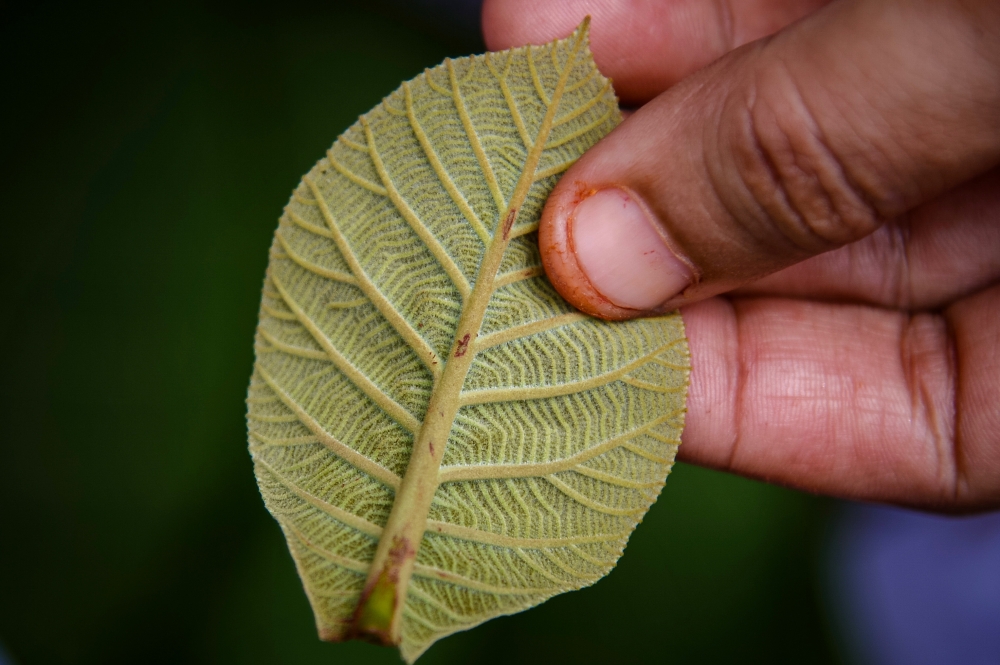
Among the leaves and flowers she uses for her eco-prints are ‘daun jati’, ‘daun’ lemuni, lemuni flowers, ‘daun ulam raja’ and ‘daun beko’/’lanang’. — Bernama pic
Two years in, Aznie’s business is growing, if unevenly. Orders for her eco-printed products trickle in mostly through word of mouth and through the network of friends she has made in the home artisan business circles. She has also joined a social enterprise that helps market and sell her eco-printed purses and T-shirts to a wider customer base than she could reach on her own.
But the income remains modest and unpredictable, rising and falling in accordance with her supply of materials and the number of hours she can put into her work. It is not, by itself, enough to replace a salaried job.
Aznie told Bernama that after her husband passed away, she tried to keep her administrative job, but found it difficult to juggle work and childcare. She finally quit in 2020. She last tried to get a permanent position two years ago when her two older children went to secondary school, but the salary offered, which she said was less than RM3,000, was not enough to cover childcare expenses for her youngest child, on top of household expenses for the family.
Although her eco-printing business provides Aznie with an income, supplemented by zakat assistance and government aid for single mothers, it has yet to provide her with much of a financial safety net.
Khazanah Research Institute (KRI) researcher Ilyana Syafiqa Mukhriz said gig work in Malaysia has expanded rapidly in recent years, but protections have not always kept pace with the growing number of people earning a living outside conventional employment.
“Interestingly, Malaysia is unique in extending the definition of gig worker to those in the creative sector,” she said.
However, home artisans are not covered by the Gig Workers Act 2025 for now. (The Act was introduced to regulate Malaysia’s gig economy and safeguard the welfare, rights and social safety net of gig workers.) The law only covers workers who sign up to a platform that connects them to customers. Creatives such as actors, film production crew, singers, musicians, composers, lyricists, journalists, stringers, photographers and videographers are covered by the Act, and so are those providing translation, caregiving and aesthetics services.
Aznie is considered an independent contractor and under the law, she is not entitled to Employees Provident Fund (EPF) contributions, or benefits provided by the Social Security Organisation (Perkeso). Rather, her access to safety nets is limited to voluntary schemes, such as the EPF i-Saraan programme for the self-employed and Perkeso’s Self-Employment Social Security Scheme (‘Lindung Kendiri’).
Ilyana said the voluntary factor of these schemes is the issue here. In a research paper by KRI, published in July 2026, it noted that “(f)or informal workers, the safety nets that cushion lifecycle risks are largely absent, voluntary, or only now being made mandatory and even where they exist, take-up remains relatively low”.
“I think our government is trying to address the gaps in social protection for those who are in the informal sector. Obviously, I think more needs to be done in order to make sure that they’re really secure,” Ilyana said.
Aznie told Bernama she does not have an i-Saraan account, but still has her EPF savings from her previous job. She contributes to Perkeso’s Self-Employment Social Security Scheme although her contributions are sporadic. She does not receive any EPF or Perkeso contributions from her clients. Despite that, she does not want to stop producing eco-prints as she has started to see the benefits of her hard work doing training and networking.
Back at her house, it was time to see the results of the morning’s work.
Carefully, Aznie and her friends unrolled the reddish-pink cloth across the table. What emerged was a stunning piece of work, with leaves and flowers showing up in stark greens and yellows against a backdrop of hot pink.
There were gasps of excitement and appreciation, followed by a sense of relief.
Even as she displayed her work, Aznie was already thinking of her next project.
“I recently obtained some eucalyptus leaves. Can’t wait to try them out,” she said, grinning. — Bernama